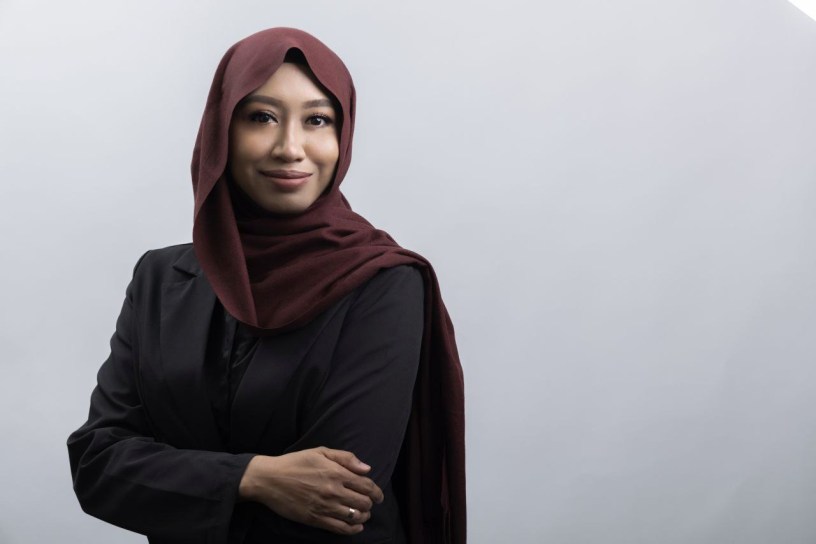
After 13 years in technology and business development, Nur Alfisyah did not leave the corporate world because she was unhappy. Instead, two years of building a wellness business alongside her career showed her the potential of creating something that could grow beyond her own individual effort.
Today, through her partnership with 4Life Research and as part of the Winners team, Nur is focused on building teams, mentoring aspiring entrepreneurs and developing a business that extends beyond Singapore. Drawing on her corporate experience, she believes sustainable entrepreneurship is not simply about selling products, but about creating systems, developing leaders and building something that can grow beyond its founder.
After spending 13 years in the corporate world, what inspired you to make the leap into the wellness industry?
I actually enjoyed my corporate career. I spent 13 years in tech and business development and learnt a lot from those years, so I never saw entrepreneurship as something I needed to escape into.
I started building this business on the side for about two years while I was still employed. What changed was that I began to see the potential of building something of my own — something that could grow beyond the hours I personally put into it.
Eventually, I realised I wanted to see what would happen if I gave that same energy and experience to building my own business.
That was when I decided to make the leap full-time.
What attracted you to partner with 4Life Research instead of joining another company?
The research and products caught my attention first, but I stayed because I understood the business model.
People sometimes look at network marketing companies as though they are all essentially the same. They’re not. Just as two companies can operate in the same industry but have completely different business models, the same applies here.
When I was evaluating 4Life, I wasn’t only asking, “Do I like the products?” I was looking at the company behind them, the compensation structure, how the business could be duplicated, the international opportunity, the systems available to affiliates and whether this was something I could realistically build long-term.
Coming from 13 years in tech and business development, that mattered to me. I needed to understand how the engine worked, not just what we were promoting. One of the biggest attractions for me is the ability to build globally. I’m not restricted to Singapore. With one business, I can develop customers and teams across the different markets where 4Life operates, and I’m already experiencing that today.
Then there’s the mentorship and system. I have had access to leaders from different parts of the world, including people many levels above me, who still coach, train and work alongside us. I have also seen the same system develop leaders across different countries and backgrounds.
So today, when people ask me why 4Life, my answer goes beyond the products. I looked at it as a business owner: Is there a strong product? Is there a viable business model? Can it scale? Can it be duplicated? Can I build something beyond myself? For me, those pieces had to come together.
You often talk about building something meaningful rather than simply earning an income. What does “meaningful success” look like to you?
Meaningful success to me is when what you have built can continue to grow beyond your own individual effort.
One milestone that strengthened this belief happened when I was away in the US for almost a month. During that time, my team continued building, and I was able to guide them from afar as they reached the next milestone in our business.
That was significant because I wasn’t physically there doing everything with them. The systems were working, the leaders were stepping up and the business was still moving forward.
It reinforced something I strongly believe in today: success isn’t about making yourself indispensable. It’s about developing people and putting systems in place so that progress doesn’t depend entirely on you.
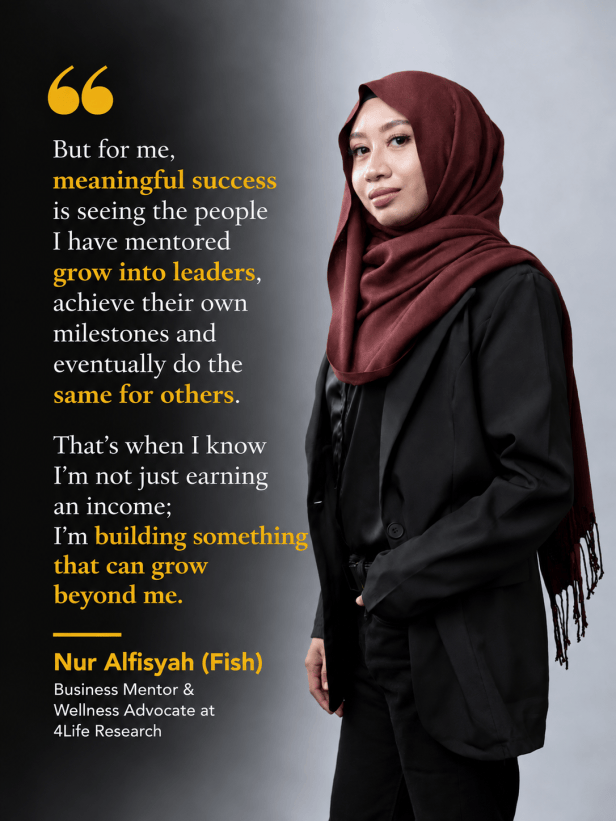
Of course, financial success matters. But for me, meaningful success is seeing the people I have mentored grow into leaders, achieve their own milestones and eventually do the same for others. That’s when I know I’m not just earning an income; I’m building something that can grow beyond me.
What do you believe people misunderstand most about building a business through a global wellness company?
I think many people assume it’s mainly about selling products or constantly approaching people. For me, that’s actually a very exhausting way to build a business.
The longer I have been doing this, the more I have realised that it is a relationship and leadership business. You build credibility and trust, learn how to communicate, develop people and put systems in place so that what works for you can be duplicated by someone else.
The wellness products are obviously an important part of what we do, but if you want to build something long-term, you have to learn how to build people too.
You mentor individuals who want to build their own businesses. What qualities do you look for in someone with entrepreneurial potential?
I look for someone who is coachable, but also someone who takes initiative.
You don’t need business experience. You don’t need to be naturally confident, and you definitely don’t need to know everything from day one. Those things can be developed. But I can’t want your success more than you do.
Give me someone who is hungry, willing to learn, prepared to do the work and able to get back up when something doesn’t work. I can work with that.
What is one decision you almost decided not to make because it felt impossible, but eventually chose to pursue anyway?
For a long time, I think I was quite careful about how big I allowed myself to dream. Sometimes, the impossible thing isn’t actually doing something. It’s allowing yourself to believe you are capable of something bigger than what you have already achieved.
So right now, one of my decisions is simply this: stop short-changing what I might be capable of, decide what I want and then do the work required to grow into it.
What is your vision for Singapore in the next five years?
I would love to see more people in Singapore understand how global entrepreneurship has changed. We are a small country, but being small doesn’t mean our businesses have to remain small. Today, with technology, systems and the right business model, someone based in Singapore can build relationships and businesses across multiple countries without setting up traditional infrastructure everywhere.
I’m already seeing that happen within our own organisation. My vision is to develop more entrepreneurs and leaders from Singapore who don’t only think about the local market. I want them to see Singapore as their base and the world as their marketplace.
If you could have a superpower for one day, what would it be and why?
Teleportation.
I work with people across different countries, and there are so many whom I have met more often through screens than in person.
I would spend the day teleporting from country to country, meeting my teams and mentors, eating something good at every stop and still getting home in time to be with my family.
Also, no airport queues. That’s already a superpower.
Connect with Nur Alfisyah: Instagram and LinkedIn.