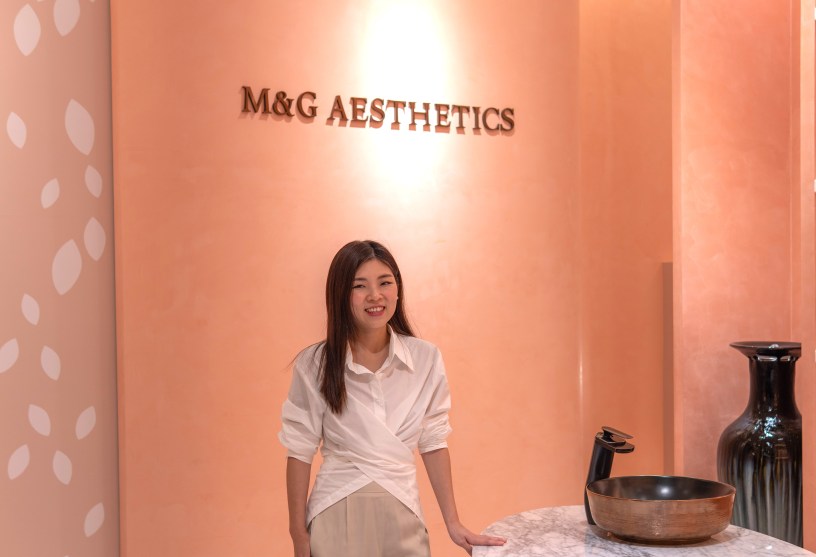
Renee’s interest in postpartum recovery began with her own experience of motherhood. After giving birth, she encountered physical changes such as a weakened pelvic floor and abdominal muscle separation, and soon realised that many women are going through similar challenges without knowing where to seek support.
Working alongside her mother, Ginny Li, founder of M&G Aesthetics, Renee helped steer the business beyond traditional beauty services towards personalised pre- and postpartum recovery. By combining hands-on treatments with non-invasive technology, she aims to redefine postpartum recovery care—empowering mothers to prioritise their post-childbirth healing as a vital foundation for long-term health and wellbeing.
Your interest in postpartum recovery began with your own experience after childbirth, including a weakened pelvic floor and abdominal muscle separation. What made you believe that pre- and postpartum recovery should become a major focus of the business?
I noticed that there was a culture of silence around postpartum recovery, and I experienced this personally as a mother. When I was expecting my first child in 2017, everyone prepared me for the baby, the sleepless nights, confinement and childcare, but nobody really prepared me for my own recovery.
The closest thing I remember was postpartum massage, with the assumption that once confinement and the massages were over, you were supposed to return to normal and prepare to go back to work. Because postpartum recovery was rarely discussed, even among mothers, many of us assumed that the changes and struggles we experienced were unique to us or were simply things we had to accept.
I saw the same mindset among our clients. New mothers experiencing issues such as a weakened pelvic floor or abdominal muscle separation often viewed them as aesthetic concerns rather than signs that their bodies needed proper recovery. That was when I realised there was a genuine gap in postpartum care. I wanted to help women understand and address the changes their bodies go through rather than simply accepting them as part of becoming a mother.
When you were helping your mother, Ginny, at M&G Aesthetics, the business was primarily focused on beauty services. How did you convince her that the business needed to evolve, and were there moments when the two of you disagreed?
Looking back, the transition happened naturally. After becoming a mother and speaking with other new mothers, I understood their challenges firsthand and saw an opportunity to offer more personalised support.
My mother, founder of M&G Aesthetics, brought more than 40 years of experience in aesthetics and body assessment. Together, we developed the oMAkase programme, where pre- and postpartum treatments are tailored to each woman’s condition and needs.
Our different strengths made the pivot work. She brought decades of expertise, while I brought my experience as a mother and understanding of modern women’s postpartum challenges. It was less about convincing her to change the business and more about combining our knowledge to create something new.
Under your leadership, revenue grew by more than 150%. Beyond the numbers, what did that growth tell you about the unmet needs of women seeking support before and after childbirth?
The growth confirmed something I had already noticed: there was a significant gap in support for women after childbirth. During pregnancy, mothers typically have regular prenatal check-ups, followed by a postnatal check around six weeks after delivery. After that, the focus quickly shifts almost entirely to the baby — vaccinations, developmental milestones and health checks.
There is no equivalent pathway for continuously monitoring the mother’s physical recovery. Yet pregnancy and childbirth can cause significant changes to a woman’s body. Women were actively looking for support because they wanted to understand what was happening to their bodies and find practical, accessible ways to recover.
The growth showed us that there was a real need for more dedicated support for postpartum recovery — a need that was not being adequately addressed within mainstream healthcare. That was the market gap we wanted to help fill.
What can technology add to postpartum recovery and body treatments that hands-on techniques alone may not be able to provide?
Technology adds greater precision to postpartum recovery. It does not replace hands-on treatments, but complements them by addressing concerns that traditional methods alone may not fully resolve.
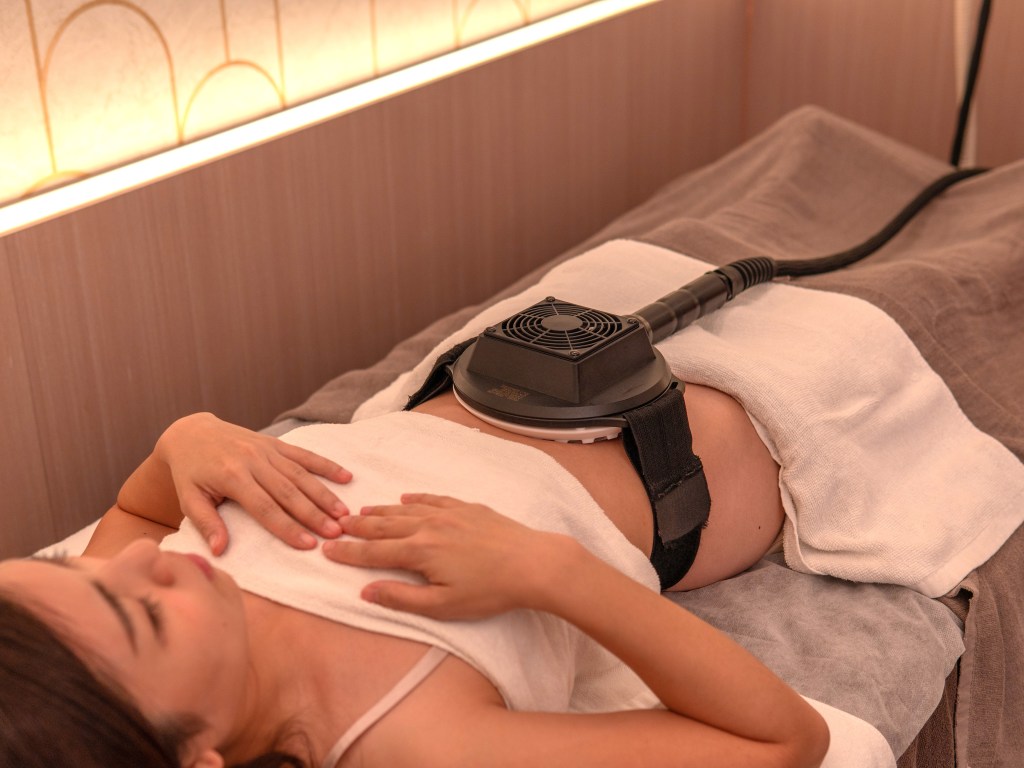
For example, radiofrequency stimulates collagen production for deeper skin tightening, while functional magnetic stimulation can target deeper muscles affected by abdominal separation that may be difficult to activate through exercise.
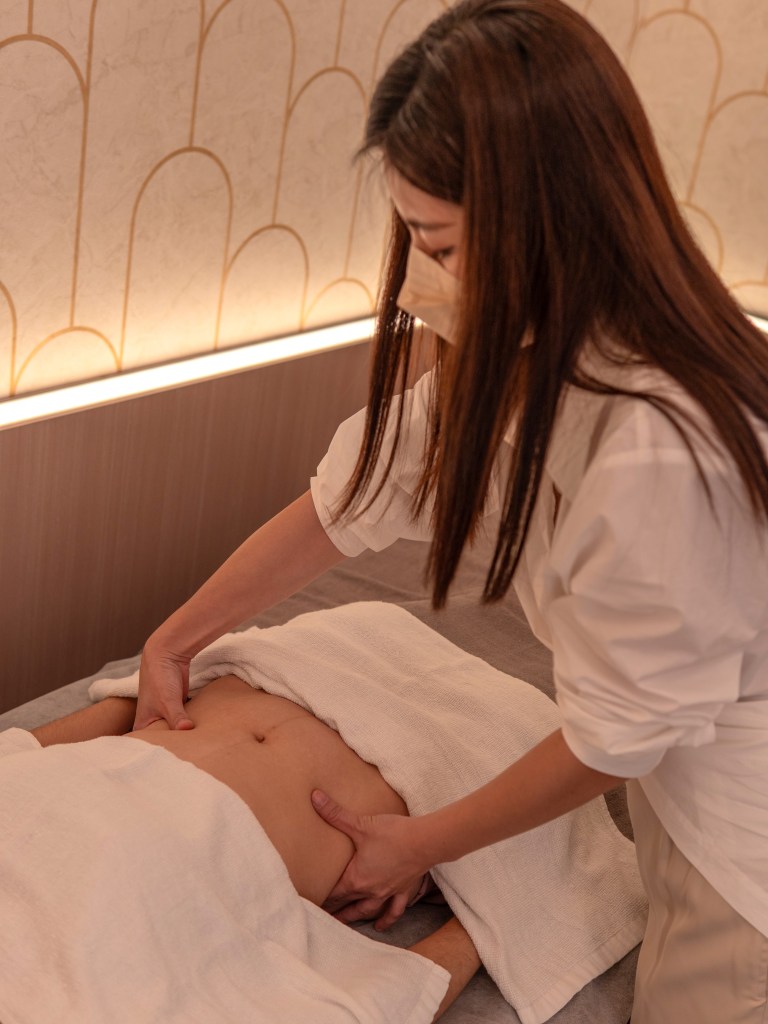
At M&G Aesthetics, we combine technologies such as radiofrequency, ultrasound and functional magnetic stimulation with hands-on techniques. Technology provides precision and consistency, while hands-on treatment offers comfort and the human touch.
Our approach is to assess each woman individually and combine the appropriate treatments rather than apply a one-size-fits-all solution.
Do you think postpartum recovery is sometimes treated as a luxury rather than an important part of a woman’s overall wellbeing?
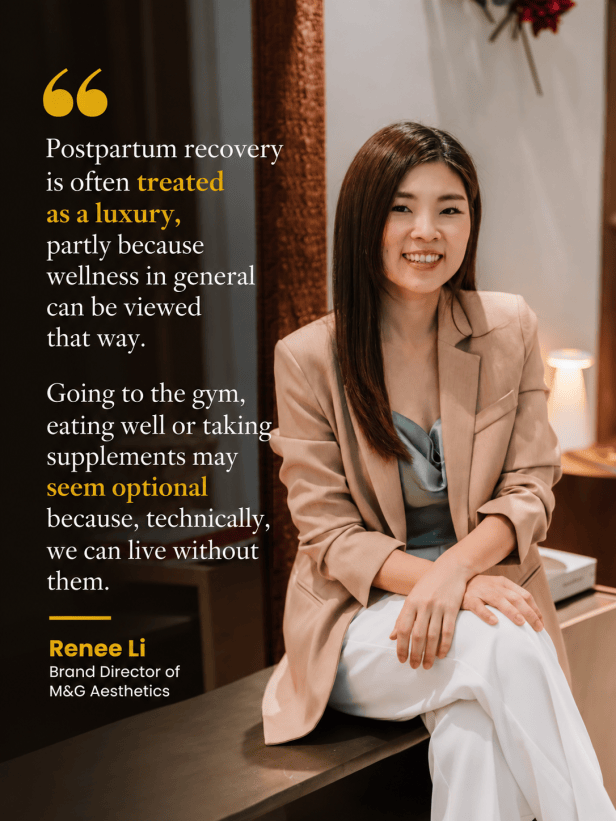
Definitely. Postpartum recovery is often treated as a luxury, partly because wellness in general can be viewed that way. Going to the gym, eating well or taking supplements may seem optional because, technically, we can live without them. Postpartum recovery tends to fall into the same category.
The problem is that women may not see recovery as necessary until they experience persistent back pain, pelvic floor problems or abdominal separation that does not resolve and begins affecting daily life. By then, recovery may take longer.
I think we need to change this mindset. Postpartum recovery should not be something women seek only when something goes wrong. It should be recognised as an important part of caring for the body after childbirth. We routinely monitor a baby’s health and development, and I believe greater attention should also be given to the mother’s recovery.
If you could redo one part of your life, what would you change and why?
If I had the opportunity, I would probably go back and choose life sciences as my university major. The more I learn about women’s health, the more I realise how much there is still to understand, research and develop.
Sometimes I wonder how much more I might have been able to contribute to advancements in women’s health if I had built that scientific foundation earlier. At the same time, that realisation has strengthened my motivation today. Although I did not take that academic path, I still want to contribute to advancing the way we understand and support women’s health.
What is your vision for Singapore over the next five years?
Over my eight years of motherhood, I have seen awareness of fertility and postpartum health grow tremendously. Topics once considered private, including fertility challenges and IVF, are now discussed more openly.
Over the next five years, I hope Singapore moves beyond simply raising awareness to providing stronger support for women as they navigate the physical, emotional and psychological transition into motherhood.
I would like to see these conversations translated into action through greater recognition of mothers, better support infrastructure and policies that acknowledge what women experience beyond giving birth.
If you could have a superpower for one day, what would it be and why?
I would choose the ability to let women see what is happening inside their bodies and also see into their future. Much of postpartum recovery is invisible. If women could see how their tissues are repairing and their muscles rebuilding, I think it would change how they view recovery.
If they could also see the long-term difference between addressing these changes early and living with them for years, they might take recovery more seriously. It is not simply about how they look or feel immediately after childbirth; it can affect their quality of life years later and, in turn, their families.
Connect with Renee: M&GAesthetics and LinkedIn.
Health Advice Disclaimer
The information provided on this platform is for educational and informational purposes only. It is not intended as medical advice, diagnosis, or treatment, and should not be relied upon as a substitute for professional medical consultation, advice, or treatment from a qualified healthcare provider.
In Singapore, all health-related content is to be understood as general wellness information and not a substitute for medical consultation. Individuals are encouraged to seek advice from a registered medical practitioner under the Ministry of Health (MOH) before making any healthcare decisions.
