
Lukas Leong understands the tuition industry not only as a marketer, but also from the perspective of a former struggling student. Having attended tuition himself and experienced the journey from failing subjects to eventually achieving As, he understands many of the concerns students and parents face when looking for academic support.
Today, Lukas applies that experience to helping tuition centres improve their marketing, generate leads and convert enquiries into enrolments. From advertising and messaging to automation and trial lessons, he believes effective marketing begins with understanding what parents and students genuinely need.
You attended tuition frequently yourself and went from failing subjects to eventually scoring As. How did your experience as a struggling student influence the way you now market tuition centres?
Because I have experienced both struggling academically and eventually doing well, I understand many of the pain points students go through. That helps me market tuition centres more effectively because I can relate to the emotions behind those struggles.
I can then translate that understanding into the writing and messaging used in advertisements, making them more relatable to students and parents and, ultimately, helping the ads perform better.
What are some of the biggest challenges tuition centre owners face when it comes to marketing?
I would break it down into three main challenges: generating leads, converting those leads into trial lessons and turning trials into enrolments.
For lead generation, it comes down to running effective advertisements with the right messaging, formats, targeting and understanding of parents’ pain points. When converting leads into trials, speed is very important. Centres need to respond quickly and follow up consistently through calls, messages and automation.
Finally, when converting a trial into an enrolment, I encourage centres to demonstrate the student’s progress. Show where the student was before the trial and what changed afterwards. Even if it is simply understanding a concept they previously struggled with, demonstrating that improvement gives parents confidence that the centre can help their child.
Beyond grades and testimonials, what actually makes a parent choose one tuition centre over another?
One important factor is the teacher and how they teach. Tuition centres can show parents the frameworks, teaching methods and approaches their teachers use to help students understand concepts more easily and achieve results.
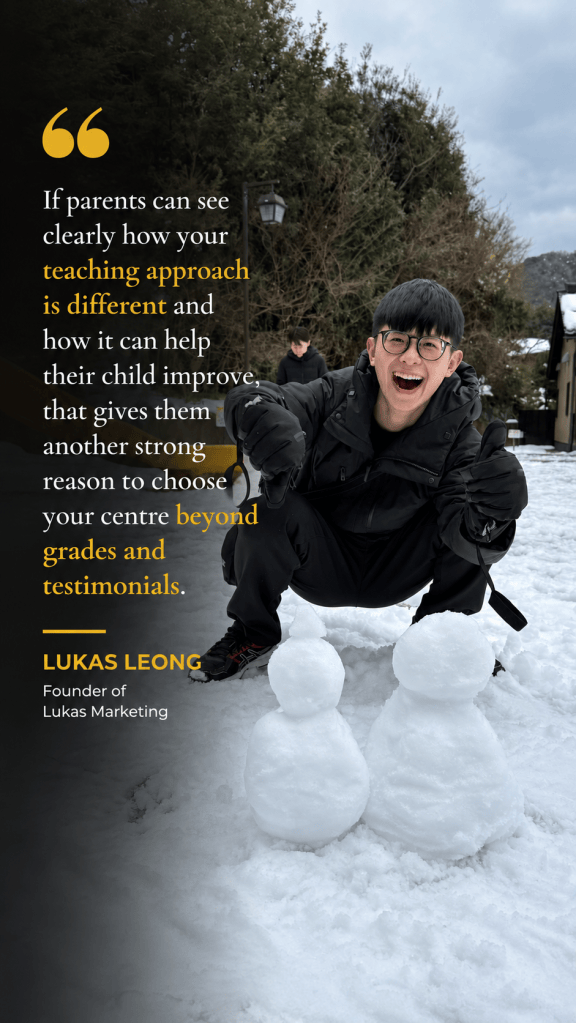
If parents can see clearly how your teaching approach is different and how it can help their child improve, that gives them another strong reason to choose your centre beyond grades and testimonials.
As AI and automation become more powerful, how do you make marketing more efficient without making communication with parents feel impersonal?
AI can definitely help businesses create content and advertisements more quickly, but I do not think relying entirely on AI-generated content is the best approach. We are already seeing many AI-generated advertisements and visuals, and they can sometimes feel generic.
The most important part of marketing is still the messaging. You need to understand how your leads feel, what they are concerned about and how to show them that you understand their situation. That requires research and conversations with tuition centre owners, parents and prospective customers.
AI can make the process faster, but the human understanding behind the message is still very important.
Where do you see the tuition industry heading in the future?
In the near future, I believe the tuition industry will continue to grow because education remains important. However, what tuition centres teach may evolve, with areas such as AI and other emerging skills becoming more relevant. Looking further ahead, perhaps over the next 10 to 20 years, I think the industry could change significantly.
We are already seeing that having a university degree does not necessarily guarantee a job. At the same time, more people are becoming solopreneurs or starting small businesses instead of following traditional corporate career paths. If that trend continues, the way people view formal education and tuition may eventually change as well.
If you could speak to your younger self, what would you tell him and why?
I would probably go back to when I first became a business owner at 19 and tell myself to learn as much as possible, as quickly as possible, without focusing too narrowly on one skill. When I started, I concentrated heavily on becoming a better copywriter and spent one or two years developing that skill. It gave me a strong foundation in messaging, but I eventually realised that one skill alone was not enough.
I needed to develop complementary skills as well. That eventually helped me transition from being a copywriter into running a marketing agency. I would tell my younger self to keep learning broadly while continuing to build on your core strengths.
What is your vision for Singapore over the next five years?
I hope Singapore continues to remain safe and economically strong, while creating opportunities for people to build sustainable careers and businesses. From the perspective of the areas I work in, I think we will see more people becoming solopreneurs and business owners.
The traditional corporate route may not be suitable or available to everyone, especially as the job market changes. I hope Singapore continues to provide an environment where people have the opportunity to create their own paths, whether through employment, entrepreneurship or new forms of work.
If you could have a superpower for one day, what would it be and why?
I would choose the ability to fly. I love travelling, so being able to fly anywhere would allow me to visit more places without spending time or money on flights. I could explore the world freely for a day and probably save thousands of dollars on plane tickets!
Connect with Lukas: LukasMarketing and Instagram.