After more than a decade in advertising and branding, Eugene Choong has come to believe that many SMEs do not actually have a marketing problem but instead they have a brand clarity problem. Having worked with multinational brands before spending eight years in China, he returned to Singapore during COVID and founded Bamboo3, bringing his corporate advertising experience into the SME space.
Today, Eugene works with business owners to clarify their target audiences, value propositions and the problems they genuinely solve before investing further in marketing. In this interview, he discusses why generic messages fail, how emotion influences buying decisions, where AI fits into marketing and why he hopes to help more Singapore companies build brands capable of going global.
You have mentioned that most Singapore SMEs do not actually have a marketing problem, but a brand clarity problem. What led you to that conclusion after more than a decade in the industry?
I came from a corporate advertising background, working with MNCs that were generally clear about their mission, target audience and the problems they solved. When I returned from China during COVID and started Bamboo3, I brought that experience into my work with SMEs.
I quickly realised that many business owners struggled to explain their target audience, value proposition or what differentiated them. When asked who their customers were, many simply said, “Everybody.”
One example was a Singaporean who launched an Australian-made milk powder brand in China. Despite listing its vitamins, minerals and competitive pricing, he could not explain why parents should choose his brand. This was particularly important after China’s melamine scandal, when parents prioritised safety and trusted imported brands.
That reinforced my belief that many SMEs do not have a marketing problem, but a brand clarity problem. Without a clear reason for customers to choose you, you eventually compete on price and that becomes a race to the bottom.
Many businesses describe themselves using words such as “quality”, “trusted” and “customer-focused”. Why do these messages often fail to differentiate a brand, and how can an SME uncover something genuinely distinctive about itself?
The problem is that everybody says similar things. If every business talks about quality, trust and good service, consumers have little reason to see one as different.
I always return to the fundamentals: Who is your target audience? What are they really buying? What problem are you solving, and what is your value proposition?
Purchasing decisions are also emotional. Someone may say a car is simply for getting from point A to point B, but people also consider status, reliability, safety and how a brand makes them feel. Some buyers may prioritise family safety, while others may be drawn to luxury, reliability or understated status.
SMEs therefore need to look beyond functional benefits and understand the emotional reasons customers choose them. That is where genuine differentiation begins.
How do you help business owners see their brand from the customer’s perspective and uncover uncomfortable truths about how the market actually sees them?
I often use stories and examples because business owners can be emotionally attached to their companies and may struggle to accept that their messaging is not working. Ultimately, what matters is whether customers know you exist, consider your product, try it and eventually recommend it.
I start with the fundamentals: mission, vision, values, target audience and value proposition. Branding, marketing and sales are different but interconnected, and strong branding makes selling easier. Businesses must also understand that customers move from awareness to interest, desire and eventually action.
During COVID, I worked with a disinfection company competing mainly on low prices. However, customers questioned whether such a cheap service was safe for their children and pets. The real message was not simply about killing viruses, but providing peace of mind that their families were safe.
That is what I help businesses uncover — what customers genuinely care about and how to communicate it clearly.
AI now allows businesses to produce advertisements, social posts and even marketing campaigns faster and cheaper than ever. How do you view this trend?
AI is here to stay. I use it myself to automate tasks and operate without needing a large team. However, generating content does not mean you know whether it is effective or appropriate for your customers.
AI can accelerate marketing, but it still needs strategic direction. Understanding your customers, their pain points and the messages that resonate with them requires experience and judgement.
Business owners should also consider how best to use their time. Rather than trying to master websites, SEO, advertising and AI themselves, they may be better focused on improving operations, profitability and growing the business.
AI is an extremely useful tool, but human experience is still needed to direct it effectively.
If you were sitting across from an SME owner who told you they had tried Facebook, Google and TikTok but nothing seemed to work, what would you ask before allowing them to spend another dollar on marketing?
I would go back to the same fundamentals: Who is your target audience? What problem are you solving? What is your value proposition, and what messages have you been putting into the market?
Whenever I work with a new client, I conduct an audit of what they have already done. I want to understand whether they genuinely have a marketing problem or whether the problem lies with their brand, target audience or messaging. Often, it is a combination of these.
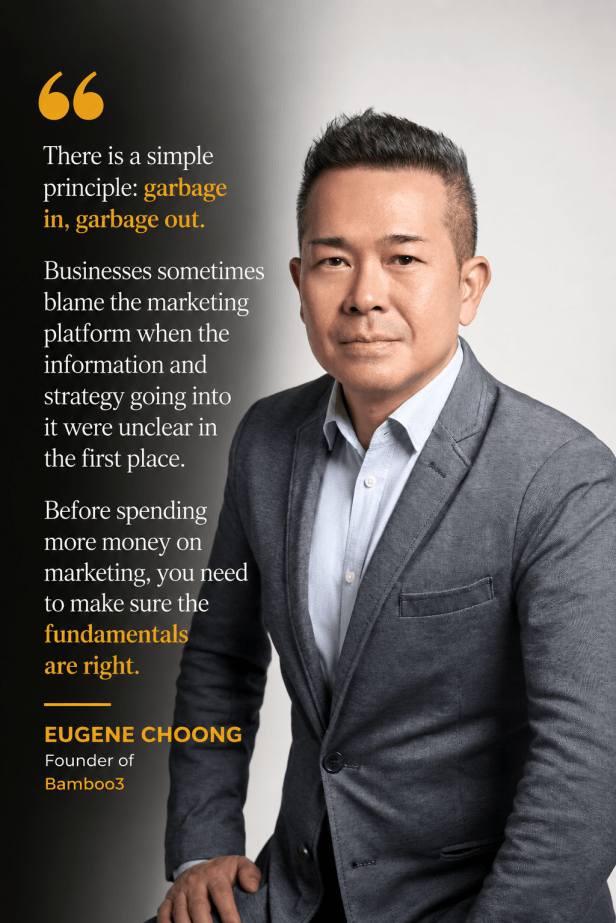
There is a simple principle: garbage in, garbage out. Businesses sometimes blame the marketing platform when the information and strategy going into it were unclear in the first place.
Before spending more money on marketing, you need to make sure the fundamentals are right.
If you could speak to your younger self, what would you tell him and why?
I would tell myself to leave the corporate world earlier, start working with SMEs and eventually invest in local companies.
My dream is to help Singapore companies go global. Having worked on Singapore Airlines in advertising and spent eight years working in China, I have seen the strengths of Singaporeans and our culture.
We tend to be strong in processes, hardworking and humble. We may not always promote ourselves well, but our actions and the quality of our work often speak for themselves.
I believe Singapore businesses have the ability to succeed internationally, but they need discipline and strong fundamentals. That includes being very clear about who their customers are, what they stand for and why people should choose them.
If I had started this journey earlier, I would have had more time to help build and invest in Singapore companies with the potential to go global.
What’s your vision for Singapore in the next five years?
My vision is for Singapore to remain relevant and continue to be a source of positive influence in the region. I hope we can strengthen our position not only economically, but also through the standards we set in ethics and sustainability.
Singapore may be a small country, but we have the opportunity to demonstrate how strong economic development can go hand in hand with responsible and sustainable practices.
If you could have a superpower for one day, what would it be and why?
I would choose the ability to end suffering, whether it is caused by natural disasters or by people. There seem to be so many disasters and wars happening around the world, and it is saddening to read the news each day and see the suffering they cause.
If I could have one superpower, even for just one day, I would use it to bring an end to as much of that suffering as possible.
Connect with Eugene: Bamboo3, Instagram and LinkedIn.