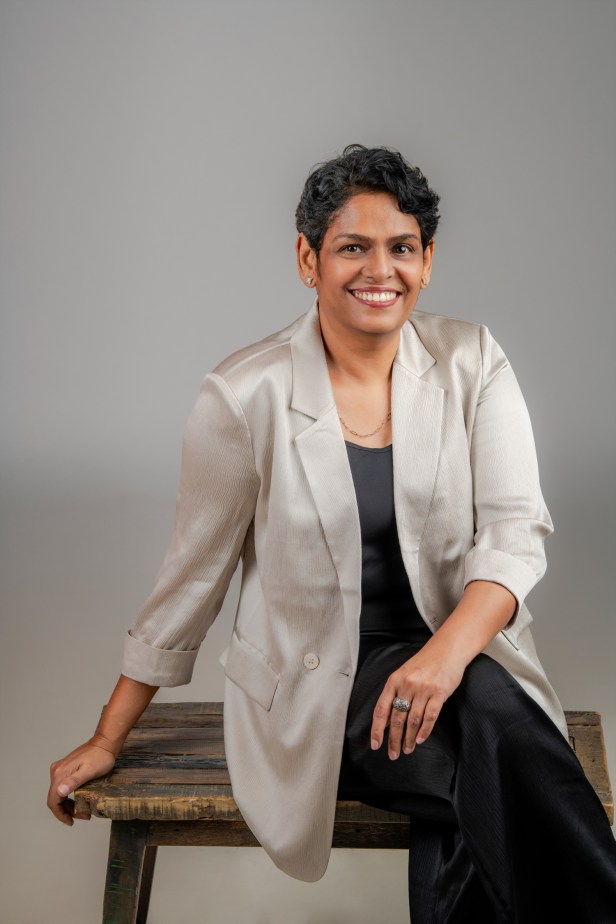
After three decades in technology, strategy, ecosystem building and transformation, including leadership roles at Microsoft and BlackBerry, Annie Mathew has witnessed first-hand how major technological shifts can create enormous opportunities while disrupting careers and organisations. Her experience convinced her that successful transformation depends not only on technology, but also on governance and people.
Today, through Pivot Project, Annie focuses on helping people navigate career transitions in the AI era. Drawing on lessons from initiatives such as Code Without Barriers, she believes skills alone are not enough. People also need confidence, visibility, networks, opportunities and communities that enable them to turn new capabilities into meaningful career outcomes.
You had a successful corporate career and held leadership roles at Microsoft and BlackBerry. What made you willing to leave that behind and start Pivot Project?
I do not see it as leaving my corporate career behind as much as carrying those lessons into a new chapter. I spent three decades across technology, strategy, ecosystem building and transformation, and two things became very clear to me: governance and people.
I experienced two major technology shifts. First, was mobile while I was at BlackBerry and AI while I was at Microsoft. Both created tremendous opportunities, but also significant disruption. With AI, the governance question is not simply, “What can AI do for me?” but also, “Should I be using AI here?” because the decisions we make have implications for people, not just productivity.
At the same time, no technology transformation succeeds unless people understand it, adopt it and drive it. AI is disrupting jobs while creating new ones, but there is no direct pathway between the two. Someone whose marketing role is disrupted cannot simply learn AI and assume they will automatically secure a new AI-related marketing role.
I saw a gap between disruption and opportunity, and that became the space I wanted Pivot Project to address.
Code Without Barriers reached hundreds of thousands of women across Asia, yet one of your biggest lessons was that training alone is not transformation. What led you to that realisation?
Code Without Barriers began during COVID with 40 women across Malaysia and New Zealand and eventually skilled around 780,000 women across Asia. However, when we reached nearly 600,000 women, only about 6,000 had participated in hackathons, and even fewer secured jobs. This showed me that skills alone were not enough.
I identified seven non-skill gaps: direction, opportunity, networks, bias, policy, visibility and confidence. A woman returning after nine years away, for example, may learn AI but remain invisible to traditional hiring systems.
One woman with a nine-year career gap joined our community and, with the right support and pathways, secured a global AI engineer role with a major insurance company in Singapore within about 18 months. It showed me that people can reinvent themselves, but they often cannot do it alone.
Pivot Project works with women returning after career breaks, mid-career professionals, seniors and others navigating change. What is the biggest barrier preventing capable people from successfully reinventing themselves?
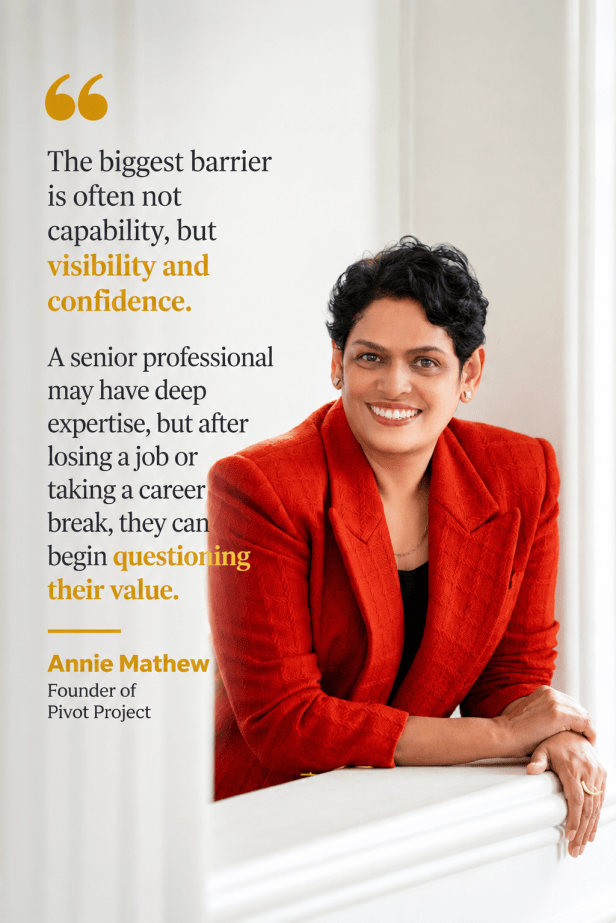
The biggest barrier is often not capability, but visibility and confidence. A senior professional may have deep expertise, but after losing a job or taking a career break, they can begin questioning their value. Collecting more qualifications does not necessarily make them visible to employers.
People need opportunities to demonstrate their skills, whether through LinkedIn, writing, mentoring or projects, while a supportive community can help them stay confident throughout the transition.
Employers also have a responsibility. Candidates already employed may appear safer, while hiring someone returning after a long career break requires greater intentionality. Both individuals and organisations therefore need to help capable people become visible and successfully transition into new roles.
After decades in technology, what skills do you think will matter most in the AI era: technical skills or distinctly human qualities that AI cannot easily replace?
Both matter, but in different ways. AI fluency is becoming foundational, although not everyone needs to become an AI engineer. Professionals should understand what AI can do, how to work with it and its limitations.
The real differentiators will increasingly be human qualities such as judgement, curiosity, problem framing, communication and empathy, particularly when decisions involve uncertainty.
Governance judgement is equally important. We need to ask not only, “Can we do this?” but also, “Should we do this?” AI can be incredibly powerful, but humans must remain accountable for how it is used.
As AI reshapes organisations and the workforce, what do you think leadership will ultimately boil down to?
Leadership will become even more important as we decide when humans are needed, when humans and AI should collaborate, and when AI can operate independently. Future teams may include a small number of people managing many AI agents, but leadership will still be essential.
Cognitive diversity also matters. AI can scale rapidly, so a flawed system that excludes certain groups can magnify that problem and become difficult to reverse. We therefore need diverse perspectives when designing, testing and using AI.
Leadership in this era is not about giving orders. It is about collaboration, judgement and bringing different perspectives together to create positive outcomes.
Looking back at your career, is there anything you regret doing or not doing?
There are not many choices I regret. I took several major career breaks, including year-long maternity breaks and a year to complete my MBA. While breaks can appear to set you back professionally, I used them to reskill and explore different industries.
If I could change one thing, I would have recognised earlier the activities that consistently gave me energy, such as mentoring, writing, building communities, working with entrepreneurs, serving on boards and helping leaders navigate difficult decisions.
I once saw these as activities at the side of my career. Looking back, they were actually pointing towards the work I was ultimately meant to do. I would tell my younger self to pay attention to what consistently gives you energy because it may reveal where you truly belong.
What is your vision for Singapore over the next five years?
I would love Singapore to become a global example of how AI leadership, strong governance and human mobility can work together. The next challenge is not simply adopting AI, but ensuring inclusive growth and considering who may be left behind as jobs are transformed.
Leaders need to consider not only business value, cybersecurity and risk, but also the impact on the workforce. Can someone returning after a long career break demonstrate their capabilities? Can a 50-year-old transition into an AI-enabled role? Can young people without established networks secure opportunities?
My vision is for Singapore to combine strong AI governance with workforce mobility, becoming not only an AI-ready economy, but an AI-ready society with responsibility at its core.
If you could have a superpower for one day, what would it be and why?
I would choose the ability to let people see their own potential clearly for one day. When someone loses a job, takes a long career break or feels overwhelmed by AI, it can be difficult for them to recognise the value they still possess. Sometimes another person, be it a mentor, manager or friend can see that potential much more clearly.
Someone may already have tremendous domain expertise and simply need to add AI capabilities to become incredibly valuable. If I could give people that clarity for one day, I think the decisions they make the next day could be very different. That would be the superpower I would choose.
Connect with Annie: PivotProject and LinkedIn.