
For Marcus, Delson and Ryan, entrepreneurship began with a simple observation: many parents, students and tuition providers were struggling with fragmented systems, limited communication and time-consuming administrative work. Drawing on their experience as tutors and product builders, they co-founded Podsee to make tuition easier to discover, manage and deliver.
Rather than opening another tuition centre, the 3 co-founders chose to support the wider education ecosystem. Through technology, automation and AI, they aim to help tuition providers spend less time on administration and more time on what matters most, and that is teaching students and creating meaningful educational outcomes.
Can you share your entrepreneurial journey and what inspired you to co-found Podsee?
Marcus: Podsee was not my first entrepreneurial venture. I started exploring business at 16 and previously worked on several side ventures involving aquatic plants and a clothing brand. The idea for Podsee began when I met our co-founder, Delson, while facilitating an economics orientation camp at Singapore Management University. As fellow tutors, we began discussing our experiences and future plans.
Collectively, we had taught around 40 students and noticed that the connection between many parents and children was not as strong as it could be. We began speaking directly with parents, including approaching families around Marine Parade, to understand their challenges. Many Singaporean parents have demanding schedules and limited time for themselves or their children.
We decided to support parents through one of the most significant parts of their parenting journey: education. Podsee currently connects parents and students with tuition centres, helping them find suitable options more easily. We also help parents manage tuition schedules, fees and payment reminders, creating a more organised experience around their children’s education.
Why did you decide to solve problems for tuition centres instead of starting another tuition business yourselves?
Marcus: We are often asked this question because we are tutors, and starting a tuition centre would appear to be the natural next step. However, there are already many people opening tuition centres. We asked ourselves why we should create another one when we could instead support the entire ecosystem.
A single tuition centre can only serve a limited number of students. A platform that supports hundreds or thousands of tuition centres can potentially impact far more parents, students and educators
We want to play the supporting role by giving tuition providers the tools they need to operate more effectively, while helping families access and manage education more easily.
Every start-up faces uncertainty in its early days. What were the biggest challenges you encountered while building Podsee?
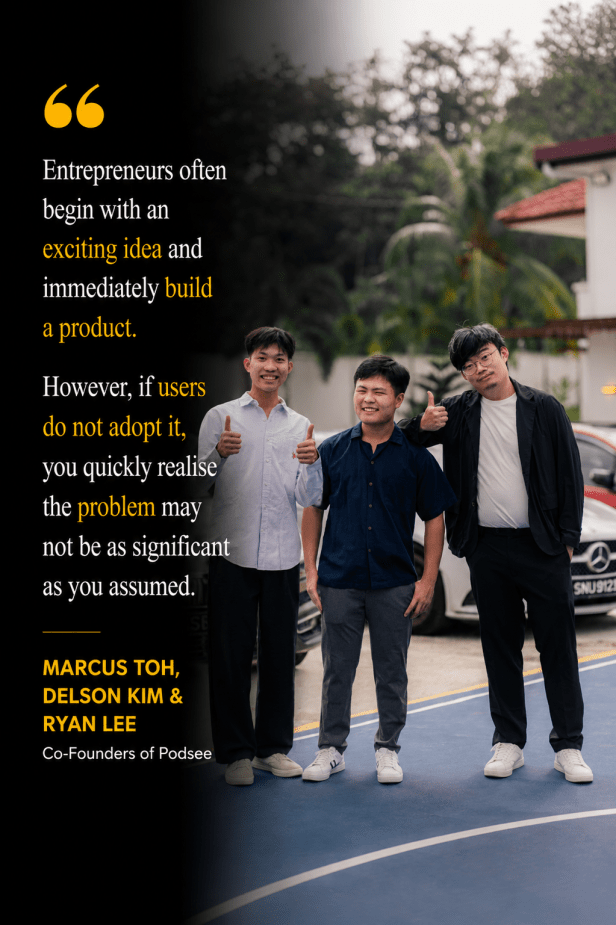
Marcus: The biggest challenge was not developing a solution, but identifying a genuine problem worth solving. Entrepreneurs often begin with an exciting idea and immediately build a product. However, if users do not adopt it, you quickly realise the problem may not be as significant as you assumed.
Our first product was a swiping app that recommended nearby activities for parents while their children attended tuition. We thought parents would appreciate suggestions for how to use those free hours. However, after two months, nobody used it.
That experience taught us to focus on understanding the problem before developing the solution. We later discovered that many tuition centres still manage administration through spreadsheets, WhatsApp and handwritten records. More than 60% do not use a customer relationship management system to automate tasks.
We created a CRM and secured several paying customers, but adoption remained slower than expected. This taught us that even when a problem exists, customers may not immediately recognise its urgency. We must therefore continue refining the product, communicating its value and adapting to what the market genuinely needs.
Many tuition centres still rely on spreadsheets, WhatsApp and other manual processes as you mentioned. Why has the industry been slow to embrace digital transformation?
Marcus: I believe it is closely connected to the mindset of educators. As tutors and teachers, our priority is helping students learn and grow. Business expansion, revenue and operational efficiency are not always at the forefront of an educator’s mind. Education is also deeply personal. It is traditionally built around a teacher standing in front of a student, providing guidance and forming a human connection.
That is why many education technology tools struggle with adoption. Educators may be concerned that technology will weaken the personal relationship that makes teaching effective.
However, Podsee is not trying to replace educators. We want to improve their working lives by reducing administrative burdens and allowing them to focus more fully on teaching.
AI is rapidly changing education. How do you see it transforming tuition centres over the next five years?
Marcus: AI can significantly simplify the administrative responsibilities that tuition centres often dislike handling.
A traditional CRM requires users to log in, update attendance, record payments and manage schedules manually. We recently developed an additional layer called Pocket Assistant using agentic AI workflows.
Instead of navigating a dashboard, tuition centre operators can send a message through Telegram or another communication platform. The AI assistant can then complete the administrative task on their behalf.
This makes digital adoption easier for educators because they can interact with the system through familiar tools rather than learning complex software.
Ryan: Tuition centres already have established processes, but many of those tasks consume time that could be spent teaching.
Education ultimately exists to help students improve. However, centres must also remain financially sustainable, which means managing payments, operations and administration.
We believe AI should support the business side of education rather than replace the teacher. By automating repetitive work, technology can place educators in the best possible position to focus their energy on students.
If you knew you had only one year left to live, what meaningful work would you still choose to pursue, and why?
Ryan: I would continue building products. Creating solutions to real problems is what drives me. Whether I am working on Podsee or developing something to solve a challenge in my own life, I find fulfilment in turning ideas into useful products.
Even with very little time left, I would still want to create something valuable for others. I believe the greatest contribution I can make is to use my creativity and technical skills to build products that improve people’s lives.
What is your vision for Singapore in the next five years?
Marcus: Singapore is recognised globally for the strength of its education system. Tuition is sometimes criticised for increasing competition, but I believe it has also contributed to the country’s academic progress by supplementing formal education.
Instead of debating whether tuition should exist, we should focus on making quality education more accessible.
My vision is for every student to have the opportunity to receive additional educational support, regardless of their family’s circumstances. Through Podsee, we hope to make tuition more accessible, transparent and manageable for parents, while helping educators deliver it more effectively.
If you could have a superpower for one day, what would it be and why?
Marcus: I would choose the speed of The Flash. I love motorsports and go-karting, and I enjoy moving quickly. Speed forces me to focus completely because there is no room for distraction.
Having superhuman speed would allow me to travel instantly, meet more people and accomplish far more within a day. It reflects how I like to work, moving quickly, staying focused and progressing from one challenge to the next.
Ryan: I would choose the ability to know and understand everything, similar to the concept explored in Limitless. Every day involves solving new problems. If I could instantly access the knowledge required to develop the right product or solution, I could build more effectively and create a greater impact.
