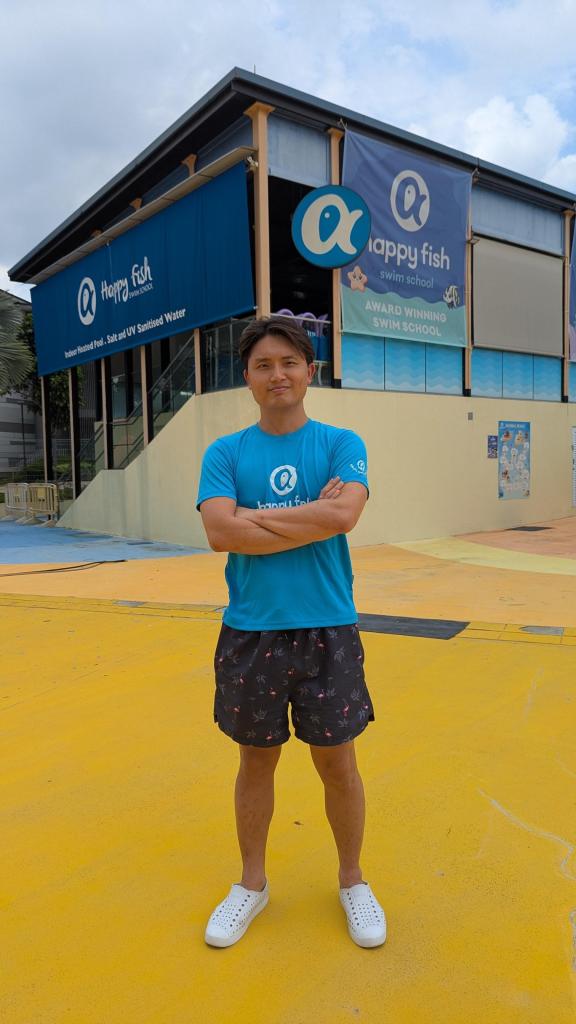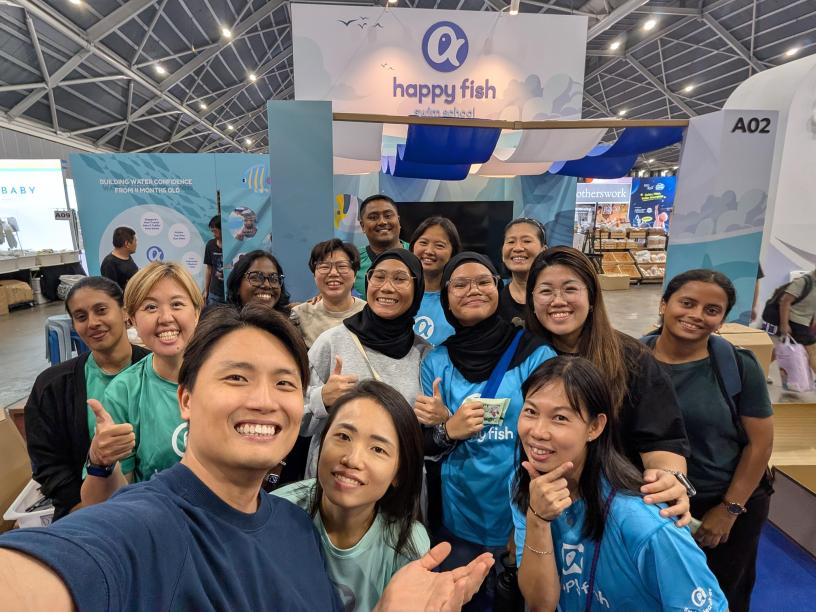
Meet Jian Yong, founder of Happy Fish Swim School, whose lifelong passion for swimming evolved into a mission to help children build confidence, emotional resilience, and stronger family bonds through water. Having swum since the age of three, Jian Yong believes swimming should become as natural for children as learning how to walk.
Starting his business at just 19 years old, Jian Yong overcame industry scepticism, construction challenges, and the impact of COVID-19 to grow Happy Fish into one of Singapore’s recognised swim schools. Today, his philosophy extends beyond swimming lessons, focusing on child-led learning, meaningful parent-child connections, and helping children enjoy the process of growth rather than rushing towards outcomes.
Swimming has been part of your life since childhood. What made you turn that passion into a business?
I have been swimming since I was three years old. As far back as I can remember, swimming already felt natural to me, almost like walking. Because of that, I always wanted more people to experience the joy of swimming.
When I was young, I realised very few of my friends could swim. Whenever I invited them to swim with me, most would say they did not know how. Later, I had the opportunity to become a swimming instructor, and that inspired me to take things further by starting a swim school.
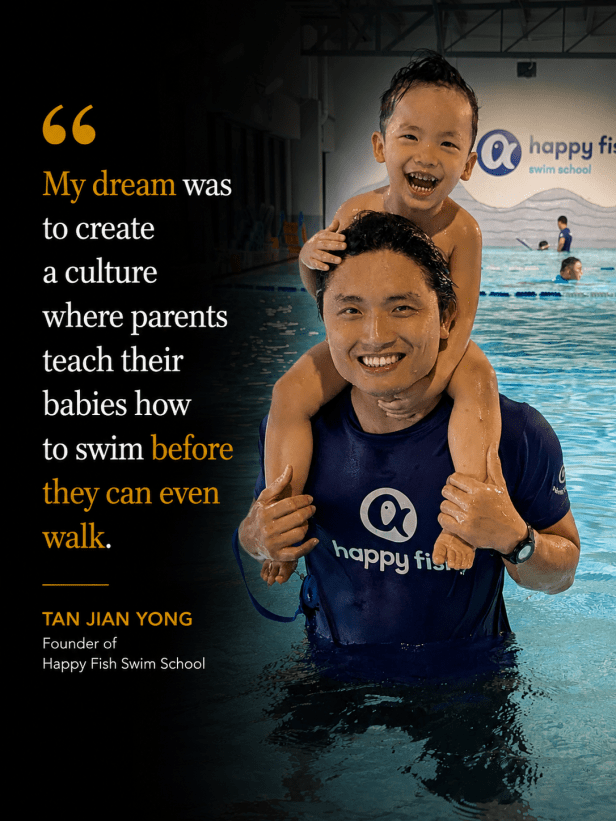
My dream was to create a culture where parents teach their babies how to swim before they can even walk.
What were the toughest challenges during the early years of building Happy Fish?
There were several memorable challenges. The first was starting the company at 19 years old while working with much older coaches who had been in the industry for decades. Many of them did not initially want to listen to someone younger, so I had to earn their respect patiently and learn how to work with different personalities.
The second major challenge was building our first swimming pool in 2014. No one had ever built a swimming pool inside an existing shop unit before, so even the architects and engineers were unsure how to proceed. The location was especially difficult because there was an MRT line beneath the building. Our original budget was around $200,000, but the final cost became almost double that amount.
What made it more stressful was that we had very few sign-ups before opening. Things only changed after I uploaded a video of my daughter, Laura, happily smiling underwater while swimming. At that time, most baby swimming videos showed children struggling or holding their breath. Her joyful expression was something very different, and the video went viral. Within a week, the pool became fully subscribed.
The third major challenge was COVID-19. We were shut down for 10 months, and even after reopening, recovery was slow. During that period, we bought a yacht so we could continue bringing students out for activities and also generate income through yacht rentals. Thankfully, the yacht business did very well and helped us survive financially. Today, both Happy Fish and the yacht business are growing again.
You mentioned that your dream was to create a culture where parents teach their children how to swim, just like teaching them how to walk. Why is this philosophy so important to you?
Over the years, we have taught close to 40,000 children, and I have personally seen the difference between children who learn swimming early and those who do not. Children who swim from a young age are often more emotionally stable and confident. Swimming involves bilateral movement, resistance, buoyancy, and strong parent-child bonding. These experiences help children develop emotionally and physically.
There was also research conducted by Griffith University in Australia involving 7,000 babies, which supported these findings. Beyond safety, swimming builds water confidence, and water confidence often translates into confidence in real life.
I genuinely hope future generations can grow up feeling as natural in water as they do walking on land.
Many parents today are highly protective of their children. How do you help children build courage and confidence in the water?
Our philosophy and teaching methods are very different from traditional swim schools. Firstly, we use a mission-based approach. Instead of telling children they are here to learn swimming techniques, we frame lessons as fun missions they need to complete. There are stickers, rewards, and small gifts involved, so children become excited about completing challenges rather than focusing on fear.
Secondly, we strongly believe in child-led progression. Every child develops differently, with different emotional needs and confidence levels. We cannot force every child to follow the exact same structure.
If a child feels less confident, we slow down and introduce games that still teach important swimming skills. If the child feels more confident, we can progress faster. By adapting to each child emotionally, lessons become enjoyable rather than stressful, both for the child and the parents.
You are also a father yourself. How has parenthood influenced the way you run Happy Fish?
My philosophy at Happy Fish is very much shaped by how I raise my own children. I have three children, and all of them are vegetarian by choice because they have a strong affinity with animals. Ironically, my wife and I are non-vegetarians.
They are also self-taught and do not attend traditional schools. My parenting philosophy is very different from the common mindset of rushing children to succeed academically. I believe people should enjoy the process of growth instead of constantly chasing outcomes.
That is also how I run Happy Fish. Children do not need to rush. Progress should happen naturally. I spend almost 10 hours a day with my children, communicating, guiding, and learning together with them. For me, meaningful experiences and relationships matter more than purely tangible achievements.
If you could give your 18-year-old self one piece of advice, what would it be?
I would tell my 18-year-old self to be bold, take risks, and trust the process. I was not a structured person when I was younger, and I was not a very good student either. But being willing to try new things and take risks shaped who I am today.
So I would simply say: follow what aligns with your values and philosophy, do not worry too much about where it will lead you, and enjoy the journey.
What is your vision for Singapore in the next five years?
I hope more people will have children. Honestly, I hope Singapore’s fertility rate improves because our local population growth is slowing down. I also hope Singapore continues building strong families and communities for the next generation.
If you could have a superpower for one day, what would it be and why?
I would want every parent to spend one full day entirely focused on their children without work distractions.
I believe strong generations are built through quality time, bonding, and meaningful memories. If parents could spend a whole day simply enjoying time with their children, they would realise how rich they already are in life.
Connect with Jian Yong: HappyFish and Instagram.