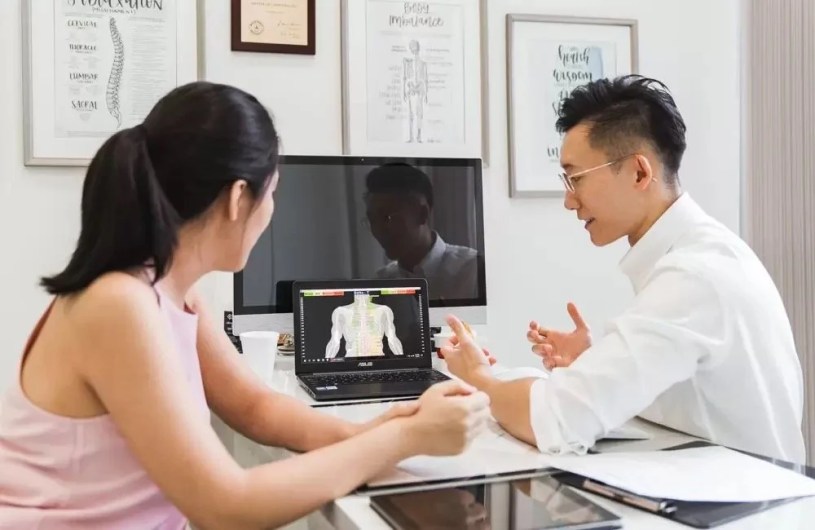
A serious basketball injury at the age of 12 changed the course of Dr Disney Seow’s life. After years of back pain and limited relief from conventional treatment, his experience with chiropractic care at 17 sparked an interest that eventually led him to pursue the profession. Although initially drawn to engineering, he discovered that his true calling lay in helping others overcome physical discomfort and improve their quality of life.
In 2018, Dr Disney founded Macquarie Chiropractic, which has since expanded to three locations in Singapore. His journey from hands-on practitioner to healthcare entrepreneur has brought valuable lessons about leadership, business sustainability and the meaning of success. Today, he shares his experiences, addresses common misconceptions about chiropractic care and explains why he believes patient trust and realistic expectations are essential.
You suffered a serious basketball injury at the age of 12 and experienced years of back pain before discovering chiropractic care at 17. How did that experience change your life and inspire you to become a chiropractor?
I didn’t immediately see myself becoming a chiropractor. I was good at mathematics and physics, so I initially pursued an engineering diploma in Perth. However, I eventually realised that I couldn’t see myself spending my career working at a desk. I decided to transfer my academic credits and move to Sydney, where I studied chiropractic from 2010 to 2014.
My interest in chiropractic began with my own injury. After a basketball accident at 12, I experienced persistent back pain and numbness extending down my left leg to my toes. My parents took me to a GP, but the advice was mainly to take painkillers and rest. Surgery was also discussed as something I might have to wait until I was 17 to undergo. As an active teenager who loved basketball, that was difficult to accept.
When I eventually received chiropractic treatment, I experienced noticeable changes after three adjustments. I still experience some pressure in my lower back today, but that experience allowed me to return to physical activities and gave me my first real understanding of chiropractic care.
You established Macquarie Chiropractic in 2018 and have since expanded to three locations in Singapore. What has been your greatest challenge in transitioning from practitioner to entrepreneur?
The biggest challenge has been managing people and business operations. As a practitioner, you focus primarily on treating patients. When you become a business owner, you suddenly have to handle staffing, marketing, operations, rental costs and many other responsibilities.
If I had known how difficult the journey would be, I might have reconsidered it! When I designed the Macquarie Chiropractic logo, I included eight stars because my original ambition was to establish eight clinics. Initially, I believed that having more outlets automatically meant greater success. Today, I recognise that expansion also brings financial risks and operational pressures.
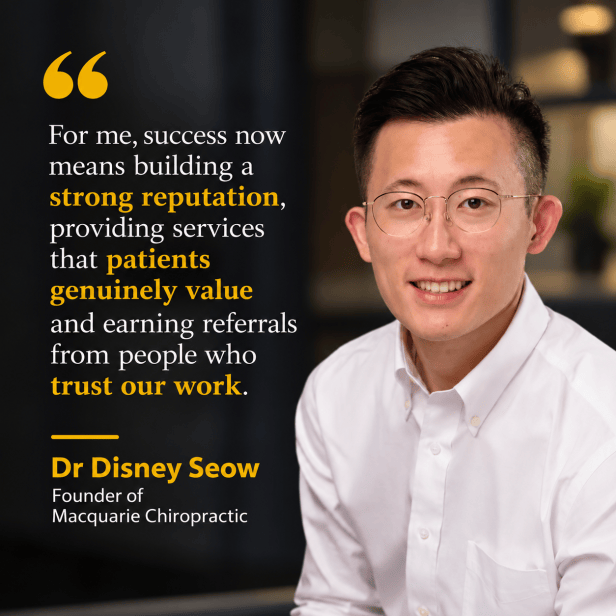
The market ultimately determines what is sustainable. For me, success now means building a strong reputation, providing services that patients genuinely value and earning referrals from people who trust our work. As a healthcare professional, I believe that is a more meaningful measure of success than simply increasing the number of clinics.
What are some misconceptions people have about chiropractic care that you wish to debunk?
One misconception is that manual spinal adjustments can physically push a displaced disc back into position. In reality, these adjustments primarily involve joint movement and do not directly reposition disc material.
At our clinic, we distinguish between joint-related and disc-related conditions, which may require different approaches, including decompression-based treatment.
Every spinal condition requires proper assessment and an appropriate treatment plan. Manual adjustments alone cannot address every spinal problem.
Singaporeans often spend long hours sitting at desks and looking at screens. What tips would you recommend for maintaining good spinal health?
My simplest advice is to avoid sitting in the same forward-leaning position for too long. Take regular breaks, lean back and gently look upwards every hour, provided it feels comfortable.
We spend so much time looking down at screens that we rarely move our necks in the opposite direction.
Everyone’s spinal condition is different, even among people of the same age. That is why we assess each patient’s condition and tailor treatment to their individual needs.
How do you build trust with patients while helping them understand the benefits, limitations and potential risks of treatment?
Trust begins with the initial assessment. During the first consultation, I take a detailed medical history and ask about previous injuries, including road accidents, serious falls and other incidents that may affect the spine.
This helps me understand the patient’s condition and determine how carefully treatment should be approached. I also believe patients should be encouraged to describe what they experience during and after treatment. As practitioners, we cannot directly feel what patients are feeling. Their feedback is therefore essential.
Some patients have previously received chiropractic treatment elsewhere and may notice differences in the methods used at our clinic. I explain the distinction between approaches targeting the spinal joints and other treatments that may be considered for disc-related conditions.
Research into chiropractic care continues to develop, and I believe it is important to stay informed about the available evidence. Ultimately, trust comes from proper assessment, clear communication and allowing patients to evaluate their own experiences rather than simply accepting what a practitioner tells them.
If you could speak to your younger self, what would you tell him?
I would tell him to be less ambitious, appreciate what he already has and practise gratitude. When I was younger, I was extremely driven and always hungry for more.
Ambition helped me achieve certain things, but I have since realised that constantly pursuing bigger goals does not necessarily lead to greater satisfaction. I would encourage my younger self to slow down, be content and recognise the value of what he has already accomplished.
What is your vision for Singapore in the next five years?
I hope Singapore continues to prosper by strengthening its position as a global hub for wealth, talent and artificial intelligence. As a country with limited natural resources, Singapore depends heavily on attracting talented people, investment and new opportunities.
We must remain competitive with other international financial and business centres, including Hong Kong and Dubai. I believe artificial intelligence will play an increasingly important role in economic development, and Singapore should position itself strongly in this area.
Ultimately, I hope these developments will contribute to the country’s continued prosperity.
If you could have a superpower for one day, what would it be and why?
I would choose the ability to absorb the knowledge of an entire book simply by touching it. Imagine being able to touch a thousand books in one day and immediately understand their contents! I would use that opportunity to acquire as much knowledge as possible.
More importantly, I could apply what I had learnt to make better decisions and anticipate developments over the next five to ten years. For me, knowledge is valuable because it helps us understand possibilities and prepare for the future.
Connect with Dr Disney: MacquarieChiropractic and Instagram.
