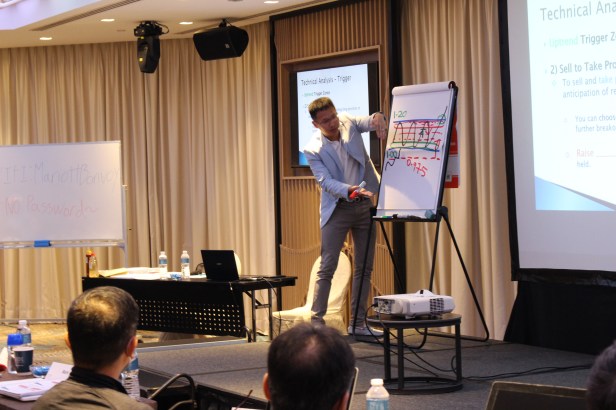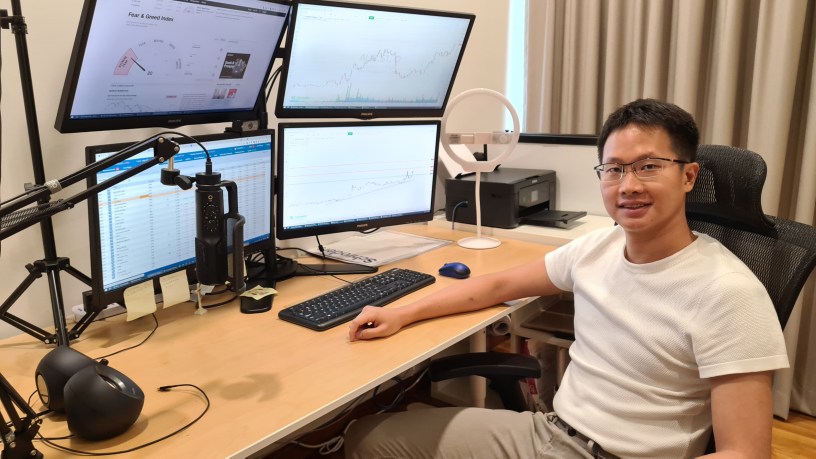
For Joey Choy, success in the financial markets has never been a straightforward journey. From experiencing significant trading losses to facing a S$740,000 financial setback following a client’s default, he has learnt that protecting capital, managing risk and remaining disciplined are just as important as identifying profitable opportunities.
Today, Joey is involved in trading, investing, business and financial education, sharing lessons shaped by both success and adversity. Guided by perseverance, faith and gratitude, he believes that trading is not about predicting the future but managing uncertainty. Beyond financial achievements, his greatest priorities remain his family, helping others and making a meaningful difference.
You experienced major losses early in your trading journey and later faced a S$740,000 financial setback. What did those experiences teach you about money, risk and yourself?
Those experiences completely changed how I view money and risk. Initially, I focused on how much I could make. After suffering losses, I realised a trader’s first responsibility is protecting capital and staying in the market long enough to seize opportunities.
The S$740,000 setback resulted from a client’s default, leaving me to deal with the financial consequences. It was an extremely difficult period, but it taught me that money can be rebuilt through perseverance.
My wife stood by me and gave me the strength to rebuild. I also remained grateful to God for what I still had rather than focusing solely on my losses. Today, before making any trading, investment or business decision, I ask myself, “What happens if I’m wrong?”
Most people focus on potential gains, but experience teaches you to respect downside risk. Ultimately, setbacks don’t have to define you. What matters is how you respond and whether you keep moving forward.
Many people enter trading because they want financial freedom. What is the difference between someone who treats trading professionally and someone who is essentially gambling?
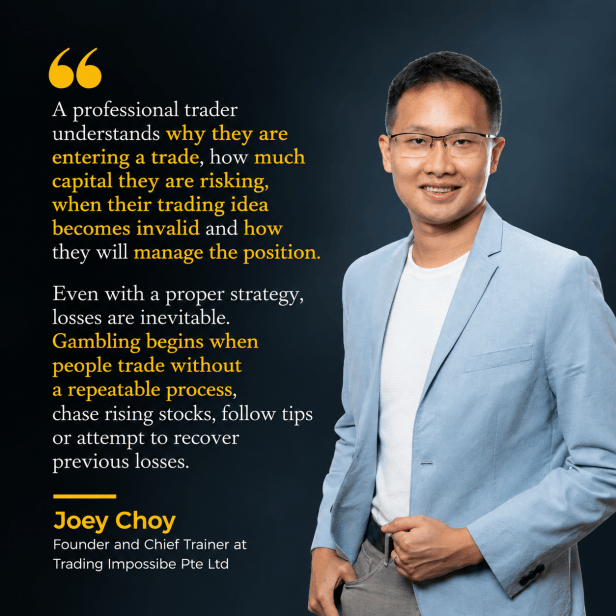
The biggest difference is having a process. A professional trader understands why they are entering a trade, how much capital they are risking, when their trading idea becomes invalid and how they will manage the position.
Even with a proper strategy, losses are inevitable. Gambling begins when people trade without a repeatable process, chase rising stocks, follow tips or attempt to recover previous losses.
Professional trading isn’t about predicting markets accurately. It is about managing uncertainty, identifying favourable probabilities, controlling losses and allowing profitable positions to develop.
That’s very different from betting everything on the next trade.
In volatile markets, what separates those who panic from those who profit?
Preparation. Panic often happens when someone takes excessive risks or enters the market without a plan. It’s easy to feel comfortable with risk when markets are calm. Your true risk tolerance becomes apparent when prices fall sharply.
Before entering a position, I identify important support levels, my risk point and how much I am prepared to lose. When volatility arrives, I follow my plan rather than react emotionally.
Volatility doesn’t guarantee profits. Sometimes protecting capital and waiting is the best decision. However, fear can also create opportunities by pushing prices towards important levels.
Risk management allows you to remain rational when markets become irrational.
What are some of the biggest misconceptions about trading and investing that you wish to debunk?
The first misconception is that trading offers quick money. Without proper knowledge, it’s often a quick way to lose money.
Another is that successful traders must win most of their trades. You can experience regular losses and still perform well if you control them and allow profitable trades to run.
People also assume that trading more frequently produces better results. Sometimes there simply aren’t worthwhile opportunities, and waiting is part of trading.
Finally, technical analysis isn’t a crystal ball. Charts and indicators cannot predict the future with certainty. They help identify trends, momentum, support, resistance and market behaviour. Ultimately, successful trading requires a repeatable process and consistent risk management.
With AI, algorithms and sophisticated trading tools increasingly available to ordinary investors, is technology making people better traders or simply allowing them to make mistakes faster?
Technology is an amplifier. With a sound strategy, it can significantly improve efficiency. Traders can now scan thousands of stocks, set alerts, analyse information and test ideas quickly. AI will accelerate these capabilities further.
However, technology cannot replace judgement and discipline. Someone without a proper strategy or risk management may simply make poor decisions faster.
AI might generate ten stock ideas within seconds, but that doesn’t mean you should buy all ten. The important skill will increasingly be knowing which information matters, what to ignore and when not to act.
I see AI as a powerful tool, not a shortcut. Its value ultimately depends on the person using it.
If people could remember only one thing about your work long after you stop doing it, what would you want that to be?
I hope people remember me as someone who worked hard, remained grounded and always thanked God for the opportunities I received. Trading and investing have been important parts of my life, but I don’t want my legacy to revolve solely around stocks or financial achievements.
What matters more is whether I have made a positive difference in someone’s life.
Over the years, I have taught people about trading, investing and risk management. If my guidance helped someone avoid a costly mistake, make better financial decisions or become more disciplined, that would be meaningful.
I have experienced difficult periods, but I kept persevering. I’m grateful for my family’s support and God’s blessings. Ultimately, I hope people remember that I genuinely tried to help others.
What is your vision for Singapore in the next five years?
I hope Singapore remains a place where people can build opportunities through entrepreneurship, careers and investing. I’m particularly passionate about improving financial literacy.
Ordinary investors now have access to information and sophisticated tools previously reserved for professionals. AI will accelerate this transformation. However, greater access doesn’t automatically translate into better financial decisions. Education and understanding risk will become increasingly important.
I hope Singapore continues strengthening its position as a trusted financial centre while helping individuals make informed investment decisions. Our ability to adapt quickly has always been a strength, and it will remain essential as technology transforms business and finance.
If you could have a superpower for one day, what would it be and why?
I would choose the ability to pause time. Between trading, running multiple businesses and managing various responsibilities, life can sometimes become overwhelming. I would use that extra time to be with my wife and children, reflect and pray.
Those moments remind me that life has a purpose beyond markets, business and financial achievements. As entrepreneurs, we are often so focused on the next goal that we forget to appreciate the present.
I’m still learning to balance ambition with family life. Markets will reopen tomorrow, and there will always be more opportunities. However, time with the people you love is something you can never get back.
Connect with Joey: Facebook, Instagram and TikTok.