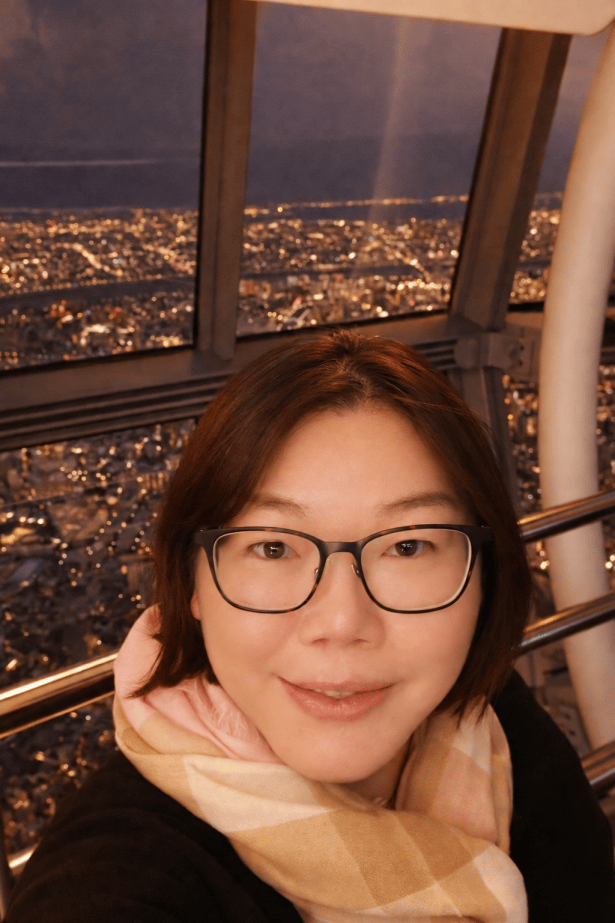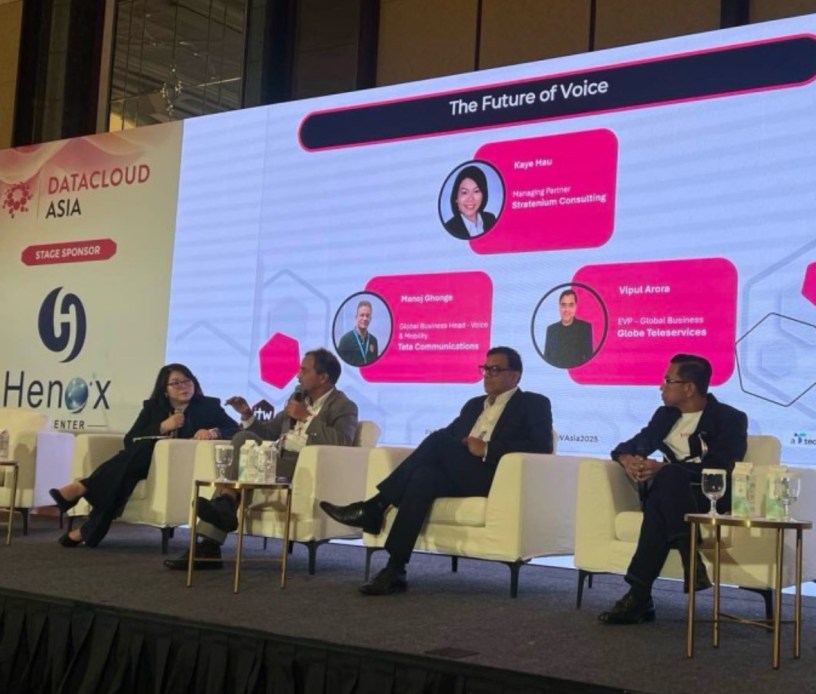
After nearly two decades across telecommunications, media, digital infrastructure and technology, Kaye Hau did not initially plan to become an entrepreneur. What began as a much-needed career break after the intensity of the COVID-19 period unexpectedly introduced her to consulting and eventually led her to establish Stratenium Consulting.
Drawing on years of both strategic and operational experience, Kaye believes that good strategy cannot exist solely on paper. From helping organisations navigate transformation to advising technology companies entering Southeast Asia, her approach centres on understanding execution, people and the realities behind lasting change.
You have spent nearly 20 years across telecommunications, media, digital infrastructure and technology. What eventually gave you the conviction to step out and establish Stratenium Consulting?
Establishing Stratenium Consulting wasn’t a straightforward decision. I wasn’t actually planning to start a business. After working at full capacity throughout COVID-19, which was an extremely challenging period, all I really wanted was to take a break. One thing led to another, and a friend who was in consulting brought me into the industry.
After working on several cases, I realised how much I enjoyed solving problems and giving advice. I have always enjoyed fixing problems, and consulting gave me the opportunity to do that.
Once I realised this was something I genuinely enjoyed, I decided I might as well establish my own company. That’s really how Stratenium Consulting started.
What have you learnt about the gap between a strategy that looks good on paper and one that actually works in the real world?
Earlier in my career, strategy involved a lot of planning on paper. However, once you reached the launch stage, you often discovered that certain things hadn’t been considered.
A simple example is an Operational Readiness Test (ORT). When you start running through everything required for a product launch, you realise how many operational details weren’t considered at the strategic level. It could be something as basic as when brochures need to be printed and delivered to retail stores. Even that needs to be built into the timeline.
As you gain more operational and execution experience, the way you develop strategy matures. Today, when I develop a strategy, I’m drawing on years of execution experience and understanding what can go wrong, what needs to happen and how much lead time is required.
Ultimately, strategy remains strategy until you execute and launch it. Only then do you truly know whether it works.
Transformation is one of the most frequently used words in business, yet many transformation programmes fail to deliver lasting change. From your experience, why do organisations struggle to transform?
One of the biggest factors is people. Change practitioners across industries will tell you that you can change processes and introduce the best tools, but if people don’t adopt or embrace them, the transformation is unlikely to succeed.
Organisational willingness is equally important. Sometimes employees are passionate about change, but the organisation itself isn’t sufficiently motivated or committed to making it happen.
That is where we often see a disconnect. Something may look good on paper, but it isn’t cascaded effectively to the people doing the actual work. That gap between strategy and the working level can become a major impediment to digital transformation and organisational change.
You work extensively across Asia Pacific. What do international technology companies most commonly misunderstand when trying to enter or expand across Southeast Asia?
The first thing they need to understand is that Southeast Asia may be an economic bloc, but it is extremely diverse. Every market has its own culture, systems and level of maturity, whether regulatory, technological or commercial.
Companies cannot take a one-size-fits-all approach, whether they are coming from the West or the East. Every market requires some degree of customisation.
Singapore is often a useful launch market because it’s smaller and provides an environment where companies can test their approach. However, succeeding in Singapore doesn’t automatically mean you will succeed in the countries around the region.
Each country has different market dynamics. Relationships and face-to-face interactions are also still highly valued in this part of the world. Companies therefore need to understand that no single Southeast Asian country can represent the entire region.
Do you think organisations are moving too quickly to adopt AI without first being clear about the business problem they are trying to solve?
Not necessarily, but organisations need to understand exactly where their pain points are and where AI can genuinely create value across the business.
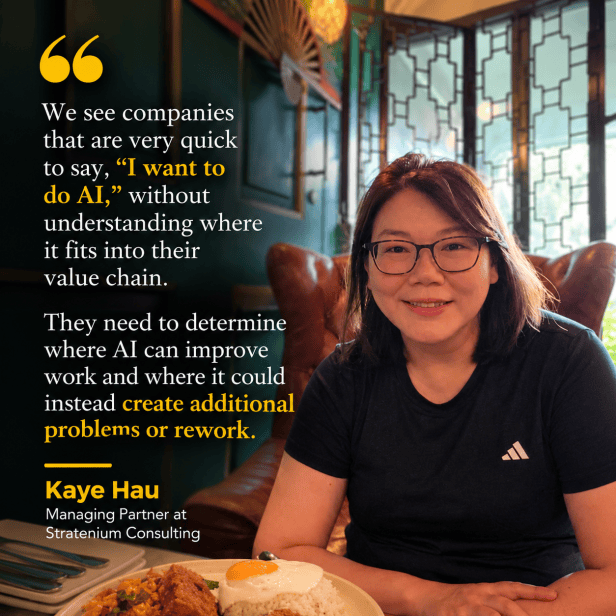
We see companies that are very quick to say, “I want to do AI,” without understanding where it fits into their value chain. They need to determine where AI can improve work and where it could instead create additional problems or rework.
It is also important to have conversations with employees because you cannot effectively change workflows without understanding how people actually work. There is understandably a lot of fear surrounding AI and job displacement. If employees feel they are teaching AI to perform tasks they currently do, they are naturally going to wonder what happens to their jobs afterwards.
Leaders need to address that conversation from the beginning. Without proper communication and planning, blindly adopting AI can create more problems — not necessarily because of the technology itself, but because of low morale, resistance and fear among employees.
Describe a situation that made you rethink your life.
It happened before I established Stratenium Consulting. I was dealing with a combination of health concerns and very long working hours, and eventually I realised that something had to give.
Fortunately, the health issue turned out to be only a scare, but it gave me a different perspective on life.
It made me ask myself what I was actually trying to achieve. Was I adding value and creating positive opportunities, or was I simply caught in an endless cycle without knowing where I was creating meaningful value?
That health scare really put things into perspective for me.
What is your vision for Singapore in the next five years?
Singapore has always tried to stay at the forefront. Our “kiasu” mentality keeps us on our toes, and for a small country without many natural resources, I think that drive has played an important role in getting us to where we are today.
There are many emerging technologies and start-ups in Singapore doing impressive work. We may not have the largest R&D budgets globally, but we have talented people doing incredible research and developing frontier technologies.
My hope is that Singapore continues to thrive as a vibrant hub and incubator where innovation and new technologies can come together.
I wouldn’t necessarily say we will become another Silicon Valley, but I hope we can continue creating the environment for innovation to flourish and perhaps see several more unicorns emerge from Singapore over the next five years.
If you could have a superpower for one day, what would it be and why?
I would like to have a sidekick or a double who could handle all the daily tasks and grind that still need to be done.
That would give me more time for myself, my children and my family. If I could have that superpower for just one day, I would happily let my double take care of the grind while I spent that time with the people who matter most to me.
Connect with Kaye: LinkedIn.