Jean Tan spent more than a decade as an HR business partner, experiencing the entire employee journey from recruitment and onboarding to development and retention. Her career took a different direction following COVID, when she transitioned into wealth management and employee benefits, giving her a new perspective on the connection between people, financial security and business sustainability.
Today, Jean draws on both her HR and wealth management experience to help business owners build more meaningful and sustainable employee benefits strategies. At the heart of her approach is a simple philosophy: take care of the people so that the people can take care of the business. In this interview, she discusses employee retention, workplace culture, financial protection and why taking care of employees does not necessarily mean spending more.
You spent more than a decade as an HR business partner before moving into wealth management and employee benefits. What did you experience in HR that eventually made you realise you could help businesses in a different way?
In HR, I experienced the entire employee lifecycle, from recruitment and onboarding to development and retention. What struck me was how employee benefits came into the conversation at almost every stage.
Candidates consider benefits when evaluating job offers, while existing employees look to them for support when life happens. Benefits may not be the main reason someone stays, but they can give employees one less reason to leave. I have seen employees remain with companies for decades when they feel financially secure and protected.
At the same time, I understand the employer’s perspective: costs must remain sustainable. When structured properly, employee benefits are not simply an expense, but a practical people strategy that protects employees while strengthening the company’s employee value proposition.
This experience allows me to approach people challenges from both the employee’s and employer’s perspectives.
SMEs often want to provide better benefits but have limited budgets. How can a business take better care of its employees without spending significantly more money?
Taking care of employees does not necessarily mean spending more. It can start small and simply mean spending more intentionally. For SMEs, the first step is understanding the workforce: people’s profiles, their needs, their existing coverage and what the company can realistically sustain within its budget.
It is not necessarily about adding more benefits. Sometimes it means restructuring existing benefits and directing resources towards areas where employees are most financially vulnerable.
SMEs do not need to copy large MNCs. They need benefits that are appropriate for their people, budget and stage of growth. These costs should also be considered from the beginning so that the business can continue growing sustainably.
Many companies use salary as their main tool for attracting and retaining talent. From your experience, what benefits or support do employees genuinely value beyond their paycheque?
Salary will always matter. But from my experience across HR and wealth management, employees also remember how a company responds when life happens. If they face a serious medical condition, do they have some form of financial protection? When they have family responsibilities, is there flexibility and understanding?
Beyond medical benefits, employees value flexibility, well-being support and development opportunities. They want to grow, and they want to know their employer cares about them as individuals rather than simply as headcount.
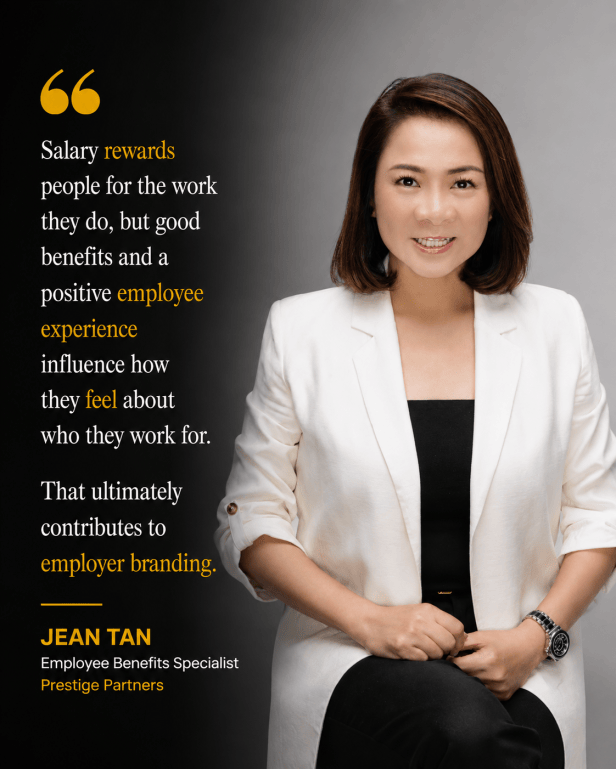
Salary rewards people for the work they do, but good benefits and a positive employee experience influence how they feel about who they work for. That ultimately contributes to employer branding. Personal and professional goals are not mutually exclusive.
Your business motto is, “Help take care of the people so that the people can take care of the business.” Why does this philosophy matter so much to you?
I have spent most of my career between people and the business, and I have learnt that taking care of employees and building a successful business are not competing priorities; they reinforce each other.
It means understanding what employees need while recognising what the business can realistically provide. Sometimes that involves difficult decisions, but people should feel heard, valued and trusted.
The business must also remain healthy because without success, it cannot continue supporting its people. I see it as a partnership: take care of the people, and the people take care of the business. That is the relationship I want to help businesses create.
What separates companies with strong workplace cultures from those that struggle with employee engagement?
I think it comes down to consistency. A strong workplace culture is not built through one-off events, big celebrations or occasional gestures. It is built through what employees experience every day, supported by the organisation’s systems, processes and everyday practices.
Employees need to know that fairness, accountability and support are consistently present, rather than depending on who their manager is or what kind of day someone is having.
When there is consistency, trust becomes easier to build. Ultimately, a strong workplace culture is built through the small promises that a company consistently keeps.
What challenge in your life are you most grateful for today, and how has it shaped the person you have become?
I am grateful for my transition from HR into wealth management, particularly because it meant starting again after COVID.
Wealth management taught me to slow down, listen more carefully and understand what truly matters to people. I realised that many business and financial decisions are ultimately about protecting something or someone we care about.
Starting again taught me resilience, humility and the willingness to relearn. It also gave me space to reflect on the kind of professional, person and business owner I wanted to become.
I also realised that none of my previous experiences had gone to waste. From starting work at 14 in F&B, banquets and sales to more than a decade in HR, everything contributed to this new chapter and gave me a deeper perspective on how to serve people better.
What is your vision for Singapore over the next five years?
I would love Singapore to remain a place where businesses can grow with both ambition and compassion.
SMEs are a significant part of our economy, and I hope more business owners see taking care of their people as an investment rather than simply a cost. Competing for talent should not be only about higher salaries, but also about creating workplaces where employees feel valued and protected.
Better employee experiences, stronger workplace cultures and financial protection can help both people and businesses thrive. If more SMEs embrace this approach, we can build a more resilient Singapore together. This is something I would love to contribute to.
If you could have a superpower for one day, what would it be and why?
I would choose the ability to build bridges between different perspectives. Trust takes time to build, but it grows when better conversations happen. Better conversations lead to better decisions, stronger relationships, stronger teams and ultimately stronger businesses.
If I could have one superpower, I would want to build those bridges instantly by understanding everyone’s perspective and finding common ground.
Connect with Jean: LinkedIn and Instagram.