
After spending more than 15 years in healthcare, Kelly made an unexpected career transition into business financing and government grants. Having worked in general practice and specialist clinics, as well as clinic management, she developed valuable skills in communication, problem-solving and understanding people’s needs. Her desire to help others remained unchanged, even as she ventured into a different industry.
Today, Kelly supports small and medium-sized enterprises (SMEs) in navigating financing options, understanding lenders’ requirements and identifying relevant government assistance schemes. Drawing on her experience in healthcare, she believes that listening and understanding individual circumstances are essential to providing meaningful solutions. In this interview, she shares her career journey, common misconceptions about business loans and her hopes for Singapore’s business community.
You spent more than 15 years in healthcare, working in GP and specialist clinics as well as clinic management. What kept you in the medical industry for so long, and what eventually inspired you to pursue a different career?
I stayed in healthcare for more than 15 years because I genuinely enjoyed helping people. Over the years, I gained valuable experience working with patients and doctors, as well as managing clinic operations. It was a fulfilling career that allowed me to make a difference in people’s lives.
Eventually, however, I felt it was time to challenge myself and explore something different. That’s when I decided to move into business financing and government grants. Although the industry was completely different, my motivation remained the same.
I still wanted to help people, but this time, I would be supporting business owners and helping their companies grow.
Moving from healthcare into business financing is a significant career change. Which skills from your previous career have proven particularly useful when working with business owners and borrowers?
I would say communication, patience and problem-solving. In healthcare, we interact with people from all walks of life, each with different needs, concerns and circumstances.
The same applies when working with business owners. Every business faces different challenges, and what works for one company may not necessarily work for another.
My healthcare experience taught me that listening carefully and understanding someone’s situation is often more important than immediately offering a solution. I continue to apply that principle when helping businesses navigate their financing needs.
What do business owners commonly misunderstand about how lenders assess their companies and determine how much they can borrow?
Many business owners assume that as long as their company is profitable, obtaining a business loan should be straightforward. However, lenders consider several factors beyond profitability.
These include the company’s cash flow, existing financial commitments, credit history and ability to repay the loan. Sometimes, a business may generate strong sales but still face difficulties securing financing because of its financial position.
That’s why I always emphasise the importance of understanding a company’s overall financial health. Having good revenue doesn’t automatically mean a business qualifies for the amount of financing it wants.
When an SME is struggling with cash flow, how do you determine whether additional financing will genuinely help the business rather than simply create more debt?
The first step is understanding why the business is experiencing cash-flow difficulties.
For example, are customers taking too long to make payments, or is the company consistently spending more than it earns? These are two very different situations.
If the problem is temporary, such as delayed customer payments, financing may help bridge the gap, provided the business can comfortably manage the repayments. However, if the company is already struggling with existing debts or consistently operating beyond its means, borrowing more money could make the situation worse.
Ultimately, the suitability of additional financing depends on the company’s circumstances. It’s important to identify the underlying problem before deciding whether another loan is the right solution.
Besides financing, you help SMEs identify government support that can reduce their costs. How do you help business owners determine which grants and assistance schemes are relevant to them?
Many business owners know that government grants are available, but they are often unsure which schemes their companies qualify for. I usually begin by understanding the business’s needs and objectives.
For example, does the company want to digitalise its operations, expand overseas, improve productivity or hire additional employees? Once I understand its priorities, I can help identify potentially suitable support schemes.
These may include the Productivity Solutions Grant (PSG), Enterprise Development Grant (EDG) or various workforce support programmes. My role is to help business owners understand their options, assess which schemes may be relevant and avoid overlooking available assistance.
What’s one uncomfortable truth about money that you think everyone should understand?
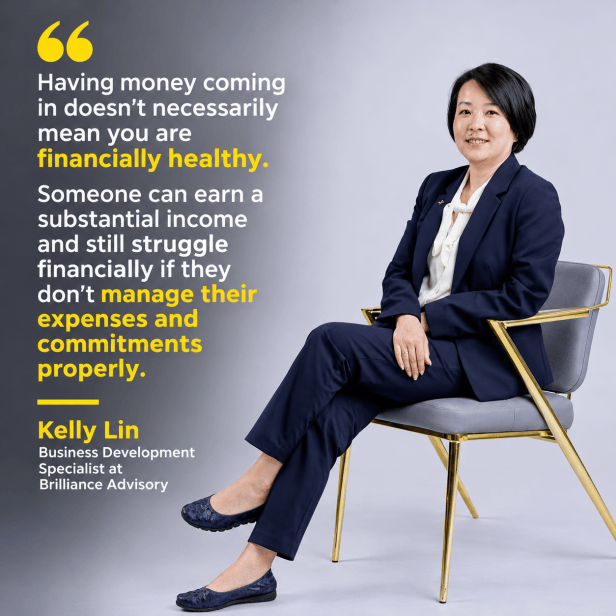
Having money coming in doesn’t necessarily mean you are financially healthy. Someone can earn a substantial income and still struggle financially if they don’t manage their expenses and commitments properly.
I have also seen how cash-flow problems can seriously affect businesses, even when they are generating sales.
To me, financial health isn’t simply about how much money you earn. It’s about how effectively you manage the resources you already have.
What’s your vision for Singapore in the next five years?
I hope Singapore continues to grow as a strong business hub, particularly for our SMEs. With artificial intelligence and technology advancing so rapidly, I would like to see more businesses embrace digitalisation without being left behind.
I also hope there will be greater opportunities for mature workers to remain active, contribute their experience and continue developing their skills. Most importantly, I want Singapore to remain a place where businesses and people can grow and prosper together.
If you could have a superpower for one day, what would it be and why?
I would love to have the ability to see into the future. Not because I want to predict lottery numbers, but because I would like to help people avoid making costly mistakes.
In business, a single poor financial decision can sometimes have serious consequences. If I could foresee potential problems and help business owners make better decisions before those problems arise, I think that would be a wonderful superpower.
Connect with Kelly: Facebook, Instagram and LinkedIn.