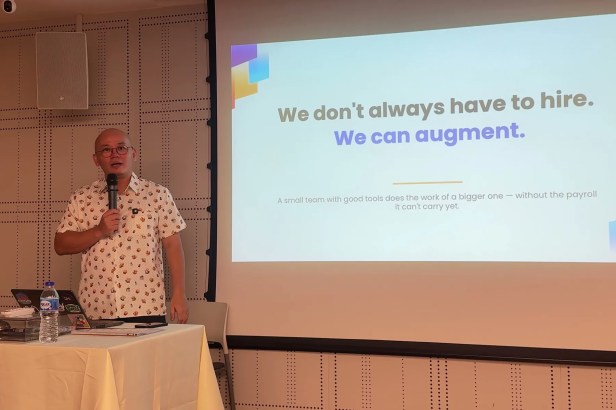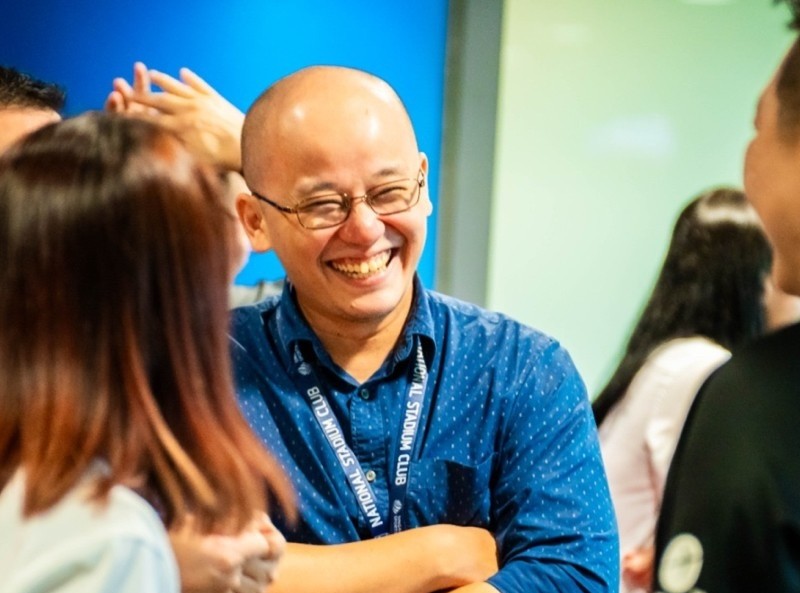
From teaching chemistry at a junior college to helping businesses embrace artificial intelligence, Haojun’s career demonstrates how curiosity and a willingness to learn can open unexpected opportunities. As the founder of On The Ground, an AI consultancy, he draws on his teaching experience to help organisations improve productivity through practical AI training, automation and customised solutions.
Despite having no formal computer science qualifications, Haojun taught himself to develop AI-powered solutions and now trains others to do the same. A father of two young sons, he also believes that AI literacy should begin early. In this interview, he shares his entrepreneurial journey, common mistakes businesses make when adopting AI and his hopes for Singapore’s technological future.
You started your career as a chemistry teacher before moving into technology. Could you share your journey and what inspired you to establish On The Ground?
I began my career as a chemistry teacher at a junior college after completing my studies on a scholarship. During my teaching years, I introduced team-based learning, an established teaching approach that was still relatively uncommon in Singapore.
I used Google Forms to automate certain processes, allowing me to collect students’ answers before lessons and quickly identify areas where they needed additional support.
That experience showed me the power of automation. Although it wasn’t artificial intelligence, I realised technology could significantly improve how people worked. As I interacted with professionals from other industries, I began recognising similar opportunities in businesses.
Eventually, I established On The Ground to apply automation and emerging technologies to help companies work more effectively. In many ways, I’m still doing what I did as a teacher. The audience has simply changed.
Despite having no formal coding or computer science background, you have taught yourself AI and now train others professionally. How did you acquire these skills, and what advice would you give someone following a similar path?
Although I don’t have formal coding qualifications, I have been interested in computers since childhood. I grew up using older systems such as MS-DOS and Windows 95, when computers were considerably less user-friendly.
As a teenager, I even attempted to learn HTML and build websites, although I never completed the course. When modern AI tools emerged, I realised that learning to code had become much more accessible. Instead of struggling through everything independently, I could ask AI questions, receive explanations and get assistance writing code.
That changed how I approached learning. I began experimenting, building solutions and gradually developing my technical abilities through practice.
My advice is not to let a lack of formal qualifications discourage you. Start with a problem you want to solve, use AI to guide your learning and keep experimenting. You don’t necessarily need to become a traditional programmer before you can create useful solutions.
Through On The Ground, you have helped companies adopt AI and develop customised solutions. What are the most common mistakes SMEs make when implementing AI?
The biggest mistake companies make is implementing AI without first understanding the technology or identifying specific problems. Many assume that allocating a budget, hiring consultants or purchasing AI tools will automatically improve productivity.
However, some external consultants may lack knowledge of the company’s operations, resulting in additional costs. I believe a better approach is to train existing employees, starting with one repetitive, time-consuming task. As they become familiar with AI, they can develop solutions suited to their work.
Simply providing AI subscriptions isn’t enough. Real value comes when employees understand how to apply the technology effectively in their daily responsibilities.
On The Ground emphasises practical AI training. What’s the biggest difference between attending an AI course and becoming genuinely proficient at using AI?
An AI course is a good starting point, but true proficiency comes from regular practice and real-world application. I encourage my team to use AI beyond work, such as planning holidays or organising personal activities, while remaining mindful of privacy and sensitive information.
I have met people who attend multiple courses but struggle to apply their knowledge because their workplaces offer few opportunities to practise.
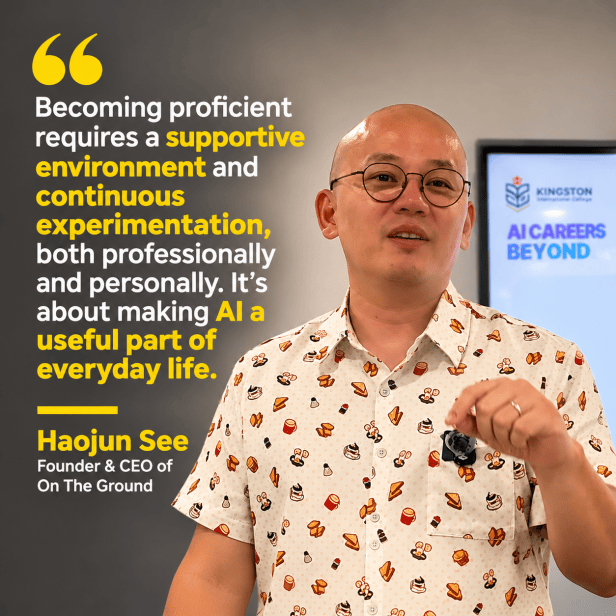
Becoming proficient requires a supportive environment and continuous experimentation, both professionally and personally. It’s about making AI a useful part of everyday life.
As a father of two young sons, what excites and worries you most about raising children in an AI-driven world?
I’m excited by the creative possibilities AI offers children. Under my supervision, my younger son started using it at just three years old, generating pictures of dinosaurs and imaginary creatures to print and colour.
However, AI also brings risks, including distractions, reduced real-world interactions and unhealthy working habits. My children see how extensively I use AI for work, so they understand both its benefits and drawbacks.
I believe shielding children from AI isn’t the answer. Instead, we should teach them to use it responsibly while maintaining a healthy balance between technology, creativity and real-world experiences.
What’s one belief you have changed your mind about, and what caused you to see things differently?
I used to believe that major AI companies were genuinely driven by their stated ambitions to make the world better. Their mission statements, public announcements and founding stories often present inspiring visions.
However, my perspective has changed.
I have become more sceptical of corporate messaging because these companies also have responsibilities to investors and shareholders. Protecting profitability and meeting commercial expectations inevitably influence their decisions. I don’t necessarily think that’s wrong. Businesses have obligations to the people who invest in them.
However, I have realised that we shouldn’t depend entirely on technology companies to create a better world. That responsibility belongs to all of us. As everyday AI users, we must decide how to apply these technologies responsibly and use them to benefit others.
What’s your vision for Singapore in the next five years?
I hope AI will drive Singapore’s economic growth, improve productivity and enhance people’s quality of life. I initially thought most organisations were still exploring AI, but conversations with public servants and business leaders revealed that many are already using it in advanced ways.
My vision is for AI to become everyday infrastructure, accessible not just to large corporations but also to SMEs and non-profit organisations.
The tools are increasingly affordable and capable. What’s missing is often the knowledge and confidence to use them effectively. Bridging this gap could create greater opportunities and improve lives across Singapore.
If you could have a superpower for one day, what would it be and why?
I would choose the ability to transfer knowledge instantly from one person to another. I remember watching a television programme where characters could share their knowledge through a special object.
I found that concept fascinating.
Imagine being able to transfer everything I have learnt directly to someone else, without requiring them to spend years acquiring the same knowledge. They could immediately understand how I approach problems and develop solutions.
More importantly, they could build upon that knowledge and achieve things beyond what I have accomplished. As someone who enjoys teaching and helping others learn, I think that would be an extraordinary superpower.
Connect with Haojun: LinkedIn.