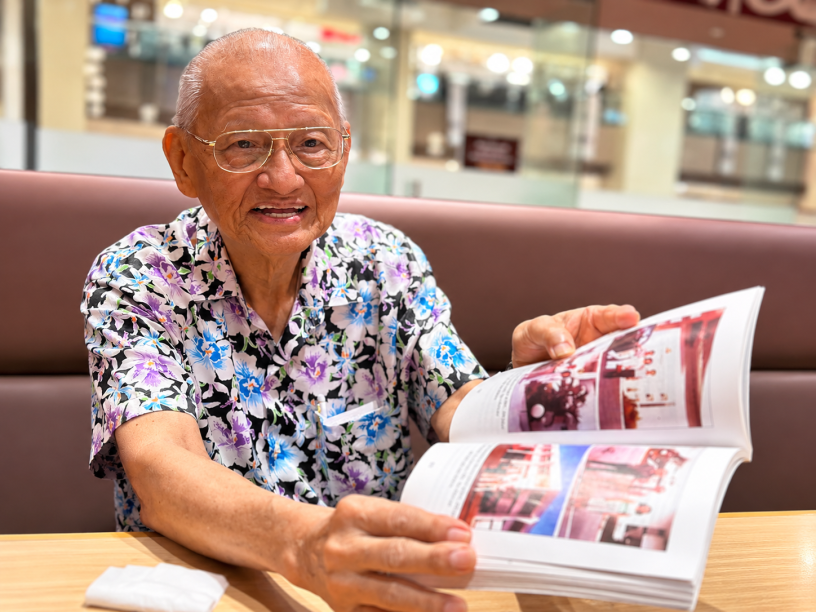
At 90, Lim Chin Leong has witnessed Singapore’s remarkable transformation, from its early years of nation-building to the modern country it is today. A former teacher who became one of the pioneers of Singapore’s Ministry of Foreign Affairs, his career took him to Tokyo, New Delhi, London, Kuala Lumpur and Cairo, where he represented a young nation finding its place on the international stage.
Beyond his years in education and diplomacy, Lim has remained committed to writing, faith and the values that have guided him throughout his life. In this interview, he recalls childhood encounters with danger, his early teaching experiences, an unexpected rescue mission in Malaysia and his belief that love, charity and forgiveness are essential to a meaningful life.
You have lived through nine decades of extraordinary change, including Singapore’s journey from a young nation to the country it is today. What are some of your most vivid childhood memories?
One unforgettable memory was a fire at home. One evening, my father and I were transferring kerosene from a large tin into a smaller container. Our maid was holding a candle, which she accidentally brought too close to the kerosene.
The kerosene caught fire, and I suddenly realised my left foot was burning. I quickly grabbed a hanging curtain and used it to smother the flames. Unfortunately, our maid also suffered severe burns and subsequently passed away. It was a tragic incident that has remained with me throughout my life.
Another frightening experience occurred when I nearly drowned in a river. I used to walk along the riverbed, but one afternoon, I ventured into deeper water. When I realised my feet could no longer touch the bottom, I panicked and began swallowing water.
I shouted for help, believing I was about to drown. Fortunately, my feet eventually touched the sandy riverbed, allowing me to stand up. I was so frightened that I cried out in Hokkien that I was going to die. After recovering from the shock, I decided not to tell anyone what had happened.
You began your professional journey as a teacher before becoming a diplomat. What inspired you to enter teaching, and what were your early experiences like?
My journey into teaching began somewhat unexpectedly. After completing my studies at St Andrew’s School in Singapore, I hoped to secure a government scholarship to further my education.
Although I was academically qualified, I was ineligible because I was a Johor national. Fortunately, I came across an advertisement in The Straits Times inviting applications to the Singapore Teachers Training College. I applied and was accepted into its two-year Certificate-in-Education programme.
The monthly allowance of $100 was particularly welcome because it enabled me to support myself without burdening my parents.
I graduated in 1957 and began teaching at Bukit Panjang Government Secondary School, where I was tasked with establishing a science laboratory. I subsequently taught English at Gan Eng Seng Chinese Middle School and Thomson Chinese Middle School.
Teaching English to Chinese students was especially rewarding. I could see their genuine determination to improve their command of the language. I often stayed until 7 pm marking their exercise books. Their enthusiasm and willingness to learn encouraged me to give my best as a teacher.
You were among the pioneers of Singapore’s Ministry of Foreign Affairs. What was it like representing a young nation, and which diplomatic experience remains particularly memorable?
During my diplomatic career, I was posted to five cities: Tokyo, New Delhi, London, Kuala Lumpur and Cairo.
Each posting brought memorable experiences, but one incident during my time in Kuala Lumpur stands out. Several Singaporeans had gone missing while climbing Mount Belumut in Johor. Our mission received instructions from the Ministry of Foreign Affairs to assist in locating them.
High Commissioner Nathan asked me to travel to Kluang and provide whatever assistance I could. Fortunately, the Member of Parliament for Kluang was the son of my aunt, who had supported me during my years at St Andrew’s School.
Through him, I was introduced to the local chief police officer, and their assistance helped expedite the search operation. Within a week, the missing Singaporeans were found and rescued.
News of the rescue spread quickly, and I unexpectedly became the centre of media attention. Friends called to congratulate me, although I never watched the television coverage or heard the radio broadcasts. Looking back, I hadn’t prepared for any of this. I simply responded to the situation and did what I could. It was an experience that required me to think on my feet.
What do you think younger Singaporeans may not fully appreciate about the sacrifices and challenges faced by those who helped build the nation?
I belong to the generation of Lee Kuan Yew, and his thinking influenced my understanding of public service and nation-building. During my career, I had opportunities to sit down with him over lunch alongside other officers and exchange views.
Those experiences left a lasting impression on me. Singapore’s early government operated with limited resources. We had to be extremely careful with public spending. The word parsimonious was sometimes used to describe that approach. When the Ministry of Foreign Affairs was established in 1965, Singapore had to build its foreign service quickly.
We were a newly independent nation, and many institutions and systems had to be developed from the ground up. I was among the officers who received training and became involved in those early efforts.
Younger generations may not fully appreciate the financial constraints, uncertainty and urgency that characterised Singapore’s formative years. Those of us who served during that period understood that building a nation required discipline, resourcefulness and a strong sense of responsibility.
At 90, you have witnessed tremendous changes in society, technology and human relationships. What values do you believe have stood the test of time?
Technology has transformed society, and today, everyone is talking about artificial intelligence. While technological progress brings opportunities, it also carries dangers and risks that we must recognise.
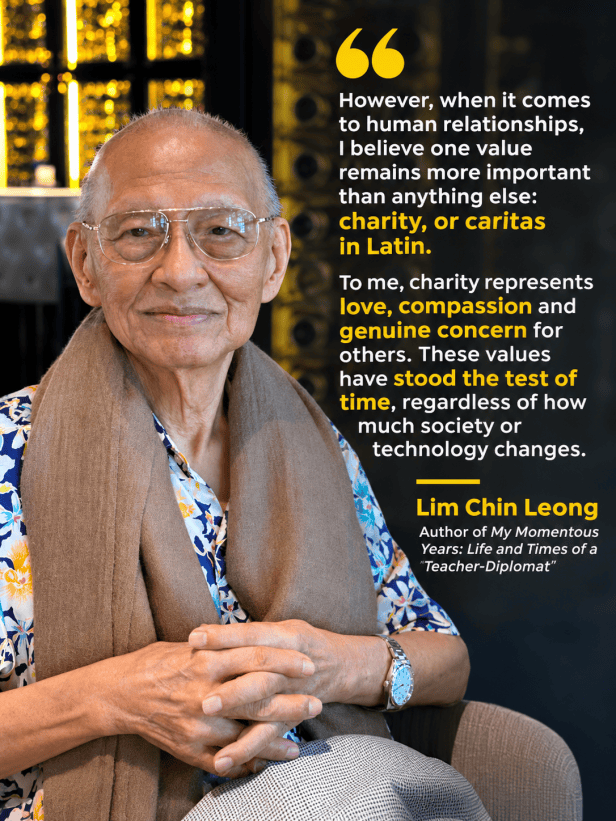
However, when it comes to human relationships, I believe one value remains more important than anything else: charity, or caritas in Latin.
To me, charity represents love, compassion and genuine concern for others. These values have stood the test of time, regardless of how much society or technology changes. They are central to my beliefs and, ultimately, to the purpose of my existence.
You have devoted much of your life to education, public service and writing. What continues to give you a sense of purpose, and what is the secret to living a meaningful life?
For me, the foundation of a meaningful life is love. I believe we should surround ourselves with people who share values such as compassion, charity and kindness.
Love is the most important element in human relationships. My faith has shaped this belief profoundly. I worship Jesus Christ because I believe He represents God’s love for humanity.
That message guides how I approach life and my relationships with others. At this stage of my life, I believe our purpose should extend beyond personal achievements. What matters most is how we treat others and whether we live according to the values we profess.
What’s your vision for Singapore in the next five years?
My fundamental vision for Singapore hasn’t changed. I believe the principles that guided our nation-building efforts remain important today. Good governance, responsibility and concern for others should continue to shape our society.
Personally, my Christian faith also influences how I view Singapore’s future. I believe love and forgiveness are essential values, not only in personal relationships but also in building a harmonious community.
The Bible teaches us to love one another and forgive those who have wronged us. These are principles I hold deeply. Whatever changes Singapore experiences in the coming years, I hope we continue to value compassion, forgiveness and mutual respect.
To me, these qualities are just as important as economic progress.
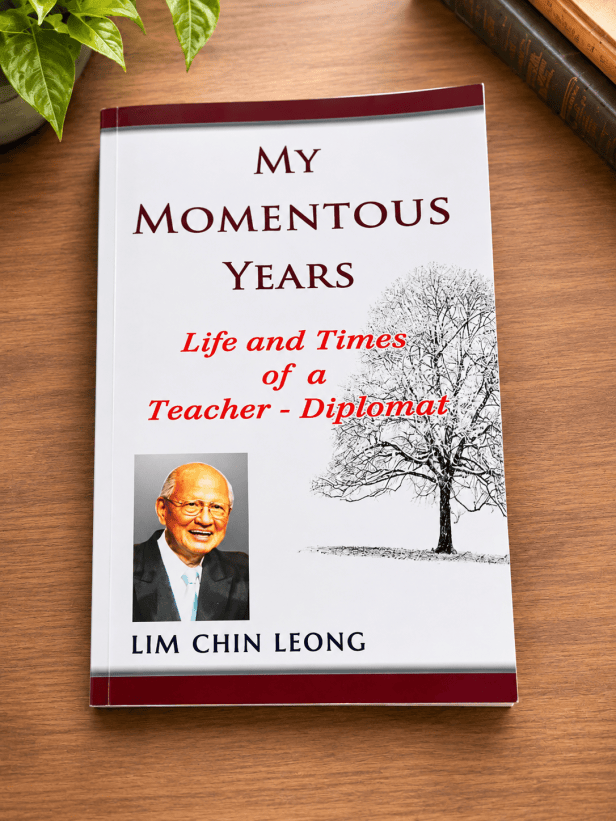
Lim Chin Leong is the author of My Momentous Years: Life and Times of a Teacher-Diplomat, a memoir chronicling his remarkable journey from teaching to diplomacy, alongside his personal experiences and reflections on Singapore’s development over the decades. His book is available at Books Kinokuniya, Ngee Ann City, Orchard Road, Singapore.
