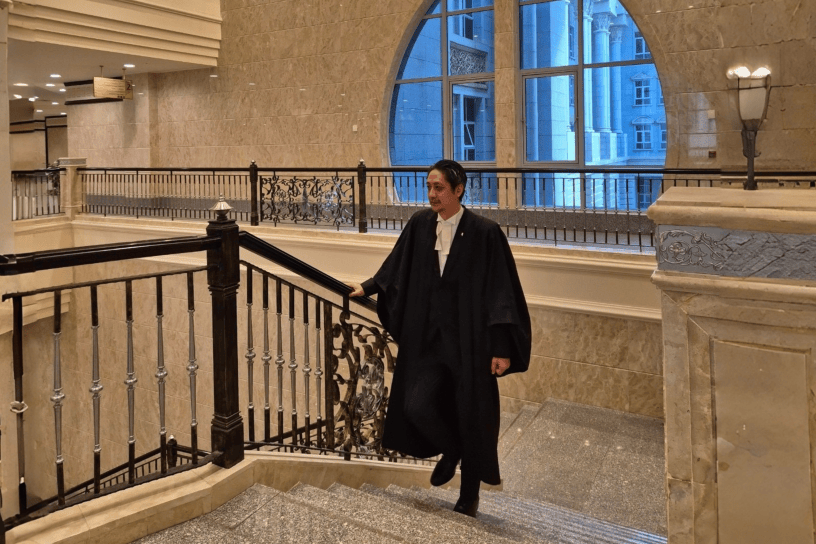
With around three decades of legal experience and more than two decades at Tay & Partners, Leonard Yeoh has built a distinguished career in dispute resolution. Having represented clients in courts across Singapore and Malaysia, as well as in regional arbitrations, he has witnessed how legal disputes can affect businesses, livelihoods and entire communities. For Leonard, litigation is not simply about winning cases but helping clients regain certainty and move forward.
Beyond the courtroom, Leonard believes that sound judgement, persuasion and an understanding of human nature are essential qualities of a successful lawyer. As artificial intelligence reshapes the legal profession, he remains committed to developing the next generation of lawyers while recognising that professional achievements mean little without the relationships and experiences that give life meaning.
You have spent around three decades in law and more than two decades with Tay & Partners. What first attracted you to litigation, and what has kept you interested after all these years?
I knew early on that I wanted a career where I would be judged on my own work and could build something independently. Law offered that opportunity.
I remained in litigation after my pupillage because I genuinely enjoyed it. The 1997 Asian Financial Crisis reinforced my decision. I watched previously successful practices struggle, while disputes multiplied as businesses faced financial pressure.
The same happened during COVID-19 in 2020, when our dispute resolution practice experienced its strongest year. When business is good, disagreements are often tolerated. When money becomes tight, contracts fail, payments stop and relationships deteriorate. That is when disputes lawyers become particularly valuable.
Our role is not simply to fight. It is to help clients recover payments, restart stalled projects and make informed decisions.
Having litigated at every level of the Malaysian and Singaporean court hierarchies and in regional arbitrations, I have learnt that disputes affect far more than the parties named in a case. A construction dispute can threaten thousands of livelihoods. A shareholders’ disagreement can determine whether a company survives.
Seeing businesses resume operations and people regain certainty after a dispute is resolved remains deeply rewarding. After thirty years, that is still what motivates me.
What have years of conflict taught you about human nature that law school never could?
Two intelligent, decent people can examine exactly the same facts and both genuinely believe they have been wronged. Law school teaches you to identify legal issues, but those issues are often only a small part of the conflict.
In shareholders’ disputes, the legal arguments may concern valuation or control. Underneath, however, there is often a sense of betrayal between people who once trusted each other. People frequently want acknowledgement before compensation. If you overlook that emotional dimension, winning the legal argument may achieve very little.
I have also learnt that decent people can behave badly under pressure. Fear of losing a business, being exposed or admitting mistakes can lead people to act in ways they never imagined.
These experiences have made me less judgemental. Everyone has a breaking point. My responsibility is to understand their circumstances and help them find a way forward.
How do you decide when a client should fight all the way and when settling is the smarter decision?
I begin by asking, “What would winning actually look like for you?”
We then consider the evidence, chances of success, financial costs, management time and long-term consequences. Being right and being better off are not necessarily the same thing. Sometimes, a reasonable settlement provides something that a judgement years later cannot: the opportunity to move on.
However, there are situations where settling creates greater problems. If a business gives in to a baseless claim, it may encourage others to make similar demands. Conceding an important contractual principle could also expose the company to future disputes.
In those circumstances, proceeding to trial may be necessary to protect the business.
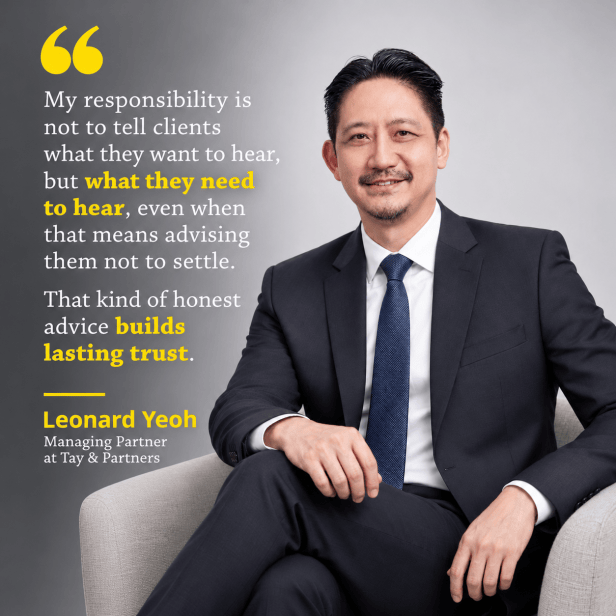
My responsibility is not to tell clients what they want to hear, but what they need to hear, even when that means advising them not to settle. That kind of honest advice builds lasting trust.
AI is increasingly capable of researching cases, reviewing documents and drafting legal work. What will remain uniquely valuable about a great lawyer?
Two things: judgement and the art of persuasion. AI will transform the legal profession, particularly routine, high-volume work. Clients should not have to pay lawyers for tasks that technology can perform more efficiently.
However, clients facing difficult decisions need more than information. They need someone who understands the consequences, evaluates the risks and is prepared to stand behind their advice.
That is judgement.
Persuasion is equally important. AI may produce an accurate legal submission, but that does not mean it can convince a judge. Effective advocacy involves reading the room, recognising when a witness is about to reveal something important and knowing when silence is more powerful than another argument.
These instincts develop through years of courtroom experience. In the end, lawyers must recognise that their value lies not in the hours spent producing documents, but in their judgement and ability to persuade.
What matters more to you now: building Tay & Partners for the next generation or developing lawyers who may eventually become better than you?
I have never considered those two separate responsibilities.
If I develop lawyers who eventually become better than me, I will have accomplished much of what is needed to secure the firm’s future.
Having spent almost a quarter of a century at Tay & Partners, I care more about what the firm will look like in fifteen years than its immediate achievements. That means giving younger lawyers genuine responsibility and allowing them to make occasional mistakes.
I also want them to understand our decisions and feel confident enough to challenge me when they believe there is a better approach. If every difficult decision still needs to reach my desk fifteen years from now, that would represent a failure of leadership rather than an achievement.
If you could meet your younger self, what would you tell him?
I would tell him to look up occasionally. During your twenties and thirties, you become so focused on achieving the next milestone that you overlook much of what is happening around you.
The important case, promotion or recognition eventually arrives, but the satisfaction is often brief before another ambition takes its place.
Looking back, I remember the people more clearly than the cases: the mentor who guided me, colleagues who worked late into the night and moments at home when I should have been more present. I would also remind my younger self to make time for sleep, exercise and meaningful relationships.
A litigator’s workload will always expand to fill the available time. If you wait until work becomes less demanding before looking after yourself, you may wait your entire career. Would my younger self have listened? Probably not. But the advice would still have been worth giving.
If you could have a superpower for one day, what would it be and why?
I would choose the ability to pause time for everyone except myself.
Not to get ahead with work, but to walk through the office and truly notice the people around me. The paralegal who always arrives first. The auntie cleaning a desk without receiving thanks. The junior lawyer struggling through a difficult submission.
We move through life so quickly that we sometimes stop noticing the people who make it meaningful. Then I would unpause time, return to being late for everything like everyone else, and simply be a little more grateful for the noise.
Connect with Leonard: Tay&Partners and Linkedin.