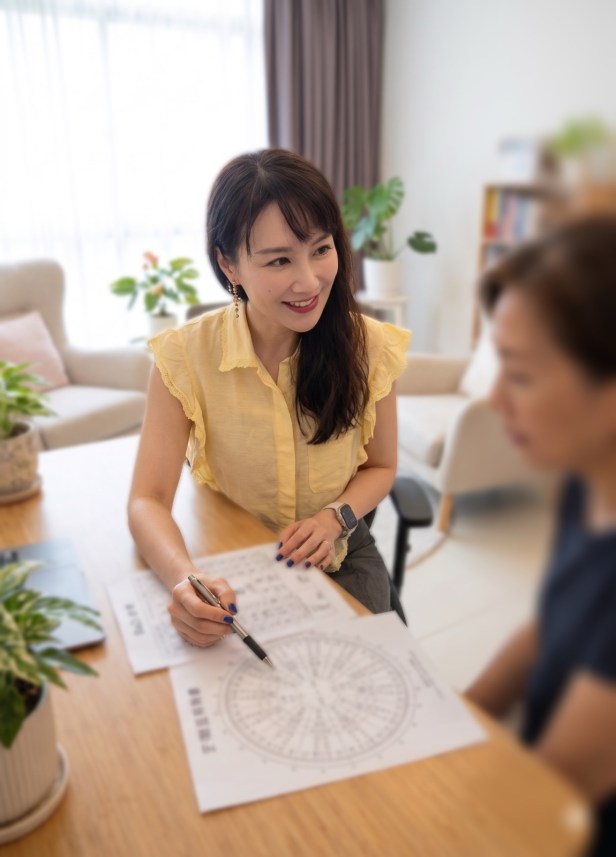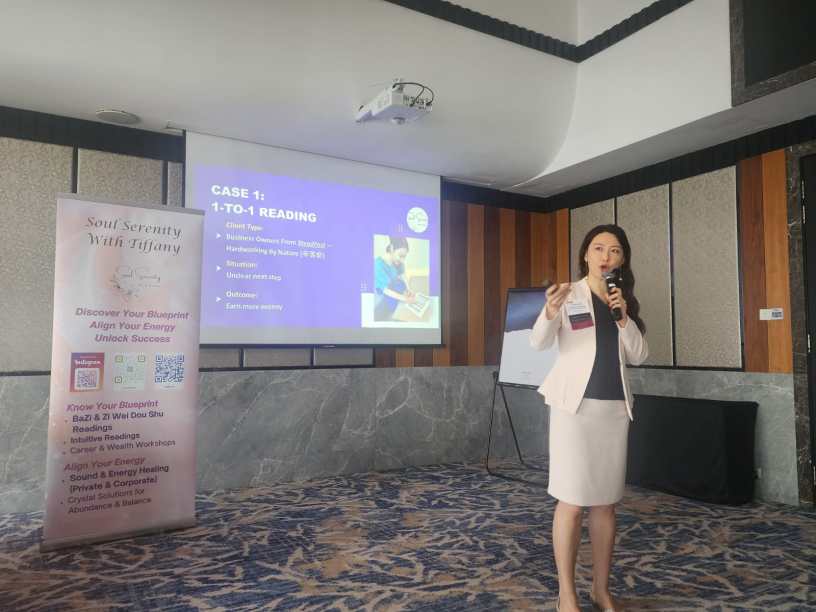
From journalism to education and Chinese metaphysics, Tiffany Sou has built a career around two enduring passions: understanding people and sharing knowledge. Having worked as a news reporter and spent a decade running a tuition business in Hong Kong, she now draws upon her academic background in educational psychology and Chinese literature to teach BaZi and Zi Wei Dou Shu, making complex traditional concepts more accessible to modern audiences.
Rather than viewing Chinese metaphysics as a means of predicting an unavoidable future, Tiffany believes it can offer perspectives on personal strengths, weaknesses and life choices. Through her consultations and educational programmes, she hopes to challenge common misconceptions and encourage a more analytical approach to these ancient systems. Today, she discusses her career transitions, the importance of practical judgement, meaningful business relationships and her ambition to promote Chinese metaphysics education in Singapore.
You began your career as a news reporter before spending a decade running a tuition business and eventually entering the metaphyics industry. What connects these seemingly different career paths, and what have they taught you about yourself?
Although these careers may appear unrelated, I have discovered two common threads: curiosity about people and a passion for sharing knowledge.
As a journalist, I needed to ask meaningful questions and understand different perspectives. As a teacher, I needed empathy to understand why students struggled and how I could explain things more effectively. The same curiosity drives my work in Chinese metaphysics today.
I have also realised that I genuinely enjoy simplifying complicated subjects. Journalists must explain complex events to the public, while teachers break down difficult concepts for students.
Chinese metaphysics is particularly challenging because many classical Chinese texts contain concepts that aren’t clearly defined or quantified. My role is to study these traditional teachings, interpret their meanings and explain them in ways that people can understand. I have learnt that I love understanding people and making knowledge more accessible.
Your current work draws upon traditional Chinese metaphysics and your academic background in educational psychology and Chinese literature. How have these disciplines shaped your approach?
I hold two master’s degrees, one in educational psychology and another in Chinese literature. Both have contributed significantly to my current work. Educational psychology helps me understand how people learn, allowing me to communicate complicated concepts more effectively.
Meanwhile, my Chinese literature background enables me to read and interpret original classical texts on Chinese metaphysics. Many practitioners acquire their knowledge primarily through their masters. I have also studied under several teachers, but I believe reading the original texts is equally important.
When knowledge passes from one generation to another, interpretations can change or become distorted. By examining the original sources, I can better understand the underlying principles and develop my own interpretations. My approach is therefore based on structured learning, classical research and careful analysis rather than relying purely on intuition.
What are the most common misunderstandings people have about Chinese metaphysics that you wish to address?
The biggest misconception is that our fate is predetermined. I believe a BaZi chart indicates tendencies, including our strengths, weaknesses, talents and potential paths to success, rather than dictating our future. People with similar charts can lead very different lives because our choices matter.
Another misconception involves annual zodiac predictions. A BaZi chart consists of four pillars, and the birth-year animal represents only one part. Predicting someone’s luck based solely on their birth year is therefore an oversimplification.
I also disagree with advice suggesting that someone lacking the water element should simply swim more. Water may symbolise qualities such as intelligence, communication or quick thinking. Developing these qualities is more meaningful than focusing on external activities.
I believe Chinese metaphysics should promote self-awareness and informed decisions rather than blind acceptance of predictions.
Where can Chinese metaphysics offer useful perspectives, and how should people balance such guidance with practical judgement and rational decision-making?
I believe guidance should be grounded in a person’s circumstances. Before each consultation, I learn about my clients’ concerns and backgrounds, researching unfamiliar industries to provide practical, relevant advice.
It’s irresponsible to predict poor luck without offering solutions. For example, even if a chart suggests favourable property opportunities, I wouldn’t recommend buying or selling without understanding the client’s plans and circumstances.
My goal is to help clients make informed decisions that suit their needs. Metaphysical guidance should complement practical judgement, not replace it.
Many entrepreneurs approach networking as a way to generate sales and referrals. What distinguishes a genuinely meaningful business relationship from one that is purely transactional?
A transactional relationship focuses on closing a sale quickly, while a meaningful one begins with genuine curiosity and understanding.
Everyone has unique circumstances and aspirations. By understanding my clients beyond their charts, I can provide personalised guidance that supports their long-term planning.
For example, I examine their ten-year cycles rather than encouraging annual consultations simply to generate repeat business. I prefer empowering clients with knowledge they can use independently. To me, meaningful relationships are built on sincerity, trust and long-term value rather than immediate sales.
If you could sit down with anyone for an hour, whom would you choose, and what would you discuss?
I would choose an influential Chinese metaphysics scholar (袁樹珊) who lived approximately 150 years ago. He contributed important practical perspectives to BaZi interpretation, including how to calculate charts for people born late at night and those living in the Southern Hemisphere.
For example, he proposed particular approaches to determining the day master for people born around 11 pm and manually adjusting charts for those born in countries such as Australia and New Zealand.
These technical considerations interest me because they address questions that older classical texts did not always explain clearly. I see him as an important figure who helped bridge traditional teachings and more modern interpretations. I would love to understand his reasoning and discuss how he approached these complex technical questions.
What’s your vision for Singapore in the next five years?
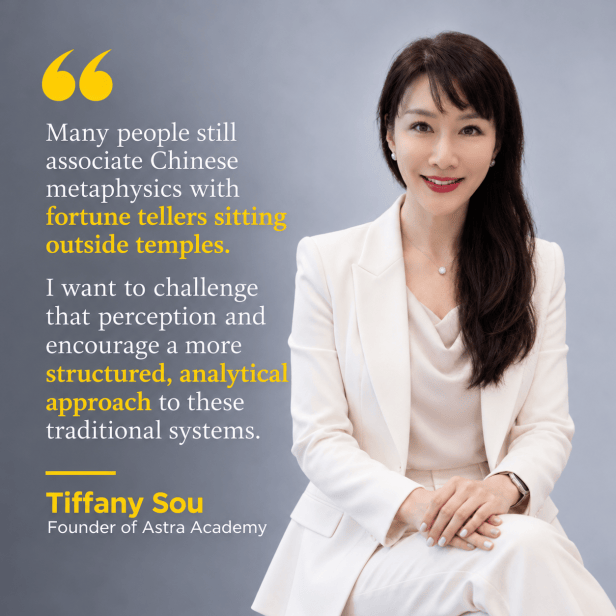
I hope more Singaporeans will develop a better understanding of BaZi and Zi Wei Dou Shu. Many people still associate Chinese metaphysics with fortune tellers sitting outside temples. I want to challenge that perception and encourage a more structured, analytical approach to these traditional systems.
I see BaZi and Zi Wei Dou Shu as frameworks for identifying tendencies and understanding individual characteristics rather than simply predicting fortune. I’m already working towards this vision by establishing an academy and conducting classes ranging from beginner to professional levels.
My ambition extends beyond providing consultations. I want to share knowledge, develop capable practitioners and make Chinese metaphysics more accessible to people who are genuinely interested in learning.
If you could have a superpower for one day, what would it be and why?
I would choose the ability to see someone through another person’s perspective. Many conflicts arise because we judge others based on our own experiences and beliefs.
Something that seems wrong to us may make sense when viewed from another person’s circumstances. If I could understand how different people perceive one another, I believe there would be fewer misunderstandings and conflicts. It would also help me understand my clients more deeply and offer guidance with greater empathy.
Connect with Tiffany: Instagram, Facebook and TikTok.