Hardik Dobariya’s entrepreneurial journey began with a problem he experienced firsthand. While working at a quantum computing start-up in Toronto, he saw brilliant scientists design cutting-edge hardware, only to wait months for the custom components needed to turn those designs into reality. The contrast between the speed of software development and the slow, fragmented nature of hardware manufacturing convinced him that there had to be a better way.
That experience eventually led to Factorem, a manufacturing platform that uses AI across areas such as quoting, supplier matching and design-for-manufacturing checks. Today, the company supports businesses working in fields including quantum technology, robotics, photonics and space technology, while positioning Singapore and Southeast Asia as an important part of the global advanced manufacturing ecosystem.
While working at a quantum computing start-up in Toronto, you struggled to source custom components. What was broken about traditional manufacturing that made you think there had to be a better way?
I was the only non-founder at the quantum start-up, working alongside quantum scientists designing state-of-the-art hardware. The challenge wasn’t the designs, but finding the right people to manufacture them. Working across software and hardware, I saw a huge disparity. Software could be fixed and updated within a day, while hardware could take three months to produce.
We started speaking to other companies and realised it was a common issue. We then looked at whether the problem was actually solvable and found organisations that had developed best-in-class ways of managing supply chains.
We took those principles and applied them to other companies. That eventually became a system, and today, that system is our product.
Factorem uses AI for quoting, supplier matching and design-for-manufacturing checks. Where can AI genuinely transform manufacturing rather than simply become a buzzword?
Manufacturing covers everything from design and finding the right supplier to actually making the component and handling logistics. There are many different segments, and AI has the greatest potential in areas where processes are repeatable. The challenge is that if you ask engineers or supply chain professionals to identify that repeatability, it can be difficult.
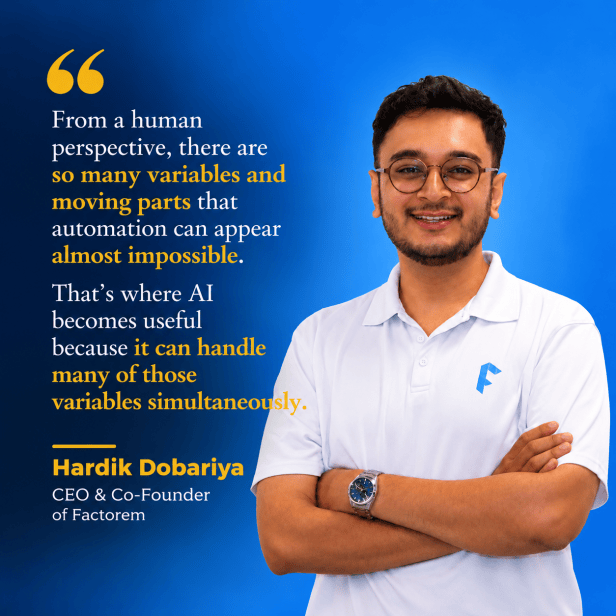
From a human perspective, there are so many variables and moving parts that automation can appear almost impossible. That’s where AI becomes useful because it can handle many of those variables simultaneously.
Pricing is a good example. It can be a function of around 85 different variables. Give that task to a person and it could take days. Give it to the right AI model and you can potentially complete it in seconds.
Factorem supports companies in robotics, photonics and quantum technology. What is one of the most exciting things you have helped build through your network that made you think, “We’re helping make the future possible”?
That’s probably one of the best parts of our job. One of the most exciting recent projects was a quantum fridge for a customer in Colorado. A quantum fridge is somewhat like the refrigerator you have at home, except it can reach temperatures close to minus 273 degrees Celsius. That extremely cold environment is required to support superconducting quantum bits.
We also manufacture components for space technology. We don’t do a huge amount of 3D printing, but when we do, it’s often for space applications. For example, we can manufacture heat sinks with structures that look almost alien because they would be extremely difficult for a human to design and impossible to produce using many traditional manufacturing methods.
AI can help design these structures, which can then be produced through metal 3D printing. It’s exciting because we’re seeing many new technologies being pieced together to create things that weren’t previously possible.
Factorem has expanded from Southeast Asia into the US market. Where do you see Singapore and Southeast Asia fitting into a global supply chain that has traditionally depended heavily on China?
Southeast Asian companies still rely heavily on China, and there’s no doubt that China’s manufacturing capabilities are elite. However, China is no longer necessarily where you go for the cheapest components, except perhaps when you’re manufacturing at very high volumes.
Factorem focuses on high-precision, low-volume manufacturing. Our clients work in deep technology, including quantum technology, space technology, photonics and robotics. These companies aren’t necessarily manufacturing millions of products. They might be producing 10 satellites a month, for example, and they need those 10 to be made extremely well and quickly, while protecting their intellectual property.
They also want to minimise issues involving trade, tariffs and cross-border logistics. That creates a strong case for manufacturing components closer to their final destination or in a stable and reliable location.
Today, more than 80% of the orders we handle are manufactured here in Singapore.
You have written about taking the path of most resistance. From engineering student to working professional and now CEO, why can choosing the harder path sometimes create the greatest opportunities?
I believe taking the harder path before 30 can create greater opportunities, provided the challenges are meaningful. In your 20s, you generally have less to lose, more energy and fewer competitors willing to take that route.
Entering manufacturing meant working alongside people two or three times my age. Despite experiencing imposter syndrome, I brought a fresh perspective.
Ultimately, conviction comes from customers recognising your product’s value. Even a few early believers can keep you motivated. What matters is overcoming challenges while creating genuine value for others.
As technology becomes more powerful, what do you think leaders should become more responsible for rather than less?
One of the biggest fears today is that AI will replace jobs. Leaders must address this honestly by explaining how their organisations will evolve and how employees can contribute to that future.
Human talent remains essential, but employees need opportunities to develop new skills. Leaders should provide time and support for experimentation, perhaps dedicating one day a week to exploring AI tools.
For SMEs and start-ups, this learning time can be spread across the week to minimise disruption. Ultimately, leadership should focus on developing people rather than simply using AI to reduce headcount.
What is your vision for Singapore in the next five years?
I think Singapore will continue doubling down on something we’re already very good at — creating an aura of trust and reliability, almost like a Swiss effect. That’s going to become even more important in a world where AI is increasingly prominent and people aren’t always sure who or what they can trust.
I believe anything carrying a Singapore brand or stamp can increasingly represent something people feel confident trusting. Maintaining that reputation may sometimes require Singapore companies to take the harder path, but I think it will be worth it in the long term.
If you could have a superpower for one day, what would it be and why?
Teleportation. It’s actually a superpower I think I would want for life, although I’m sometimes doubtful because I enjoy the breaks that come with commuting. It’s one of the few times when I don’t have to think about getting somewhere and can let someone else take control of the journey.
Teleportation would eliminate those breaks entirely, so I’m not sure I would want it permanently. But if it’s only for one day, teleportation would definitely be a good superpower to try.
Connect with Hardik: LinkedIn.