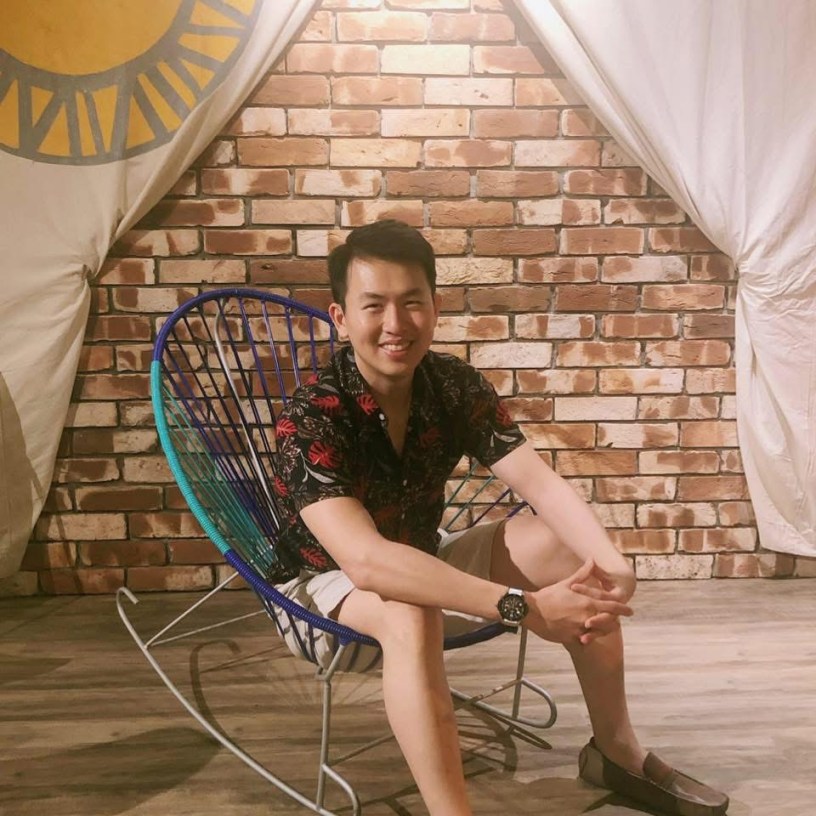
For Xavier, entrepreneurship is not simply about building profitable companies. It is about creating a life around work that he genuinely enjoys. Through Maverick Endeavours, he has built and invested in businesses spanning hospitality, longevity, regenerative medicine, wellness and investments, guided by the belief that meaningful work should bring out the best version of oneself.
His journey has taken him from construction and fund management to luxury hospitality in the Maldives and regenerative medicine through ExoThera. Across these ventures, Xavier looks for the same balance: strong commercial fundamentals, meaningful impact and the potential to improve people’s lives.
You co-founded Maverick Endeavours, and your portfolio spans luxury hospitality, regenerative medicine, wellness and investments. What is the common thread connecting every business you choose to build or invest in?
My philosophy is that you only live once. Work takes up a large part of our lives, so I want to spend that time doing something I genuinely enjoy.
Earlier in my career, I worked in construction and later ran a fund management business. While I enjoyed investing and learning how to structure deals and allocate capital, I began to wonder whether I could spend my time working on something more personally meaningful. After exiting the fund, I had the opportunity to start again and focus on work that was meaningful to me.
Three things matter most. First, I want challenging work because entrepreneurship brings out the best version of me. Second, I enjoy taking care of people, which is what attracts me to hospitality. Third, I am passionate about wellness, longevity and regeneration because they allow me to improve my own well-being while helping those around me.
That is how Maverick Endeavours came about: building businesses around things I genuinely enjoy while creating value for others.
Your investment philosophy focuses on strong fundamentals while improving people’s lives. When evaluating a new opportunity, which matters more: commercial potential or positive impact?
I think commercial potential and positive impact are equally important. Making money matters because the business must be sustainable, but creating genuine value for people is equally important.
Hospitality is a good example. The better we make guests feel, the more likely they are to return. At Ellaidhoo, some guests have returned many times, including one who visited around 30 times. We also had a 83-year-old guest who continued returning after his wife passed away because of their strong emotional connection with the resort.
This shows that commercial success and positive impact can go hand in hand. When you genuinely take care of people, they remember the experience and want to return.
The Maldives is one of the world’s most competitive luxury hospitality destinations. What attracted you to invest there, and what gave you the confidence to enter such a competitive market?
I was fortunate to understand the Maldives from both tourism and business perspectives. I first visited in 2013, and my current business partner was already involved in hospitality, giving me deeper insight into the market.
Even in 2014, before much of the newer infrastructure was developed, I could see the tremendous potential of Maldivian tourism. It is one of the world’s most profitable hospitality markets, although operating there can be challenging.
For years, I struggled to find the right entry point. That changed during COVID. When we exited our fund in 2022, hospitality valuations were extremely depressed, creating an opportunity to invest at COVID-era valuations while potentially earning pre-COVID revenues once tourism recovered.
I would say 51% of the decision was luck because the timing was so favourable. Today, the business is already achieving numbers we originally expected much later. Entering at the right valuation made a tremendous difference.
Through ExoThera, you are working in regenerative medicine, an area many people are only beginning to understand. What convinced you that this could fundamentally change people’s lives?
My interest began through firsthand experiences. I had family members suffering from knee and back pain, friends seeking aesthetic solutions, and I personally went through three sports-related concussions within two months. When I discovered regenerative technologies such as stem cells and exosomes, I saw their potential up close. Since starting the business, I have personally observed more than 100 cases across aesthetics, orthopaedics, spinal and neurological conditions, with many positive outcomes.
The technology is not new, but decades of research are now reaching maturity, and after COVID, people are far more conscious of their health. I believe regenerative medicine could become mainstream within the next three to five years.
But the more I explored the space, the more I realised that the real challenge was not the science itself, but building trust. Across Southeast Asia, this field is largely unregulated. The same treatment might cost $6,000 at one clinic and $25,000 at another, and patients have no way of knowing what they are actually getting. That is what ExoThera was built to solve.
Our goal is to become the most trusted name in regenerative medicine by applying a Singapore standard of certainty to a market that lacks it. Our scientific director, Dr. Keith Chong, audits and approves every product in our supply chain, while our medical director, Dr. Chua Kok Seng — a physician at Gleneagles Hospital and a veteran of regenerative medicine — designs our treatment, pre-treatment and post-treatment protocols.
We also brought costs down by 50 to 80% from where we started, not by cutting corners, but by improving our sourcing and process — so that certainty and value can go together.
When someone hears ExoThera, I want them to feel one thing: this is clearly the best decision I am making for my health.
What has been the biggest lesson that shaped your entrepreneurial journey, not because it generated the greatest financial return, but because it changed the way you see business and life?
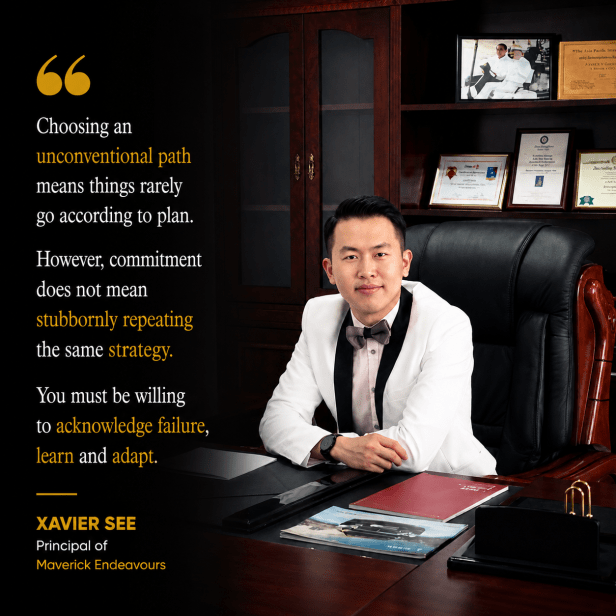
I think the biggest lesson has been commitment. There were many times when I wanted to give up, but I chose to continue. That is also why I called the company Maverick Endeavours: “Maverick” represents doing something unconventional, while “endeavours” represents commitment.
Choosing an unconventional path means things rarely go according to plan. However, commitment does not mean stubbornly repeating the same strategy. You must be willing to acknowledge failure, learn and adapt.
ExoThera, for example, went through multiple iterations. We initially worked with products costing eight to ten times more than the market, but through repeated improvements, we reduced costs by around 80 to 90% and improved the supply chain.
The biggest decision was choosing to remain committed while constantly asking, “Can we do this better?”
Where do you see yourself 10 years from now?
I have tried answering this question many times, but I rarely end up doing exactly what I imagined 10 years earlier.
I hope to eventually bring together what we are learning across hospitality, longevity, wellness, regenerative medicine and travel. People are becoming more intentional about travelling, shifting from simply escaping and letting loose towards recovering, recharging and taking better care of themselves.
Modern life places enormous demands on us, contributing to stress and burnout. I believe this will further change how people travel.
My hope is to combine our experience across these industries to create something that fundamentally transforms the way people experience travel.
What is your vision for Singapore over the next five years?
My hope is that Singapore becomes more open to different voices, perspectives and ideas. Having lived in different countries for around nine years, I have seen that Singaporeans are hardworking, ambitious and capable, although living in a small, structured country can sometimes limit our exposure to the wider world.
Real-world experience teaches lessons that education alone cannot provide. Just as you cannot learn to ride a bicycle purely from a textbook, sometimes you need to experience things firsthand.
I hope Singapore becomes more comfortable acknowledging mistakes and accepting failure. People who take risks should not be shamed when things do not work out. Our leaders can also set an example by acknowledging mistakes and demonstrating how we learn from them.
Ultimately, I hope Singapore develops a culture that embraces experimentation, honest reflection and learning from failure.
If you could have one superpower for a day, what would it be and why?
I already feel incredibly fortunate and genuinely love where I am in life, so there is little I would wish for personally.
If I could choose one ability, it would be to instantly build an exceptional team around me. Using the Avengers as an analogy, I would want my own Tony Stark, Hulk, Thor and Black Panther—people with complementary strengths who are fully aligned around a shared mission.
Finding and developing people who share your vision and can execute it well is incredibly difficult. Creating that kind of team would be the ability I would choose.
Connect with Xavier: MaverickEndeavours, ExoThera and LinkedIn.
Xavier is a member of Rainmaker, a revolutionary movement that rallies like-minded people together based on the values of Love, Authenticity, Respect, Kindness and Youthfulness (LARKY).
Health Advice Disclaimer
The information provided on this platform is for educational and informational purposes only. It is not intended as medical advice, diagnosis, or treatment, and should not be relied upon as a substitute for professional medical consultation, advice, or treatment from a qualified healthcare provider.
In Singapore, all health-related content is to be understood as general wellness information and not a substitute for medical consultation. Individuals are encouraged to seek advice from a registered medical practitioner under the Ministry of Health (MOH) before making any healthcare decisions.
