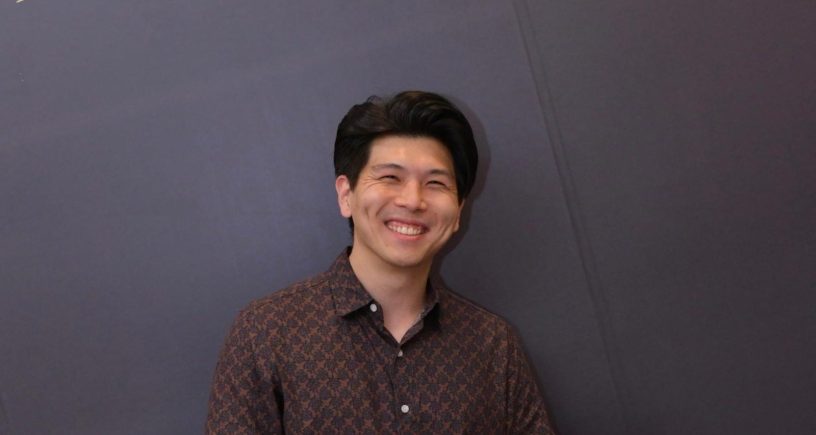
Seth’s journey into digital marketing began with a steep learning curve. Despite having studied mass communication and basic website development, he quickly discovered that modern search engine optimisation involves far more than inserting keywords or publishing occasional articles. It requires a clear understanding of Google’s evolving standards, market-specific search behaviour and the technical foundations behind online visibility.
Today, Seth works with Weave Asia and is progressing towards becoming a partner in the company. Through his work, he helps businesses understand SEO, prepare for AI-driven search and develop practical digital strategies for expanding across Asia’s diverse markets.
What inspired you to join Weave Asia?
What inspired me to join Weave Asia was the legitimacy and authenticity of the company. By observing its people-first culture, I noticed that many team members had remained loyal to the company, with some having been there for more than three years and others for over six years.
Another group of people I observed was the clients. Some of them were people I already knew, which allowed me to understand the business from the client’s perspective.
These observations made me feel very comfortable and confident about joining Weave Asia.
What were some of the biggest challenges you faced during your early years in the company?
One of the biggest challenges was understanding what SEO truly involved. Although I had learnt basic SEO while studying mass communication around 2013, the industry was still relatively new and far simpler than it is today.
Previously, businesses could rank by inserting keywords and publishing articles. Today, Google updates its algorithms regularly, and websites must meet stricter technical, content and credibility standards.
I eventually realised that SEO follows Google’s requirements, not an agency’s preferences. It is like sitting an examination: if you do not meet the criteria, you will not rank.
Before joining the industry, I assumed SEO could be handled independently. After seeing the work behind the scenes, I understood how much technical knowledge, research and consistent effort effective SEO requires.
Weave Asia aims to help businesses navigate Asian markets. Why do Asian markets require a different digital marketing approach from Western markets?
Many businesses assume that because the internet is global, their content will automatically reach an international audience. In reality, Google organises search results by location, with each country operating as its own digital market.
I often compare Google to a library with separate shelves for different countries. It first searches the shelf that is most relevant to the user’s location.
For businesses expanding overseas, this means local SEO is essential. A Singapore company targeting Australia, for example, must build visibility through Australian platforms, publications and content. Every market has its own digital ecosystem, so each requires a tailored strategy.
SEO has changed dramatically over the past decade. What are some of the biggest misconceptions businesses still have about it?
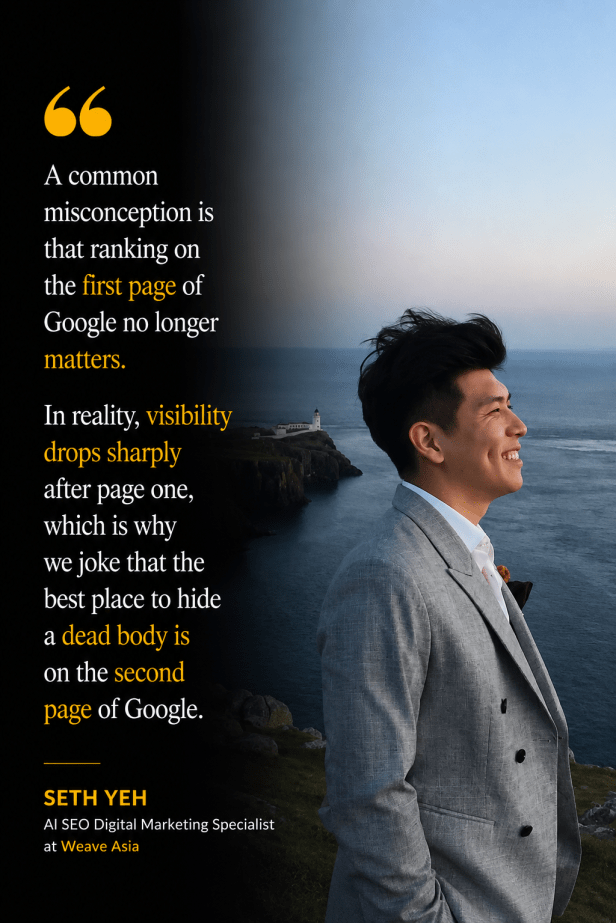
A common misconception is that ranking on the first page of Google no longer matters. In reality, visibility drops sharply after page one, which is why we joke that the best place to hide a dead body is on the second page of Google.
Another misconception is that Generative Engine Optimisation (GEO) has replaced SEO. AI platforms such as ChatGPT, Claude and Gemini still rely heavily on information from websites and search engines, making SEO the foundation for AI visibility.
I often compare GEO to a rooftop garden. It may be attractive, but it cannot exist without a strong building beneath it. Likewise, GEO works best when supported by solid SEO.
Businesses should also recognise that people search differently on Google and AI platforms. Google users typically enter keywords, while AI users ask conversational questions. To succeed, businesses should optimise for both while maintaining credible, high-quality content.
What advice would you give business owners who feel overwhelmed by the constant changes in digital marketing?
My advice is to take things one step at a time. Digital marketing covers websites, SEO, paid advertising, social media and e-commerce, so trying to master everything at once can quickly become overwhelming.
Start with the basics. Build a functional website, learn fundamental SEO and focus on the platforms where your target customers are most active. A food business, for example, may benefit more from TikTok, while others may see better results from Google Ads, Meta or long-term SEO.
Remember that SEO is a long-term investment, often taking six to twelve months to deliver strong results, while paid advertising offers faster visibility at an ongoing cost.
For businesses with limited budgets, learn the basics yourself, use website builders such as Squarespace or Shopify, and seek help from freelancers or online communities like Reddit when needed. Develop a simple digital plan, start with one platform, and expand as your business grows.
If you had only one more day to live, what would you do?
I would spend the day with my family.
Ultimately, much of what we work towards is about creating a happier and more comfortable life for the people we love.
I would probably spend the day relaxing beside a swimming pool. My son enjoys swimming, while my wife loves reading, so she could sit nearby with a book. That would be a simple but meaningful final day for me.
What is your vision for Singapore in the next five years?
I believe SEO and digital marketing will continue evolving as AI search becomes more widely adopted. While more people will use AI tools, Google is likely to remain a trusted source, with many users still verifying AI-generated information through traditional search.
Over the next five years, I expect AI search to grow alongside conventional search rather than replace it. Consumer behaviour will change gradually, even as AI technology advances rapidly.
For businesses, this is a valuable opportunity. Much like the early days of the internet, companies should start building both their SEO and GEO foundations now. Those that begin early will gain stronger authority, greater visibility and a competitive advantage as AI increasingly references trusted, well-established websites.
If you could have a superpower for one day, what would it be and why?
I would choose the power to heal.
Health is something many people only appreciate after they lose it. Earlier in my life, I neglected my well-being through poor habits and a lack of exercise, until I realised how important good health truly is.
For the past seven or eight years, I have committed to living a healthier lifestyle through regular running and consistent self-care. Along the way, I also experienced a hip injury that reminded me how easily we can take our health and mobility for granted.
If I had the power to heal, I would use it to help people recover their health because good health allows us to care for our families, pursue our goals and enjoy life to the fullest.
Connect with Seth: WeaveAsia and Instagram.
