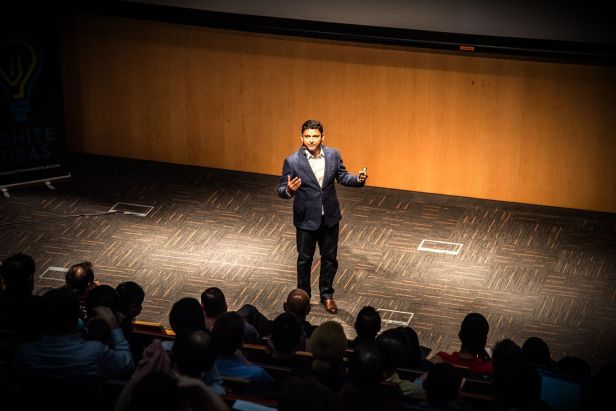
Meet Dean, who started his professional journey as a teacher before venturing into the unknown world of entrepreneurship. With no formal background in business or communications, he stumbled into public relations by chance—only to create one of Singapore’s most talked-about viral campaigns. Along the way, he learned that unconventional paths often lead to the most impactful stories.
Today, Dean is more than a PR strategist—he’s a corporate trainer, speaker, and advocate for introverted professionals who want to lead without pretending to be someone they’re not. His belief that “slow is still progress” drives both his work and his message: true influence comes not from being loud, but from being authentic.
You began your career as a teacher and later pivoted into entrepreneurship. What was the most difficult part of leaving the stability of teaching to explore something unknown?
The most difficult part was not knowing how to run a business. When I left teaching, I had zero experience in entrepreneurship. I didn’t know anything about managing a business—things like customer service, accounting, and marketing were all completely foreign to me. I attended some courses, but those only highlighted how much I didn’t know.
Back then, I wasn’t good at handling clients, even though I was running a learning centre and managing other teachers. I made mistakes—I said things I now know I shouldn’t have, simply because I was still viewing myself as a teacher, not as a business owner. That mindset held me back.
It was only after I closed the learning centre that I began to see myself more as an entrepreneur rather than a craftsman or subject specialist. That shift in identity was the hardest but most crucial part of the journey.
You stumbled into PR almost by accident and ended up creating a viral campaign. What do you think made the campaign resonate so widely?
The campaign came about quite organically. I was brainstorming with a client about how to position a psychology conference that focused on the science of happiness—what we now know as positive psychology. It was still a relatively new field at the time.
Instead of promoting the conference directly, we came up with a quirky idea: why not run a nationwide search for the happiest person in Singapore, and use that as the narrative vehicle to convey the conference themes? I wasn’t sure it would work—I was 50/50 on whether the media would embrace it or dismiss it as a gimmick.
But to my surprise, the media loved it. Radio shows were discussing it, and eventually, international outlets picked it up too. It taught me that sometimes the most unusual ideas can have the most impact. That said, not every client is open to something so unconventional—many prefer to play it safe. But in this case, taking a creative risk paid off.
How has your unconventional background, without a formal mass communication degree, become a strength in the PR and communications field?
I’ve always had a curious and creative mind, and that’s what initially drew me to PR. I didn’t know much about it at the start, but it intrigued me. After closing my learning centre, I had time and space to explore, and I became obsessed with understanding how the media works.
I began reading extensively—books on marketing, branding, and the psychology of influence. I didn’t see it as studying because I genuinely enjoyed the subjects. Without the structure of a formal education, I had the freedom to develop my own communication style. That independence allowed me to be more flexible and intuitive.
I believe that became my unique strength: I wasn’t bound by traditional frameworks, which allowed for greater creativity and adaptability in real-world scenarios.


From my own journey, I’ve learned that being introverted is not a disadvantage in entrepreneurship. In fact, I use the word “powerful” intentionally—because being a powerful entrepreneur isn’t about being loud or dominant.
Rediscovering your passion for corporate training was a pivotal moment. What role does public speaking play in your mission today?
Public speaking is essential for any business owner, no matter the industry. It’s one of the most effective ways to amplify your message. When I first started, my speaking style was very restrained—what I thought was “professional” at the time.
But after joining a speaker’s community and seeing others in action, I realised how engaging, energetic, and charismatic public speaking could be. I tried to mimic the loud, extroverted style of some speakers, but it didn’t work for me. I’m naturally introverted, and pretending to be someone I’m not felt inauthentic.
Over time, I learned to embrace my own style. Today, I’m confident in delivering impactful talks by simply being myself. I’ve received excellent feedback from my audiences, and that reinforces my belief that introverts can be powerful speakers in their own right.
Part of my mission now is to help other introverts realise they don’t need to “fix” themselves—they just need to recognise and use their strengths differently. I also want organisations to move past the “loud leader bias”—the idea that only outspoken people have leadership potential. Quiet team members have immense value and often lead in more subtle, insightful ways.
What advice would you give to aspiring entrepreneurs, especially introverts who want to step into visibility and leadership without losing themselves?
From my own journey, I’ve learned that being introverted is not a disadvantage in entrepreneurship. In fact, I use the word “powerful” intentionally—because being a powerful entrepreneur isn’t about being loud or dominant. It’s about staying resilient through ups and downs.
Introverts are often told they need to change—to speak up more or be more expressive—but that’s not true. You don’t need to be loud to make an impact. The traits introverts feel they lack are often just undeveloped skills.
Public speaking, influencing others—these are all learnable. It’s about becoming a better version of yourself, not pretending to be someone you’re not.
One key strategy is to schedule regular recharge time. Introverts gain energy from solitude, not socialising. This self-awareness helps maintain a sustainable pace on the long journey of entrepreneurship. I also strongly advise joining a community of fellow entrepreneurs. Only they will truly understand your struggles and triumphs.
Don’t rely solely on advice from family or ex-colleagues who haven’t walked this path. Finally, remember that not everything can be learned in a workshop. Real growth comes from lived experiences and conversations with people who’ve been there before.
What is the core belief that guides you, and how does it inspire you to be a light for others?
The belief that grounds me most is this: “Slow is still progress.” Entrepreneurship is like a rollercoaster—there are many moments when things don’t go our way, and we feel like failures. But those are just feelings, not facts.
On tough days, I tell myself to “just make it to midnight.” Tomorrow is a new day, and each step forward, no matter how small, counts. In today’s world, especially with social media, we’re constantly exposed to overnight success stories.
But we forget that slow, consistent progress is just as valid—if not more sustainable. That’s what I want to remind others of too.
What’s your vision for Singapore in the next five years?
This is a big question, and while I don’t claim to be especially influential, I do have a hope. I want Singapore to become a more caring society—one where people genuinely look out for one another.
I was very moved by what the Prime Minister shared during the recent National Day Rally, especially the idea of Singapore as a “we first society.” For once, the focus wasn’t just on economic growth but on building a nation with heart. That vision resonates deeply with me.
If you could have a superpower for one day, what would it be and why?
Definitely time travel. It’s such a fascinating concept. I’d want to go back in time—not to change anything necessarily, but to reflect on the decisions I’ve made and the paths I’ve taken, both good and bad. I think there’s so much value in learning from your past.
I wouldn’t want to jump ahead into the future. I prefer to use the past as a mirror to help me move forward more intentionally.
Connect with Dean: LinkedIn and Facebook.