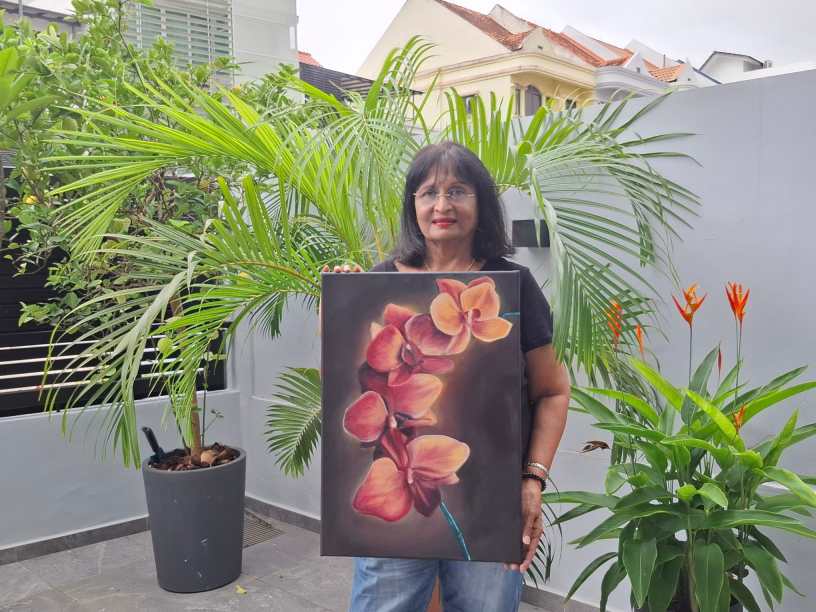
Meet Jasmin, a passionate Singaporean artist whose work spans portraits, Chinese painting, Peranakan themes, and vibrant local scenes. Through brushstrokes and textures, Jasmin expresses a profound sense of place, identity, and heritage—capturing not just what is seen, but what is felt.
Her art tells stories of belonging and transformation. Whether it’s the precision of Chinese brush painting, the familiarity of a neighbourhood street, or a Peranakan kebaya adorned with meaning, Jasmin’s creations speak to the soul. As she continues to experiment with new mediums and techniques, she remains devoted to keeping Singapore’s cultural tapestry alive—one meaningful piece at a time.
You have mentioned that you love doing portraits, Chinese painting and local scenes. So what draws you to these particular subjects and how do they reflect your identity as a Singaporean artist?
Portraits create a connection with individuals—with anyone, really. So when I do portraits, people tend to like them. When I give someone a portrait, or if I attend a live drawing class, there’s that connection. I feel a sense of oneness with them.
As for Chinese painting, my interest grew from teaching in various Chinese schools years ago. Back then, there were Chinese-stream schools, and I was exposed to Chinese painting—and Chinese calligraphy as well.
I tried my hand at calligraphy, but that requires daily practice and a lot of time. Since I engage in many different art forms, I couldn’t commit fully to that. But Chinese painting is fantastic—one stroke has to be precise to create the image. For example, when painting a cockerel, just a few strokes must capture the essence. It demands great skill.
As for local scenes, I like painting them because they represent my social environment—it’s what I know best and what I enjoy doing. It also helps promote Singapore’s history, in a way.
Can you describe an art piece that’s meaningful to you and why does it matter to you?
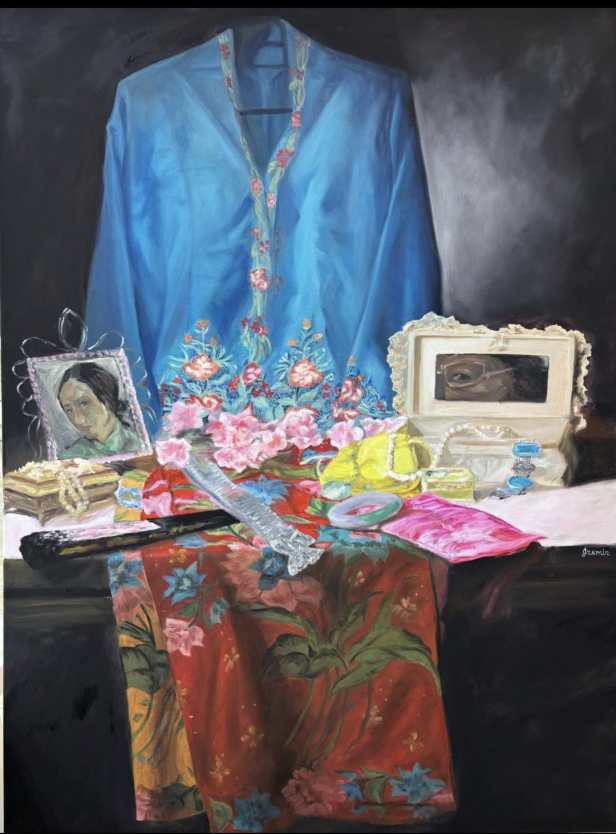
The most recent one I did—I gave it both a Peranakan name and a local name. I’m very pleased with this piece, which is for an upcoming exhibition. It’s called Cinta Tanpa Darah, Warisan Tanpa Jiwa, meaning “Love Without Blood, Heritage Without Soul.” It’s a large Peranakan-based work featuring a kebaya top and a sarong. It holds a lot of significance.
I used found objects commonly used by Peranakans. Although I’m not Peranakan or Chinese—I’m a minority in Singapore—I consider myself uniquely Singaporean. I grew up in a Peranakan enclave on Koon Seng Road, which is very famous and now one of the most Instagrammable streets in Singapore.
I’m familiar with Peranakan customs and attire. My three aunts, although not Peranakan, used to wear the kebaya. That inspired the piece. I also included Peranakan elements like the Bedak Sejuk or Sam Fong Hoi Tong powder—a very unique item.
During my research, I discovered it’s now used to polish silverware. This painting is deeply meaningful to me.
As a teacher, I used to teach art—and English as well. Our role as teachers is to promote learning and encourage students to be confident learners. That’s something I carry over into my painting practice. I strive to be the best version of myself.
As an ex-teacher, you made it a point to try various art forms that you mentioned. So how has that teaching experience influenced your own creative process today?
As a teacher, I used to teach art—and English as well. Our role as teachers is to promote learning and encourage students to be confident learners. That’s something I carry over into my painting practice. I strive to be the best version of myself.
Whatever I execute, I try my best. Nowadays, I apply this subconsciously. Creativity is important too—using found materials, for example. That promotes recycling, which I value.
If you could give one piece of advice to young, aspiring artists in Singapore, what would it be?
Paint what you love. Think of Van Gogh—during his lifetime, I believe he only sold one painting. Be inspired by the masters. Selling your work can be very difficult, even if you’re a good artist. That’s a reality young artists must face. So look up to senior artists for inspiration.
What values guide your work and how do they show up in your everyday actions?
I’ve always taught my students to be the best version of themselves—be kind, be nice, and be truthful. When painting, that means doing it yourself and not getting someone else to do it for you. Some artists do that, actually. But for me, it’s about loving what you do and staying honest.
What’s your vision for Singapore in the next five years?
I hope there’ll be more people who support the arts and local artists. Many senior artists—some in their 80s—have had to stop painting because they can’t afford it. They have stacks of paintings at home that they can’t sell. Exhibiting is expensive—sometimes $380 just to show one piece.
I hope the government or other organisations can step in to help struggling local artists. We’re now an art hub with many foreigners, but our local talents also need support. I’d love to see more art in hawker centres, HDB estates, government buildings—showcasing our own talents.
If you could have a superpower for one day, what would it be and why?
I would wish for the power to eradicate cancer. My mum had cancer and passed away within two weeks—it spread so quickly. It’s a silent killer. Many seniors are affected, and there’s no real cure. I hope for a cure or better preventive measures.
Connect with Jasmin: Instagram and Facebook.


Great work by Ex teacher👏👏👏🔥🔥🔥.
LikeLike