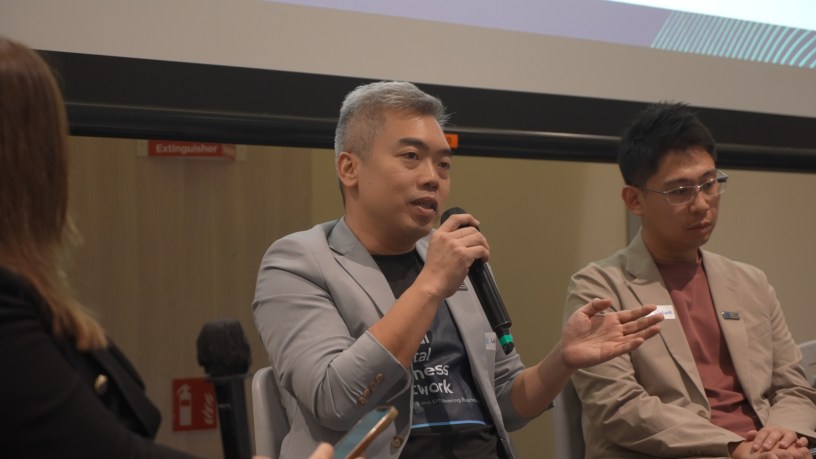
Meet Wee Kiat, the visionary founder of Global Digital Business Network (GDBN), who saw a critical gap in the business ecosystem—many SMEs and entrepreneurs were capable, but lacked the right platform to grow beyond their immediate circles.
Driven by a desire to foster real collaboration rather than transactional networking, he launched GDBN with a mission to empower business owners through cross-border connections, shared resources, and collective execution. His vision is clear: to transform the way SMEs collaborate and scale in today’s digitally connected world.
What inspired you to start Global Digital Business Network (GDBN) and how did it evolve into the vibrant community that it is today?
GDBN started from something very simple—we just wanted to create a community where business owners could get referrals, more collaboration opportunities, and resource sharing. A lot of them are quite strong as standalone businesses, but they usually lack the right platform to grow together.
So the key word is still “together”. There are certain things you cannot do alone, and it’s too much effort to cover everything by yourself. For example, if you’re an accountant but not very good with grant applications, instead of trying to do it yourself, someone in the community who specialises in grants can support you.
Working together often produces better results. Unlike some other traditional networks, I also want GDBN to be a little more flexible, meaning we don’t require compulsory meetings or assign forced duties like having to mentor others. Real business owners don’t have that much time for such obligations.
Another important point is that we aim to be a global community. There are already many networks in Singapore, so our unique benefit is growing beyond Singapore and enabling members to connect with others around the world.
In short, we focus on building human relationships, encouraging cross-border collaboration, and empowering each other, rather than controlling one another.
How does your platform specifically help SMEs gain a competitive edge?
Within the network, we also encourage visibility. This is something I learned from another network—many business owners are too busy with daily operations to show their face or build a presence.
If you ask them to do short video reels or go on LinkedIn, it’s even harder. So we encourage social visibility—at least within our small group—so people know who you are. Also, we are more than just a network. What spun off from GDBN is MEG, our Multi-agency and Execution Group.
Under MEG, we have an execution arm. We take in projects and curate strong members to deliver services together. We find jobs and want our members to be strong enough to deliver.
There are also cases where, say, a member is a photographer and might not be strong enough to pitch for an entire project. But within the network, we can do it together. Instead of losing the project, they can still be part of the overall delivery.
What are some common mistakes you see SMEs or startups make, and how does GDBN help them avoid or correct these?
A typical SME issue is desperation—they focus on low pricing instead of brand-building. After so many years, I’ve realised that we need to build a brand. Branding alone could be a several-hour topic. But don’t just focus on lowering prices.
Another common issue is over-promising. We’ve seen SMEs say, “Yes, I can do this, I can do that,” and then lose credibility because they can’t deliver. Rather than saying “I can do it,” I’d rather they find strong partners and focus on core capabilities.
Many SMEs also fail to leverage networks—they try to do everything alone. If they can’t do it, they just reject the job, and end up losing the whole project. I still encourage SMEs to join any possible network and pitch for projects together.
Another issue is doing too much without securing their home base. They haven’t built out their core capability but start chasing faster money in other sectors.
For example, many years ago, a lot of web development agencies like mine moved into SEO. They neglected their core—design and development—and when SEO became saturated, they had already lost their original ground.
It’s the same now with AI. Many are jumping into AI, but was their core capability strong to begin with?

I always emphasise accountability and integrity. In a small community, your reputation spreads faster than your ads—whether you’re good or bad, people will know.
With your workshops and networking events attracting consistent participation, what do you think makes them so engaging and impactful?
All our workshops focus on networking. Learning is just one part of the purpose. We want attendees to meet others. We try not to make our workshops sales-driven.
We advise all panellists and speakers to focus on giving rather than selling. We also encourage attendees to join our free membership—it’s our low-hanging fruit to bring people into the community.
How do you encourage members to actively contribute and support one another?
I cannot quote exact practices from another networking group, but I do believe in the principle of giving first before getting. Help first, and growth will follow. When you help others, people can see that.
We also try to create a safe and trusted environment. We discourage members from taking something they gained here and using it only to benefit another network. Within our community, we want the benefits to circulate and multiply.
What do you think makes a good entrepreneur?
I always emphasise accountability and integrity. In a small community, your reputation spreads faster than your ads—whether you’re good or bad, people will know.
I also think it’s important to be action-oriented. I try to make it a point to issue a quotation within three days after meeting a prospect—you have to be fast. Also, focus on building relationships. In our Asian culture, I still prefer physical meetings over Zoom because they build stronger connections.
Finally, be adaptable. For those not using AI tools or productivity tools, they’re falling behind. Whatever is new in the market—whether it’s a strong competitor or not—you have to adapt.
What are your future plans for GDBN?
We’ll focus more on cross-border community building. We are now shortlisting country heads to make GDBN truly global. Every country has different cultures and business models, so we’ll give them local autonomy.
For us, the network isn’t about making money from membership fees. We want a strong community. From that, we can build a group of strong partners. Under MEG, we aim to create strong execution bridges between countries—like Singapore to Taiwan, Malaysia , Indonesia, the Philippines, Thailand, China and so on.
When people come to us, it’s because we’re good at what we do and have strong connections in those countries. Many people try to do this, but either they have connections but no execution power, or they’re good at execution but lack the network.
What’s your vision for Singapore in the next five years?
The recent US tariff changes are a good signal for all of us. People are asking questions again, and Singapore will remain a critical launchpad because of our low tariffs.
Secondly, our bilingual advantage is still strong. We can use that to open doors across ASEAN, China, Taiwan and beyond. While we can’t run away from AI, we should fill the gap by focusing on relationship-building and the human element.
In the next five years, I hope Singapore becomes even more agile and adaptable—making full use of our multilingual advantage and tech savviness. We should never forget our reputation for integrity.
The Singapore brand still stands for honesty. People believe that anything coming from Singapore is trustworthy, honourable, and legitimate.
Connect with Wee Kiat: global-dbn.com


Readers are invited to join the Global Digital Business Network for FREE!
Discover the benefits and sign up here: https://global-dbn.com/register
LikeLike
It’s refreshing to see a founder speak so openly about the real challenges SMEs face—especially the temptation to chase trends like AI without a strong foundation. GDBN’s focus on collaboration and execution, not just networking, really stands out.
LikeLike
The idea of bundling execution with community is underrated. Many SME owners want to digitize but don’t have the time to chase agencies or grants. Having partners within GDBN who can deliver full-stack eCommerce solutions makes digital transformation far more realistic.
LikeLike