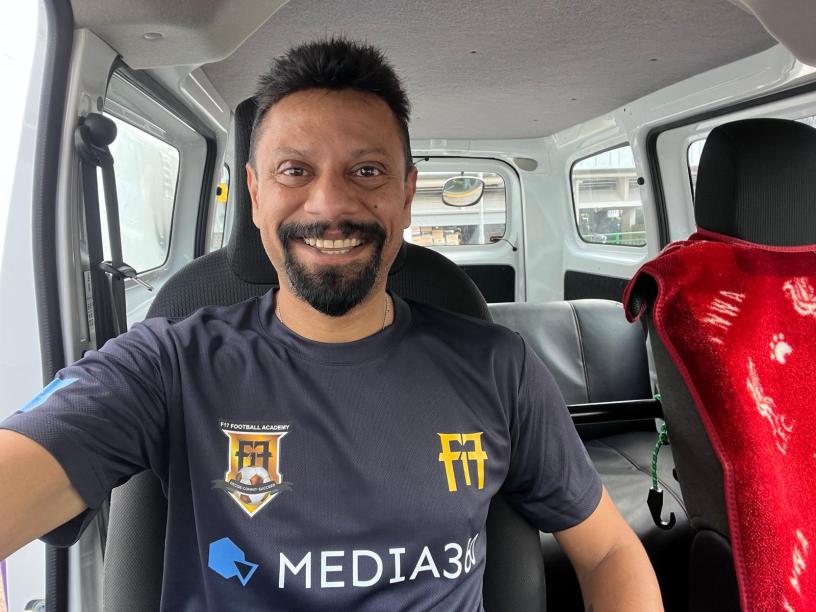
Meet Desh. With over 25 years of experience in global media agencies, Desh founded Media360 with a clear belief that clients deserve senior-level attention, customised strategies, and measurable results. What began as a personal reset after years in multinational roles has evolved into a boutique agency known for performance-driven campaigns and long-term client partnerships.
From navigating post-COVID market disruption to leveraging AI, consumer data, and insight-led creativity, Desh continues to challenge traditional agency models. At Media360, success is not defined by spend or scale, but by accountability, relevance, and outcomes that directly support business growth.
What inspired the creation of Media360, and how has your vision evolved since you first started the company?
I have been in the media industry for about 25 years, having started my career around 1999, shortly after the Asian financial crisis. I spent most of that time working in global MNC media agencies. In December 2017, my son was born, and shortly after that, in early 2018, I decided to take a break from the industry to reset and spend time with him.
During that period, I reflected deeply on my career. Many clients had told me, “Desh, we only see you during pitches, but not when the account is running.” That was because I was in a senior role and could only be involved in major presentations, not day-to-day client work. Yet my first love has always been working directly with clients, shaping campaigns and solving business problems.
I realised that if I were to return to the industry, I wanted to do it on my own terms. That was when I decided to start Media360, so I could dedicate my time to clients, manage their businesses closely, and ensure campaigns delivered real results.
It has been nearly eight years since we started. We began with just two former clients who trusted me enough to work with me again, and they are still with us today. The vision has always been for senior leadership to work directly with clients, ensuring every account is personally overseen rather than delegated entirely to junior teams. That philosophy has worked well and will continue to guide us going forward.
In a landscape saturated with media agencies, how does Media360 differentiate itself in terms of approach, value, and impact?
Large agencies have always existed, but in recent years, many smaller agencies have emerged locally. As a boutique agency, differentiation is critical. Everything we do is customised. We do not offer off-the-shelf solutions, and our clients never receive recommendations that feel recycled or familiar.
Our approach is built from the ground up, starting with a deep understanding of the brief, followed by insight gathering. A key part of our value lies in the insights generated through our proprietary tool, which maps consumer digital touchpoints and behaviour. This allows us to respond with precision.
We also use a wide range of industry and AI-powered tools to analyse consumers, markets, and competitors. Ultimately, impact is what matters most. Every campaign is tied to measurable outcomes, whether that is sales, leads, or brand metrics. Performance is benchmarked against clearly aligned KPIs agreed with the client. This clarity and accountability have been central to our success.
Can you share a success story where Media360 delivered remarkable results, and what made that success possible?
One standout case involved a property client launching a development in the west of Singapore in late 2023, just after COVID. The challenge was significant, as three other property launches were happening within a two-kilometre radius at the same time. The issue was not awareness or media spend, but how to drive footfall to the showroom.
Our research revealed that many buyers were undecided about which development to visit and which property to buy. Based on this insight, we partnered with ComfortDelGro to offer free taxi rides from the nearest MRT station to the showroom and back. This solved practical issues such as parking scarcity and convenience.
Buyers could visit our showroom first, then walk to nearby developments, but had to return to ours to take the complimentary ride back. We also introduced a priority queue system for those who used the taxi service. Nearly 50 per cent of those who took the ride either purchased a unit or balloted for one.
This was not a high-budget campaign, but a highly effective insight-driven solution that delivered outstanding results.

Whether through community service, helping those in need, or participating in family volunteering activities, giving back has grounded me personally and strengthened family bonds. It has become a meaningful and consistent part of our lives.
With AI, short-form content, and data analytics reshaping marketing, what trends will have the biggest impact over the next five years?
The first major trend is predictive consumer behaviour modelling. While brands like Tesco were already using historical data decades ago, AI now enables far more sophisticated prediction of future behaviour, upselling opportunities, and cross-category interests. This will become widely accessible across industries, including SMEs.
The second trend is hyper-personalisation at scale. Consumers will increasingly receive tailored content across websites, emails, and advertising, based on their digital footprint and real-time behaviour.
The third trend is AI-driven visual and voice recognition technologies. These tools can already analyse images, predict behavioural patterns, and even simulate how individuals may look or behave in the future. These capabilities will unlock new possibilities across marketing, security, and customer experience.
What has been one of the toughest challenges Media360 encountered, and how did you turn it into an opportunity?
Media360 was founded before COVID and had to navigate the full impact of the pandemic. During COVID, marketing budgets were slashed, competition intensified, and agencies were undercutting each other on pricing. This environment continued even post-COVID. As a local SME, we chose not to compete on price but on value.
Our key differentiator became performance guarantees. Every dollar spent is tied directly to client KPIs, whether sales, leads, or brand outcomes. This performance-led approach allowed us to continue growing despite market pressure.
As a CEO, what principle or habit has contributed most to your resilience and success?
Networking has been fundamental. Relationships built over decades have opened doors and created opportunities organically.
The second habit is giving back. Whether through community service, helping those in need, or participating in family volunteering activities, giving back has grounded me personally and strengthened family bonds. It has become a meaningful and consistent part of our lives.
What’s your vision for Singapore in the next five years?
I hope Singapore becomes the Silicon Valley of AI. If Singapore is at the centre of AI innovation, new tools and technologies will be available here first, allowing us to test, learn, and apply them rapidly. This would be transformative for industries like media, where innovations often reach Asia much later than the US.
If you could have a superpower for one day, what would it be and why?
I would give everyone a unique talent. If everyone had something special to contribute, the world would be less focused on status and competition, and far more interesting and meaningful.
Connect with Desh: LinkedIn.
Desh is a member of Rainmaker, a revolutionary movement that rallies like-minded people together based on the values of Love, Authenticity, Respect, Kindness and Youthfulness (LARKY).