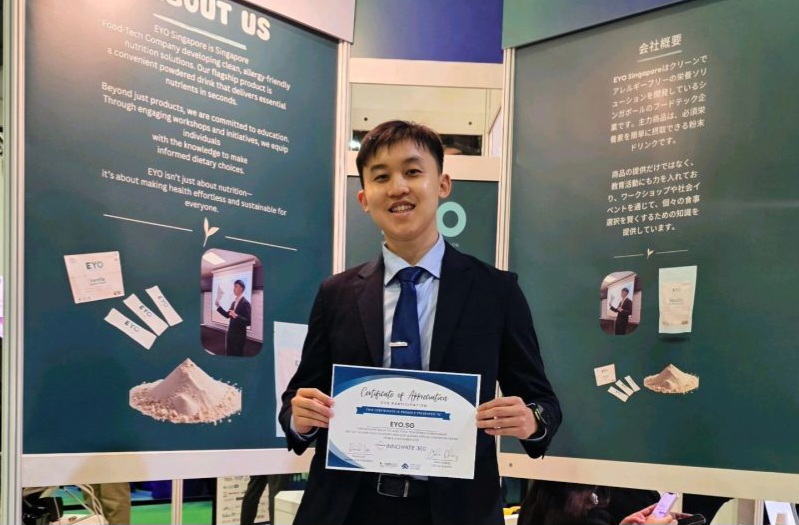
Meet Sho. He spent a decade in and out of hospital wards, undergoing 10 surgeries before the age of 25. Being lactose and soy-intolerant, Sho suffered digestive issues and skin flare-ups from taking hospital-prescribed nutrition drinks. These drinks often contain dairy, soy, wheat, and other allergens. Those years didn’t break him. Instead, they awakened him. Surrounded by other patients who also suffered digestive issues and complained about the poor taste of the nutrition drinks, he saw first‑hand how deeply the body depends on proper nourishment.
Today, that lived experience fuels EYO Singapore, a foodtech company dedicated to improving lives through enhanced nutrition for everyone, from vulnerable communities to fitness‑focused professionals. His journey is one of resilience and empathy, buoyed by the firm belief that the greatest wealth is health.
Your journey began with 10 surgeries and 10 years of hospital visits. How did those difficult years shape your mindset and ultimately lead to the creation of EYO Singapore?
During that decade where I was in and out of hospitals recovering from 10 different surgeries, I wasn’t only dealing with my own pain and recovery. I spent years surrounded by elderly patients, children, and many others going through similar suffering. They became my companions during that chapter of my life, and I saw how many of them struggled with nutrition‑related issues.
That planted a deep desire in me, not just to heal myself, but to help others live more fulfilling lives through improved nutrition. That was the seed of EYO Singapore.
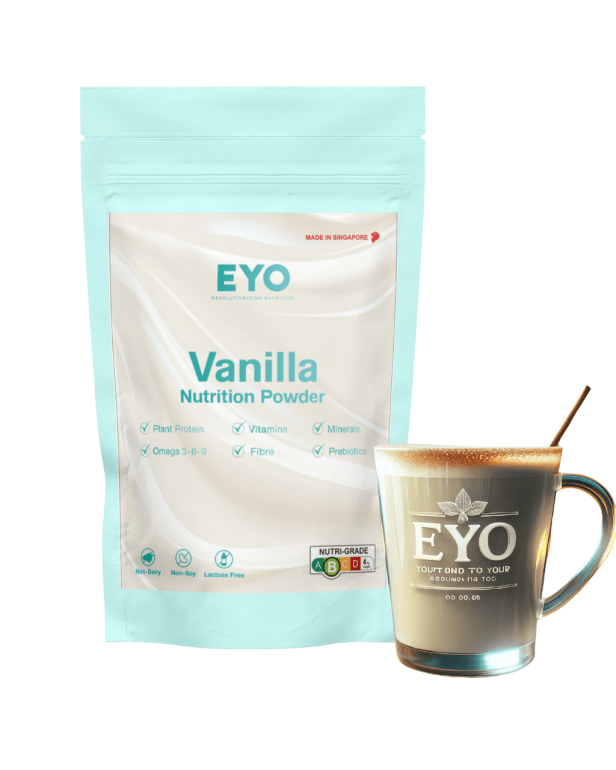
EYO1 is dairy‑free and soy‑free, with its main ingredients being plant protein from high‑quality pea and oat powders. What was the process of developing a formula that is both safe for people with allergies and nutritionally superior like?
EYO1 was developed in collaboration with food scientists at agri-food tech accelerator Innovate 360. Over three years, the team went through an intensive research and formulation process to refine both the nutritional profile and taste of the product.
The team tested more than 50 different protein blend iterations and screened over 100 potential ingredients, evaluating each for its nutritional value, digestibility, and sensory appeal.
This rigorous R&D approach ensured that only the best-performing ingredients made it into the final formulation.
We began by sourcing ingredients globally to determine the most suitable replacements for milk-based protein. After evaluating options from around the world, we selected a pea protein powder from Japan for its higher protein concentration, purity, and superior taste. Oat protein from New Zealand helps complete the nine essential amino acids profile.
Other ingredients include fibre, prebiotics, omega-3, vitamins, and minerals.
Beyond hospitals, EYO1 has also gained traction among professionals and fitness‑conscious consumers. How do you balance medical‑grade nutrition with lifestyle convenience?
All our products go through strict testing to ensure safety, purity, and accuracy in nutritional content. Each shipment from suppliers comes with a Certificate of Analysis, and we conduct our own tests as well. Our products are approved by the Singapore Food Agency and manufactured in facilities certified with ISO 22000 and HALAL standards.
With plant protein powder being the main ingredient, EYO1 is designed to support muscle maintenance and recovery, which appeals to both senior citizens and fitness enthusiasts. It contains dietary fibre and prebiotics, which makes it a suitable meal-replacement drink as it evokes a feeling of satiety.
EYO1 is sweetened with allulose, a naturally occurring rare sugar found in plants. Allulose provides around 70% of the sweetness of table sugar but with about 90% fewer calories. It is absorbed but not fully metabolised, which means it has minimal impact on blood sugar and insulin levels, and it does not promote tooth decay like table sugar. This makes EYO1 ideal for people who are watching their sugar intake or are concerned about pre-diabetes and diabetes.
It has also gained popularity among individuals who are watching their caloric intake. Each nutrient-dense serving contains under 200 calories. A typical Singapore hawker meal is around 500 to 800 calories.
I have learnt that I must let go of expectations, especially expectations of others. In business, we must do our best, stay proactive, and avoid placing unrealistic demands on people who are trying to help but are not directly accountable to us.
Early‑stage startups face multiple challenges. What are some challenges you are facing and how do you plan to overcome them?
One major challenge is gaining the confidence of dietitians and building strong networks across the region.
To overcome this, we are proactively reaching out to hospitals and healthcare professionals not only in Singapore, but also in Malaysia and Indonesia. We want them to understand our product, our values, and how we address key nutritional gaps.
What milestones or successes has EYO achieved so far?
Recently, we received support from Leave a Nest Holdings, a knowledge manufacturing company founded by a group of science researchers to tackle social problems. We won 500,000 yen through one of their programmes and have entered the final stage for a potential 5 million yen grant.
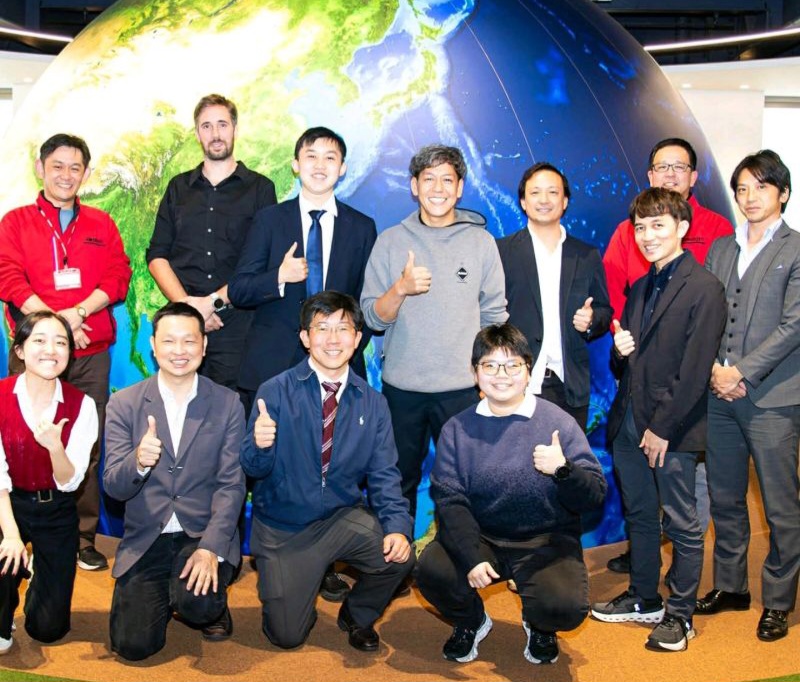
Recently, we visited Japan to explore partnerships in developing AI‑powered nutrition drinks, in which the formula is personalised for each person’s unique needs.
What is one thing you will let go of in your life, and what will you preserve moving forward?
I have learnt that I must let go of expectations, especially expectations of others. In business, we must do our best, stay proactive, and avoid placing unrealistic demands on people who are trying to help but are not directly accountable to us.
Letting go of expectations reduces disappointment and allows us to focus on what we can control.
What are EYO’s plans for the next few years?
Beyond developing nutritional drink powders, we aim to expand our education efforts. Many people misunderstand nutrition. Some believe they are eating enough; others consume too much of certain nutrients.
We want to educate children from a young age and support elderly communities, helping them to prevent nutrition‑related illnesses such as osteoporosis and colorectal cancer.
Colorectal cancer is one of the most prevalent cancers in Asia and is the most common cancer among men in Singapore. I’m personally motivated to solve this issue as my late Japanese grandmother suffered from it. That drives me to create solutions that prevent diet-related diseases.
What’s your vision for Singapore in the next five years?
My vision is to reduce malnutrition in Singapore. Underserved groups such as children, the elderly, and low‑income individuals are increasingly affected by nutritional deficiencies.
We’re seeing nutrition issues at both ends of the age spectrum. Whether it’s seniors or children, the core issue is the same and that is a lack of balanced, nutrient-dense food. This highlights a bigger problem: nutrition today isn’t just about how much we eat, but what we eat.
Poor nutrition among seniors can lead to increased frailty and cognitive decline. At the same time, some children are becoming overweight while still lacking essential nutrients because their diets are high in calories but low in quality.
Elderly people need more protein. Children need more fibre. With EYO Singapore, we aim to address these issues through nutrition literacy and supplementation.
If you could have a superpower for one day, what would it be and why?
I would like the ability to provide tailored nutrition to every individual, giving them what their body needs for a healthier and more fulfilling life.
Connect with Sho: LinkedIn and Instagram.

Health Advice Disclaimer
The information provided on this platform is for educational and informational purposes only. It is not intended as medical advice, diagnosis, or treatment, and should not be relied upon as a substitute for professional medical consultation, advice, or treatment from a qualified healthcare provider.
In Singapore, all health-related content is to be understood as general wellness information and not a substitute for medical consultation. Individuals are encouraged to seek advice from a registered medical practitioner under the Ministry of Health (MOH) before making any healthcare decisions.
