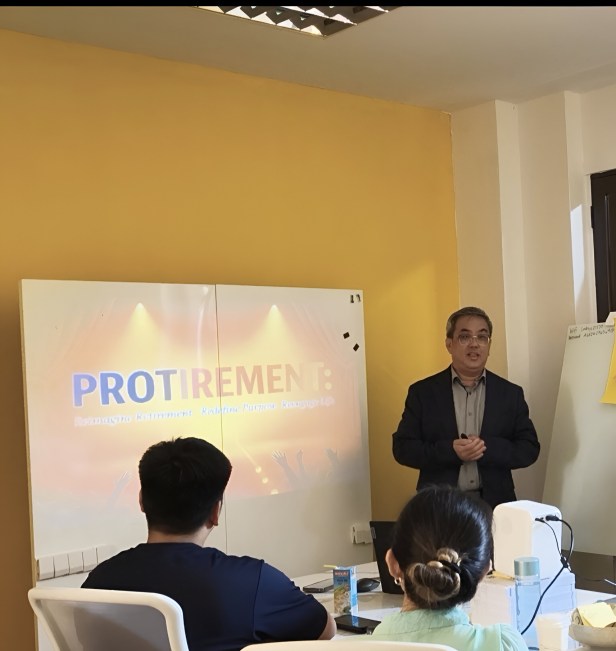
Meet Patrick, who believes retirement isn’t the end of the road but a new runway. With over 17 years of experience in financial advisory and life coaching, Patrick has seen how traditional views of retirement often leave high achievers feeling purposeless and disengaged. Through countless client interactions and personal observations, he realised that retirement requires more than financial preparation.
That insight led to his advocacy of Protirement—a life philosophy where purpose and inspiration extend beyond conventional retirement age. From writing books on financial planning to creating experiential literacy games, Patrick empowers others to prepare early, live meaningfully, and retire with clarity. Now, he is on a mission to inspire a nation of proactive retirees, ones who contribute wisdom, seek growth, and live out their golden years with pride and purpose.
You have spent 17 years observing how traditional retirement often leaves high achievers feeling “re-tired.” What was the defining moment that made you realise retirement needed a more complete redefinition?
There wasn’t a single defining moment. It was an accumulation of years of observation. In my line of work, I have often planned retirement with clients. While our CPF system focuses heavily on financial planning, I have encountered seniors who had prepared financially but still did not enjoy their retirement. Some became unwell, or had to care for spouses with dementia, scenarios they hadn’t planned for.
I have also met professionals, such as chefs and SME owners, who initially enjoyed retirement but later found it meaningless. They struggled to fill their time. These experiences made me realise that retirement must be viewed more holistically. It’s not just about money. It’s about wellness and purpose. That’s where the idea of Protirement comes in: being pro-inspired, not retired.
You mentioned that protirement is about being pro-inspired, not retired. How did this philosophy personally transform your own approach to life and work?
Previously, like many others, I believed that retirement meant slowing down after 65 or 70, eventually phasing out of life. But once I realised retirement needed a broader definition, my perspective changed. Retirement should not be about winding down, but it should be about discovering new purpose and meaning.
We can contribute meaningfully as volunteers, mentors, consultants, or coaches. This realisation gave new meaning to my own work and life. I now encourage others to repurpose their lives during this phase and make their final years a “grand finale.”
Also, in recent years, I have been undergoing more medical check-ups. I used to think frailty in old age was natural, but now I strive to remain active and healthy, both mentally and physically. I encourage those around me to adopt the same mindset.
Can you tell us more about the book that you have written The A To Z Guide To Retirement Planning: Everything You Need To Know About Accumulating And Preserving Wealth For Your Golden Years (2016)?
That was my first book. At the time, I realised there was insufficient information on retirement planning in Singapore, so I decided to write one. It focused purely on financial planning—how to manage, accumulate, grow, protect, and eventually distribute your funds. I created an acronym, MAPPED, which stands for Manage, Accumulate, Preserve, Protect, and Estate Distribution. I even trademarked it.
The book is organised alphabetically with 26 chapters—A to Z—which makes it easier for readers to find what speaks to them. They don’t need to read from cover to cover. My new book on retirement follows the same structure for the same reason.

I often use the runway metaphor. If you want to fly an A380, you need a long runway. A short runway only supports a private jet, meaning your savings capacity is limited. If you want greater financial freedom later, start early and build that long runway.
How early should someone begin preparing financially for a meaningful retirement and what are the first steps they should take?
The earlier, the better. Ideally, start the moment you earn your first dollar. But realistically, most people have other priorities in their 20s and early 30s. So, mid-30s is a good time to begin—definitely no later than 45.
I often use the runway metaphor. If you want to fly an A380, you need a long runway. A short runway only supports a private jet, meaning your savings capacity is limited. If you want greater financial freedom later, start early and build that long runway.
First, get clear about the lifestyle you want in retirement. What’s your definition of “enough”? For some, it’s $4,000–5,000 per month. For others, $10,000. Based on that, work out the numbers using inflation and investment projections.
Second, be consistent, whether through saving or investing. But also be flexible. Life will change over the next 20–30 years, such as family, economy or health. You must be ready to adjust your plan.
Ultimately, financial preparation is not just about lifestyle. It’s about freedom. With enough resources, you can make better decisions, have more options, and do what truly matters to you.
You created the Affluent Financial Literacy Game. How does engagement and experiential learning help people overcome fear or resistance to financial planning?
Many find financial planning complex. It involves numbers, projections, and strategy. Courses can be dry if the trainer just lectures from slides. But a game turns theory into experience.
In the game, players make decisions, experience scenarios, and feel the consequences, without real-life loss. For example, if they don’t protect their investments and a simulated crisis hits, they “lose” money in the game. This creates an “aha” moment where people reflect on their real-life financial habits.
Playing in pairs or groups also allows peer learning. I design my game to include tag teams, so players must communicate and make joint decisions. This teaches cooperation and deepens understanding.
Experiential learning makes financial planning less intimidating and more enjoyable and that’s key to behavioural change.
Who inspired you to become the person you are today?
There isn’t one single person. Over the years, I have been inspired by many-mentors, teachers, friends, coaches, colleagues, classmates, housemates. Each has impacted me in some way, whether through their determination, ideas, or dreams. I am a product of all these influences, and I’m grateful to each of them.
What’s your vision for Singapore in the next five years?
As our population ages, I hope Singapore will recognise the value seniors bring, not just as contributors to the past, but to the future. I envision Singapore as a hub for both financial literacy and life architecture, where retirement isn’t about fading away, but sharing wisdom and experience.
I also hope for more inclusive learning opportunities for seniors. Many want to learn about AI, tech, and more but are often dismissed because of age. Let’s create a society where every generation grows together, empowered to contribute meaningfully.
If you could have a superpower for one day, what would it be and why?
I would give people instant clarity about their life and purpose. In my coaching work, many clients seek clarity to know their next step, or why they are doing what they are doing. It’s not the how that’s difficult—it’s the why.
If everyone had clarity, they would make more meaningful decisions. No one would feel lost. Every action would have purpose. I believe that would make the world a much better place.
Connect with Patrick: LinkedIn.