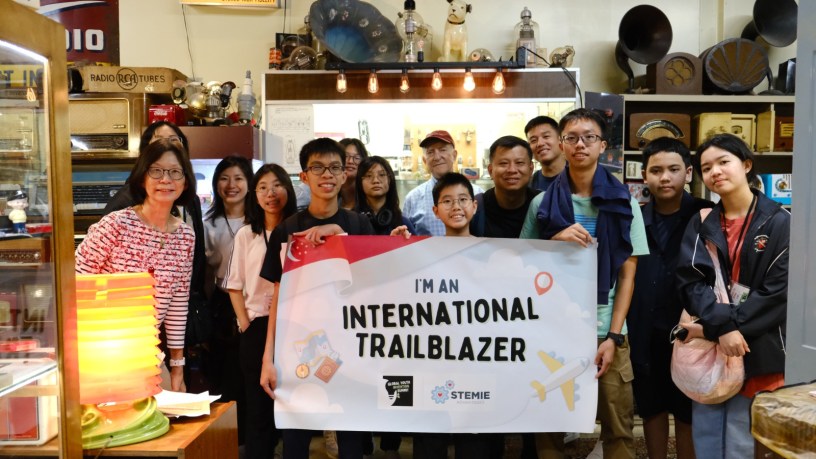
Meet Nancy, the visionary founder of STEMIE Advantages, a non-profit dedicated to closing the education gap for underrepresented students in Singapore. Through her advocacy, she champions “Lost Einsteins”—brilliant young minds from low-income families or diverse learning needs who are often overlooked by mainstream education systems.
Nancy has empowered over 22,000 students from more than 200 schools and centres through invention-based STEM programmes, made possible by training educators to implement the STEMIE framework in their own classrooms and centres. Under her leadership, STEMIE will be organising the 2nd Global Youth Invention Summit, which will debut in Singapore for the very first time. The summit is set to bring together top student inventors from 11 countries and territories, marking a major milestone in STEMIE’s mission to nurture a new generation of empathetic, purpose-driven STEM leaders ready to shape the future.
What inspired you to start STEMIE Advantages and how did the idea of addressing “Lost Einsteins” shape your mission?
The inspiration for STEMIE Advantages came from two pivotal experiences in 2021. The first was a pro bono event at Temasek Shophouse for students with diverse learning needs and from low-income families. Over three weekends, we focused on Science, technology, engineering, and mathematics (STEM), sustainability, and real-world problem solving.
The students’ achievements were inspiring, and with Temasek Shophouse’s encouragement, we transitioned from a ground-up initiative into a full non-profit.
Prior to this, I judged an invention convention in the US and visited a school where most students came from underprivileged backgrounds. Despite their circumstances, these children showed innovation, passion, and a desire to break generational cycles, but lacked platforms to shine.
This echoed the concept of “Lost Einsteins,” individuals who go unnoticed due to background or learning style. It affirmed my belief that Singapore’s diverse learners deserve equal opportunities.
STEMIE now champions underrepresented students, including those from low-income families, and youth with learning challenges through immersive STEM and invention education.
Running a social enterprise in education isn’t easy. What have been your biggest challenges in scaling STEMIE and how do you overcome them?
Our biggest constraint is the same one many non-profits face, which is securing sustainable operational funds. Without adequate general budgets, growth becomes difficult.
Specifically, we lack resources to hire key personnel such as fundraisers or marketing staff, which are both crucial for scaling impact. To overcome this, I’ve leveraged my for-profit entity, IDE Academy, to support STEMIE’s operations. This cross-organisational support allows us to fulfil our mission without compromising quality.
Additionally, we’ve partnered with organisations whose missions align with ours. These collaborations have extended our reach and helped mitigate resource limitations.

We believe every child has untapped potential. Age is not a barrier. At both STEMIE Advantages and IDE Academy, we believe brilliance isn’t determined by socio-economic status, background, or learning profile.
STEMIE has already reached over 22,000 students across more than 200 schools. Could you share some of the most impactful stories or transformations you’ve witnessed?
There are many, but let me highlight two young inventors who joined us in Primary 1. Over the past three years, I’ve seen them develop resilience and grow into future STEM leaders. They progressed from “I-type” problem statements to “we-type” solutions, focusing on social innovation and sustainability.
For example, they created solutions to help a lost elderly man with dementia return home safely, addressed frequent falls among the elderly, and a kindergarten child who devised a voice-activated tool for the visually impaired to navigate outdoor spaces without a white cane.
Despite their young age, their empathy was more deeply rooted than in many teenagers who haven’t experienced similar formative moments. This year, I also witnessed two APSN students develop separate games for children with cerebral palsy, enabling them to enjoy playtime.
Economically, these “Lost Einsteins” may view their paths as long and different, and some might assume their main goal is simply to earn a certificate. But what if they go on to take the road less travelled? That’s what Singapore needs—to support and help them move forward.
You’ve also been championing sustainability alongside innovation. How do you weave environmental awareness into STEMIE’s programmes?
We embed the 17 UN SDGs into our programmes to help students move beyond self-interest and towards a community mindset. For example, climate issues like heat or water scarcity often come up in discussions.
We incorporate current affairs such as recycling, landfill usage and sustainable lifestyles into conversations. Rather than rigid lesson plans, we encourage open discussions where students reflect on what they hear from news, the internet, or their parents.
These conversations deepen their environmental awareness through lived experience and shared perspectives.
What core values or beliefs have guided you in building STEMIE Advantages?
First, we believe every child has untapped potential. Age is not a barrier. At both STEMIE Advantages and IDE Academy, we believe brilliance isn’t determined by socio-economic status, background, or learning profile. We build all our programmes around supporting each child’s journey towards unlocking that potential.
Second, we value practical problem solving. We don’t teach in isolation. Students care about real-world problems. If they’re hungry, they can’t focus on learning. When their basic needs are met, they can contribute to change.
Here in Singapore, when students realise their learning can help solve everyday problems, they shift from being passive learners to active innovators.
Lastly, empathy is critical. We aim to raise STEM leaders who want to do good. Empathy must be developed alongside technical skill, because Singapore needs problem-solvers who can develop human-centric solutions.
What advice would you give your younger self?
I would tell myself to think about succession from the start. As someone who moved from a ground-up initiative to a non-profit, I now realise the importance of identifying future leaders early on. In business, it’s your exit strategy.
In non-profits, it’s your succession plan. This isn’t something to leave until you’re ready to step back. It must be baked into your planning from day one. I didn’t do that, and I would change that if I could.
What’s your vision for Singapore in the next five years?
I want to see a generation of STEM leaders from diverse backgrounds who possess both technical expertise and a strong sense of empathy and purpose. I envision them leading locally and globally, contributing to the nation’s growth.
Singapore is facing a unique set of challenges such as ageing population, sustainability, healthcare and social systems. We need leaders who can think differently and respond innovatively.
Through STEMIE Advantages, we aim to build that future by equipping students today to become the STEM innovators and compassionate leaders of tomorrow.
If you could have a superpower for one day, what would it be and why?
I’d like to create a solution to prevent dementia and Alzheimer’s. As baby boomers—myself included—continue to age, this will help reduce pressure on the healthcare system, support our independence and mental clarity, and lessen the emotional strain on caregivers.
Connect with Nancy: STEMIE.
Nancy is a member of Rainmaker, a revolutionary movement that rallies like-minded people together based on the values of Love, Authenticity, Respect, Kindness and Youthfulness (LARKY).

