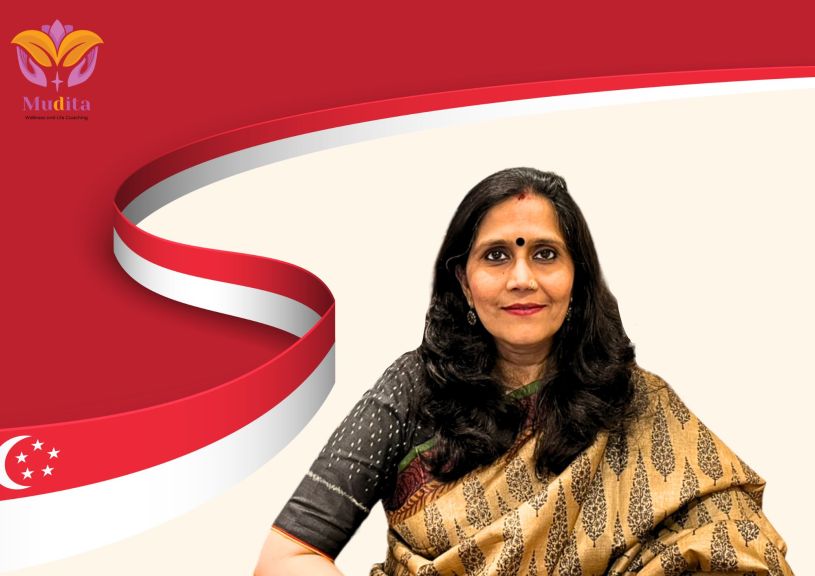
Meet Radhika, an ICF-accredited life coach, certified high performance coach, yoga therapist, and spiritual practitioner whose mission is to help women reset their lives—especially during midlife transitions. Drawing from a powerful blend of coaching disciplines, yoga therapy, and ancient spiritual wisdom, she created a unique Holistic Reset framework that empowers women to align body, mind, and spirit for deep transformation.
Her journey is rooted in personal experience and driven by compassion. After overcoming her own struggles with exhaustion and identity in midlife, Radhika found clarity through integrative healing. Today, she supports women in Singapore and around the world with tools to regain energy, reframe inner narratives, and rediscover their purpose—proving that midlife isn’t the end, but a powerful new beginning.
You hold ICF accreditation and multiple certifications across high performance, menopause coaching, and yoga therapy. What inspired you to bring these disciplines together into one holistic practice?
My inspiration has been very simple—to help women realise that midlife is not the end of the story. That’s what most people think, but in truth, it is the beginning of an empowered new chapter. I say this because I’ve personally gone through that pain, and it opened an entirely different chapter for me that is empowering and purpose driven.
The ICF accreditation helped me professionally organise my process in a systematic way. High performance coaching brought in focus on task management, resilience, and confidence building.
Menopause coaching taught me the nuances of hormonal imbalances and how mood, body, and energy shift uniquely in each individual. Yoga therapy, which I’ve practised for a long time, provided deep wisdom about the connection between body, mind, and spirit.
My mantra is: ancient wisdom and modern practices, woven with compassion, performance, presence, and the science of spirituality to provide a holistic reset for women. That has been my inspiration—something I’ve practised for myself and now offering to others.
How has your own spiritual journey shaped the way you approach coaching and healing?
My spiritual journey has never been about escaping from issues, but rather learning to be fully present in them. It’s a process, not a one-time realisation. We often hear the phrase “go with the flow,” but it’s extremely difficult to do so without awareness and discipline.
Years of practice and the deep understanding of the knowledge of yoga therapy, and the study of both ancient Indian and Buddhist philosophies taught me not to chase quick fixes, but to truly understand the body-mind-spirit connection. Spirituality, to me, isn’t tied to religion—it’s about connecting to the spirit within, listening to your inner voice. When the mind and body are disconnected, it can lead to stress, which may eventually manifest as disease.
Understanding and integrating the body, mind, and spirit has given me clarity and resilience. It gave me the confidence to face life’s challenges with the conviction that I am enough. I now see myself—and others—as whole beings. That’s why, when I coach, I don’t provide answers; I help clients uncover their own.
You mentioned coaching through the mind-body-spirit concept. Can you explain how this framework works in practice for your clients?
Most of my clients are middle-aged women. I created a model called the Holistic Reset, which honours the body, mind, and spirit to help women transition into a new chapter in life with vitality, clarity, and healing.
The first pillar is the Body, or the grounding pillar. Energy must be preserved and replenished, so we work on nutrition, movement, and awareness practices—not to focus on appearances and to look in a certain way, but to feel grounded. The second pillar is the Mind, or the clarity pillar. This helps shift old belief patterns and break the cycle of repetitive thoughts. Clients learn to rephrase their internal dialogue.
The third pillar is the Spirit, the meaning pillar, where we explore meaning, purpose, and values. Clients discover what rituals and creative expressions make them feel alive and important. This process fosters awareness, acknowledgement, and resilience, enabling clients to reconnect with themselves and move forward with strength.
Can you share a success story or breakthrough moment where a client experienced significant transformation through this holistic approach?
There are many, but one client stands out. I worked with her for three years. She came to me suffering from invisible exhaustion and immense stress. Balancing her role as a mother of two, a caregiver, and career responsibilities left her feeling overwhelmed and disconnected from herself. The emotional strain eventually triggered an autoimmune condition, requiring medication and leading to several hospitalisations.
She would describe her state as “living in a fog.” Using the three-pillar framework, we began with gentle grounding practices like yoga, breathwork and sleep-energy-nutrition tracking. In the Mind pillar, she had deeply rooted beliefs of inadequacy: “It’s too late,” “I’m not enough,” “I can’t do this.”
Through journaling, affirmations, and letting go of old thought patterns, we gradually reframed her inner dialogue. The spiritual pillar focused on rituals, mindfulness, and identifying her values—what truly mattered to her. We asked the three core questions: What is important? Why is it important? How can she act on it?
Over time, she discovered her true purpose: to teach yoga. She became a certified yoga instructor and has since moved abroad, thriving and free from medication. It’s a story of transformation that began with inner clarity and blossomed into fulfilled purpose.

Understanding and integrating the body, mind, and spirit has given me clarity and resilience. It gave me the confidence to face life’s challenges with the conviction that I am enough. I now see myself—and others—as whole beings.
In your work as a yoga therapist, how do you blend movement, breathwork, and mindfulness with life coaching techniques?
Many people assume yoga therapy is only about physical postures (asanas), but it goes much deeper. At its core, it’s about the profound connection between mind and body—facilitated through the breath. I incorporate breathwork extensively to help release stress and anxiety.
Breathwork enhances energy circulation and stimulates the nervous system, promoting overall well-being. Coaching complements this by providing structured goal-setting and follow-up. Often, people are keen to practise these techniques but struggle with consistency.
This is where life coaching tools come in—they offer psychological scaffolding and scientific backing to support sustained practice. By combining ancient yogic wisdom with positive psychology-based coaching techniques, I help clients create personalised daily rituals. These small, consistent practices—done with awareness—become powerful tools for a holistic reset.
For high achievers struggling with energy and focus during midlife transitions, what are some practical strategies you recommend?
High performers often push themselves to burnout. Midlife brings hormonal changes, physical shifts, and evolving family dynamics, all of which amplify fatigue. So, I always come back to the three pillars. For the Body, we track energy using morning and evening check-ins. Evening routines are critical—sleep times, screen habits, reading, and winding down.
Once that’s in place, the morning routine sets the tone for the day. Heavy workouts can worsen adrenal fatigue, so I recommend strength training or mindful movement instead. For the Mind, clarity is key. I encourage focused work blocks (e.g. 60–90 minutes) followed by intentional breaks—being present, not distracted. Ten minutes of mindful journaling can also help reframe negative self-talk like “I’m losing my edge” into empowering truths.
For the Spirit, ask yourself: Why is this important? Is a packed calendar what truly matters? What brings genuine joy? My guru always says, “Bring your mind where your hands are.” Even having coffee can be a mindful act. Mindfulness doesn’t need a retreat; it needs intention and integration.
What’s your vision for Singapore in the next five years?
Many women in Singapore are struggling silently with mental health challenges, midlife transitions, and burnout. Unfortunately, due to societal judgement and internalised stigma, they hesitate to open up—even to their families.
Menopause is rarely discussed, so families often don’t realise what women are going through. My vision is to see open, supportive conversations around menopause and mental health. I want women to build inner strength, aligned energy, and clarity—not just for themselves, but for their families and communities.
We need more women communities, where experiences are shared, support is mutual, and learning happens collectively. It’s a societal journey, not an individual one. Singapore is already one of the top 100 health zones in the world. With our parks, wellness resources, and safety, we can use that to also nurture mental and spiritual well-being, helping women flourish holistically.
If you could have a superpower for one day, what would it be and why?
I would love for every woman to hear her inner voice—without fear, doubt, or distraction. Women are constantly pulled in different directions—careers, caregiving, chores, relationships. I want them to truly listen to their inner wisdom. That one day of clarity could plant the seed for lifelong transformation.
I believe women are the nucleus—not in a restrictive way, but in the sense that they hold space for both family and society. When they’re grounded in their inner strength, everyone benefits. That is a sacred awakening I wish for all women.
Connect with Radhika: Instagram, Facebook and LinkedIn.

