
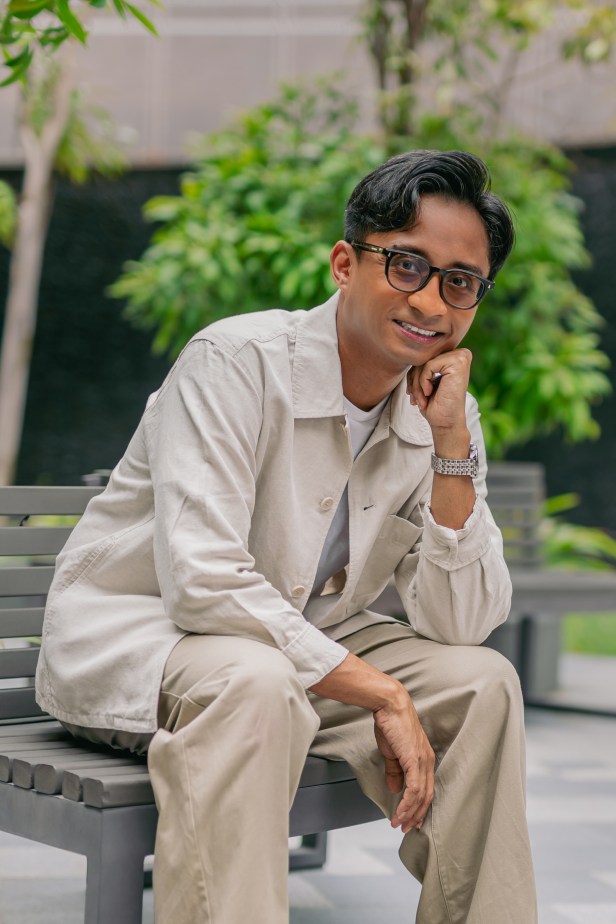
Meet Fauzi, whose journey into content creation wasn’t exactly planned—it began with a quiet government job and a love for stability. But when a friend saw his potential for comedy and nudged him into auditioning for a local mockumentary series, Fauzi discovered a hidden talent that would soon go viral. That pivotal moment caught the attention of SGAG, launching him into the world of content strategy and online humour.
Since then, Fauzi has become a familiar face in Singapore’s digital scene, known for his sharp wit, localised characters, and ability to turn everyday observations into relatable comedy gold. But beyond the laughs, he’s also passionate about mental health, community-building, and using his platform to educate and inspire. His evolution from public sector to digital creator is proof that sometimes the best careers are the ones we never see coming.
What inspired you to start content creation?
To be honest, I started my career in a very introverted role because I valued stability. I joined a government agency after a few years in other roles, thinking it would be great to have a stable paycheck—something very important in Singapore. I wasn’t sure then whether I could thrive outside of that stability.
A friend from school told me he thought I had a knack for acting and encouraged me to audition for an online series called Average Guys—a mockumentary comedy series that was quite refreshing and had never been done in Singapore before. It’s still on Facebook, actually.
We had no idea it would be so well received, but it went viral, and that’s how SGAG found me. That led to me being roped in as a content creator. At that point, I had to ask myself if this was the career I wanted to pursue. After that series, I thought—why not give it a shot?
I even approached my government agency to ask for permission to explore the media industry, with the idea that I could bring back some skills. At SGAG, I became a content strategist and was heavily involved in marketing and content planning. That experience sparked everything I’m doing today.
Where do you usually find inspiration for your funny content, and how do you make it relatable to your audience?
Most of the content on my social media feed comes from international creators, particularly Americans. They’re really good at creating viral content. But while many Asians consume that content, I wanted to create a space where Singaporeans could look at local creators and find relatable, funny content too.
So I take inspiration from overseas creators and localise the content to suit Singaporean tastes and algorithms. I’m also a keen observer—when I go out, I watch people closely, which helps me create characters that reflect real-life quirks.
My content is a reflection of what I observe in everyday Singaporean life.
When I volunteer in schools to educate students about the media industry, I always tell them—content creation is not as glamorous as it seems. Putting yourself out there makes you vulnerable to public opinion.
How do you deal with creative blocks or when jokes don’t land as expected?
If a video doesn’t perform well on social media, I see it as feedback. But it’s tricky—sometimes it’s hard to tell whether the joke didn’t land or the algorithm just didn’t work in my favour that day. So I don’t take it at face value.
I focus on content that people can relate to, content that builds community. Comedy, to me, is about creating that sense of shared experience and relatability. I constantly remind myself to create content that connects with people on a deeper level.
What do you think makes Singaporean humour unique, and how do you incorporate it into your work?
Singaporean humour shines when characters feel familiar and recognisable. I play many characters, and when one resonates, I know I’ve struck the right chord—I call it finding the “DNA” of a character. Good comedy often comes from personal experience or even trauma. I always ask myself what my followers would enjoy.
I see my page not as mine alone, but as a community space. It belongs just as much to my audience.
As a content creator, how do you prevent burnout?
I only recently learned that freelancing can feel like a 24/7 job. So now I treat it like a 9-to-5. I strictly rest on weekends—do my laundry, chores, and just unwind. Of course, content creators feel pressure to post daily, but I’ve stopped putting that weight on myself.
Thanks to technology, I can now schedule posts in advance and prioritise rest. Sunday is strictly a rest day for me now, and I’m so much happier for it.
What are a few common misconceptions about content creation?
When I volunteer in schools to educate students about the media industry, I always tell them—content creation is not as glamorous as it seems. Putting yourself out there makes you vulnerable to public opinion.
People don’t see the behind-the-scenes work—dealing with hate comments, protecting your mental well-being, crisis management, and managing yourself as a business if you’re doing this full-time.
It’s not just about being a persona on social media. There’s a lot more responsibility, risk, and emotional labour involved than people realise.
What’s your vision for Singapore in the next five years?
In the next five years, I see Singapore becoming a place where education is decentralised—where people learn from each other, not just in the classroom. That’s why I’ve started pivoting towards creating more educational content for young people, especially around the dangers of substance abuse, which I’ve experienced personally.
While I still do comedy, I now balance it with mental health content. I believe the next generation of creators will offer more value-driven, human-centric content. Even in Parliament, we’re seeing shifts from “I” to “we,” and I hope we can build on that as a community.
If you could have a superpower for one day, what would it be and why?
Invisibility—for sure. Living in a dense society like Singapore, sometimes you just want to switch off and disappear for a bit, even at home. It would be the perfect way to escape for some peace and quiet.
Connect with Fauzi: Facebook, TikTok and Instagram.

