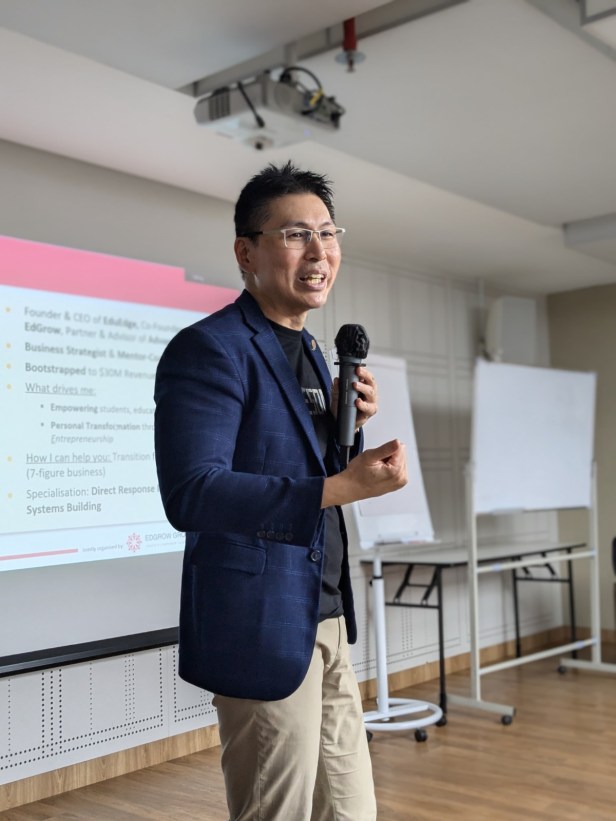
Meet Edwin, a former English teacher who took a bold leap—leaving behind the security of the classroom to launch EduEdge, an English enrichment centre dedicated to transforming language learning into a practical life skill. Since 2013, he’s helped over 5,300 students across 150 schools not only improve their grades but also regain confidence in their ability to communicate.
What began as a passion for teaching quickly evolved into a full-scale education business grounded in methodology, mentorship, and systems thinking. Today, Edwin also coaches fellow edupreneurs to scale from $100K to $1M by mastering mindset, skillset, and strategy—proving that great teaching, paired with the right business foundation, can make a national impact.
What inspired you to leave the traditional classroom and start EduEdge?
I began teaching around 2006 and spent about 7–8 years there before deciding to transition out in 2013. One thing I realised over time was that the public sector had a slightly different definition of education from what I personally believed in.
Public education focuses more on holistic, all-rounded development, which is why teachers are officially referred to as General Education Officers rather than just “teachers.” In contrast, private education tends to be more academically focused and subject-specialised.
I wanted to specialise in English because I see it as a foundation for life skills.To me, public and private education aren’t competitors—they’re complementary. The key difference lies in the emphasis and focus of each.
What were the biggest challenges you faced when starting your education business?
One major challenge was the lack of resources and support. Coming from the public sector, we were used to certain perks. For example, if you needed something, you’d call for a tender or request quotations, and vendors would submit proposals—you just had to choose.
But when you’re bootstrapping your own business, it’s a whole different story. You have to learn, unlearn, and relearn constantly. You become resourceful out of necessity. The first few years were a steep learning curve—long hours, minimal pay, and a huge mental shift.
Self-doubt crept in often. Impostor syndrome was real. And to make things tougher, sometimes your biggest critics are your loved ones. I remember hearing things like, “Are you sure about this?” or “Why give up a stable job?” It was hard to hear, especially when you’re already dealing with so much uncertainty.
But I would also say your biggest critic can become your biggest supporter—once they see the results. Most people don’t realise the first few years of entrepreneurship are less about profit and more about survival.
EduEdge has helped over 5,300 students across over 150 schools. Can you share a story that truly reflects the impact your system has had on a student’s life?
We’ve had the privilege of helping thousands of students from schools across Singapore, and many of them initially struggled with English—some were on the verge of giving up.
But once they found the right method, everything changed. One case that stands out is a student who took her O-Level English exam three times. She first sat for it as a school candidate and scored a D7. She then retook the exam twice more as a private candidate.
She had been conditionally admitted to a polytechnic diploma programme in Early Childhood Education—her dream was to become a preschool teacher. By the time she came to us, she was in her third year and needed to pass O-Level English with a minimum grade of B4 to graduate.
You can imagine the pressure and impact on her confidence after multiple failed attempts. But she didn’t give up. She was determined and worked closely with us. She applied our methodology diligently, and in the end, she scored a B3—better than she had expected.
That moment was powerful for me. It made me realise that our work isn’t just about improving English grades—it’s about opening doors and transforming life trajectories. English is more than a subject; it’s a life skill that unlocks opportunity.
What mindset shifts did you have to make moving from educator to business owner?
One of the biggest adjustments was moving from an employee mindset to an owner mindset. That meant trading stability and security for uncertainty. I also had to wear multiple hats—teacher, administrator, marketer, and janitor.
I’d sum it up into three key shifts. First, moving from “I” to “we.” As a business owner, I’m no longer working just for myself—I have a team. We support each other and share a collective vision. I’m also accountable to those who chose to walk this journey with me, especially the early team members who believed in the mission when we were still relatively unknown.
Second, resource management. A business owner’s core role is allocating resources—be it cash, time, manpower, or energy. Learning to make those decisions wisely is key.
Third, building systems. I realised I couldn’t be the bottleneck. Great leaders make themselves obsolete by empowering others. It’s like the difference between a chef who cooks everything versus a restaurateur who trains a team to run the kitchen without them.
Many entrepreneurs think growth comes from working harder. But real growth begins when we learn to work differently.

Mindset is the foundation. If your mindset isn’t ready—like a computer’s hardware—you can’t run new programmes. Entrepreneurs need paradigm shifts.
You’re now mentoring other education business owners to scale from $100,000 to $1 million. What are the top three things you focus on?
My mentoring approach revolves around three core principles: educate, empower, and elevate. In practice, I focus on three layers: mindset, skill set, and strategy.
Mindset is the foundation. If your mindset isn’t ready—like a computer’s hardware—you can’t run new programmes. Entrepreneurs need paradigm shifts. They must learn to think differently before they can act differently.
Next comes skill set—the technical knowledge and capabilities. I work with mentees across six key pillars: strategic positioning, marketing and sale, operations, HR, systems and processes and lastly leadership.
You’re creating consistent experiences, building operational systems, and developing a business that can eventually run without you.
What do you think is the main reason most edupreneurs struggle to scale?
The biggest myth is that being a great teacher automatically means you’ll build a great business. Teaching and business require completely different skill sets.
Take McDonald’s as an example. They’re not known for having the best burgers, but their systems and processes make them one of the most successful global brands.
Many edupreneurs hold on to the belief that “no one can do it better than me.” That mindset makes them the bottleneck. Even those who understand this in theory often fail in practice—they don’t apply it consistently or lack the context to apply it effectively.
Business only grows to the extent that the founder grows. And knowledge, by itself, doesn’t equal application. You might know what to do, but if you don’t know how to apply it in context, it’s as good as not knowing. That’s the real gap I see.
What’s your vision for Singapore in the next five years?
One of the biggest forces shaping our world is AI—it’s no longer a trend, it’s a permanent shift. I believe those who use AI will replace those who don’t, and among those who do, the ones who use it well will outpace the rest.
In the education sector, we’re in a privileged position to mould the next generation. My hope is that both public and private education in Singapore will integrate AI responsibly and effectively—not just in usage, but in thinking.
We shouldn’t just teach students to use AI—we should teach them to think with AI. Like the invention of the calculator, it didn’t make us dumber—it freed us to solve higher-level problems.
The vision is to develop independent thinkers who can harness AI to solve real-world problems. That’s how we go from producing good students to world-class problem solvers.
If you could have a superpower for one day, what would it be and why?
I’d want the power of perfect clarity—or clairvoyance. Imagine being able to see the past, present, and future implications of every decision, person, or system. That would allow us to design better businesses, align teams more effectively, and make sharper strategic choices.
Even just one day of such clarity could give you a blueprint for years of growth. I believe every leader is one great decision away from a breakthrough.That kind of clarity would be the ultimate competitive advantage.
Connect with Edwin: EduEdge and LinkedIn.