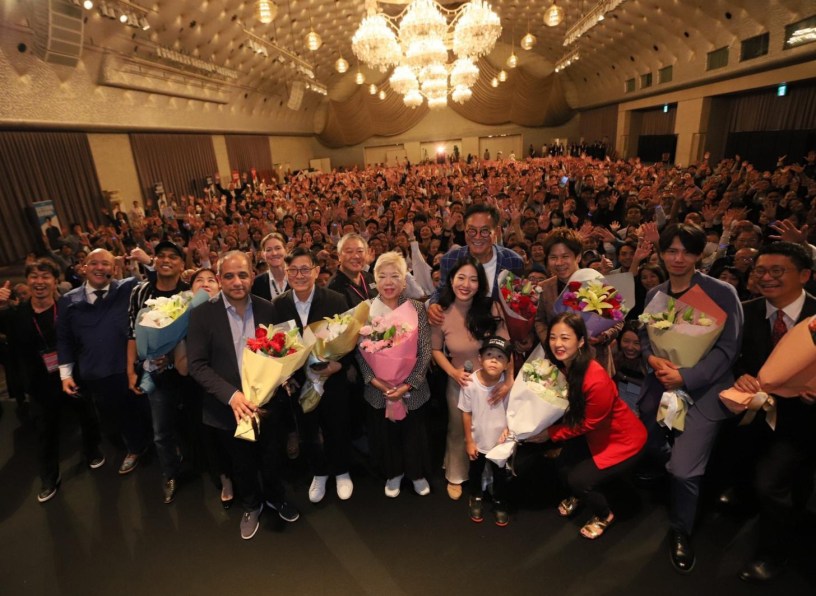
Meet Richard and Veronica Tan, the visionary duo behind Success Resources, the world’s number one seminar organiser. As co-founders, they transformed a humble idea into a global powerhouse, dedicated to empowering individuals through world-class education and personal development.
With a passion for transforming lives, they have brought internationally renowned speakers—including Robert Kiyosaki, T. Harv Eker, Tony Robbins, former President Bill Clinton, President Donald Trump, and Nick Vujicic—to stages across more than 30 countries. Driven by their mission to educate and inspire people to live their best lives, Richard and Veronica continue to lead Success Resources with heart, innovation, and an unwavering belief in human potential.
What inspired both of you to start Success Resources, and how did it evolve into one of the world’s leading seminar organisers?
Richard: We actually got into this a bit by accident. Over 30 years ago, there wasn’t a career in running conferences because at that time, there wasn’t even a school subject that taught you how to run a conference. Today, you have hotel management, conference and exhibition courses, and hospitality-related subjects—but not back then.
Veronica was a volunteer with a non-profit organisation, and I was out of a job—laid off, between jobs. A good friend of mine, the well-known Dr Patrick Liew (also a co-founder of Success Resources), who grew up with us, volunteered me to help run a conference. At the end of the event, someone came up to me and said, “Richard, you’re quite a good organiser—why don’t you do this full-time?”
Since I didn’t have a job, I said, “Why not?” That first conference was quite successful, and I simply duplicated it. And that’s how it all began—30 years ago. From a volunteer conference, we went into running full-time events.
Success Resources has worked with some of the most well-known names such as Robert Kiyosaki and T Harv Eker. How do you choose these speakers and topics for your events?
Richard: That’s a very good question. In fact, we didn’t start off with them. We started with many local speakers—smaller events with local talent. The key thing is, when you do a small job well, the universe gives you a bigger job. That’s how it happens over time.
Every programme we ran, no matter how small, we made sure to overdeliver. Word spread. So when someone wanted to come to this part of the world to speak, they’d ask, “Who should we work with?” And many people would say, “Success Resources.” That’s how we slowly got to know all these international speakers.
Veronica: In choosing them, especially in the early days, we were drawn to those who had written powerful books. Even before Robert Kiyosaki’s book came out, we had heard his tapes and were convinced his message was powerful—we wanted to bring it to the world.
We used to go to bookshops and look at the bestsellers. That’s how we brought in names like Zig Ziglar, Tom Hopkins, Joe Girard, and Jim Rohn—pioneers in personal development.
Conducting over 500 events annually in more than 37 countries is no small feat. What are some of the biggest challenges you’ve faced, and how did you overcome them?
Richard: The biggest challenge has never been the organising of events—but people. Getting the right people, training them, and building the right team is always the hardest part. Hiring is not just an art or a science—I believe it’s luck.
Someone may have a good resume but not be able to do the job. Even if they can do the job, it doesn’t mean they fit in with the team. Chemistry is very important. So team building and staffing are the biggest issues.
Veronica: And by “people,” we also mean partners. We do so many events because we believe in collaboration and partnerships. We’ve built and trained partners in different parts of the world to help us scale to 500 events in the good old pre-COVID days.
How has the personal development and business education industry changed since you first started, and how has Success Resources adapted to stay ahead?
Richard: The message hasn’t changed. To be successful, you still need to work hard, have goals, stay driven, and never give up. That part hasn’t changed.
But the way we deliver and market the message has evolved drastically. When we first started, there was no internet. We relied on direct mail, radio, and TV. Later came the internet, then social media, and now AI.
So while the core message remains the same, the delivery and marketing methods have changed—and we’ve kept up with those changes.

We measure our impact by how many lives are changed—whether it’s in wealth, relationships, marriages, or personal growth. It goes far beyond just money.
What do you think makes a seminar truly transformative for participants?
Richard: A seminar is truly transformative when the participants’ lives change—from where they are now to where they want to be.
Everyone has goals and dreams. And whatever your dream is—someone out there has already achieved it. For example, if your goal is to make a million dollars, you only have to look around you—there are people within a 2km radius who have done it. So it’s not impossible.
It just means they know something you don’t or are doing something you aren’t. When you learn the skills and get the tools, that becomes transformational.
Veronica: We measure our impact by how many lives are changed—whether it’s in wealth, relationships, marriages, or personal growth. It goes far beyond just money.
Can you share a success story that made a real difference in someone’s life?
Veronica: There are many, but I’ll share one. We had an ex-staff member who worked for us in London. She was very hardworking, hungry to learn and grow, always practising what we taught. After leaving our company, she went back to her hometown in Central Asia and started doing what we do—on a smaller scale.
Today, she is one of the most successful speakers in Central Asia. She’s financially free and highly respected. And there are many such stories.
Richard: Many Singaporean and Malaysian coaches and speakers today have, at some point, been through a Success Resources seminar.
What are your future plans for Success Resources?
Richard: Both Veronica and I have been in this industry for over 30 years. We love what we do. We’ll continue—not for money—but in service to others.
Our goal now is to help young people, like our staff, become better than us and eventually take over what we do.
What’s your vision for Singapore in the next five years?
Richard: After travelling around the world, we know Singapore is an amazing, well-managed place. Following the path of our late Prime Minister Lee Kuan Yew, the current ministers have managed this small country so well—it’s one of the most successful nations in terms of quality of life and economy.
Did you know Singapore is one of the countries with the longest life expectancy? We’re now considered one of the “Blue Zone” countries—just like Japan and parts of the Mediterranean.
This is largely because of how well the government has managed healthcare and infrastructure. I’m proud to be Singaporean. When I travel and say I’m from Singapore, people respect that. It’s a brand in itself.
So my dream is that Singapore continues to be what it is today—and moves forward for the benefit of everyone.
Veronica: To add on, even though Singapore is known to be expensive—for both residents and tourists—we still have people flying in from all over the world to attend our events.
Despite the costs, they come because the value is there. That’s why we keep doing what we do—not just to run events but also to promote Singapore as a global destination and financial hub.
Connect with Richard and Veronica: SuccessResources.
We come to the second part of the interview, where we caught up with Oei Aisoen recently. Oei and Veronica, both dynamic entrepreneurs and passionate community builders, have teamed up for their latest project aimed at empowering women. Drawing from their own journeys of resilience and success, they are creating a platform that uplifts, supports, and inspires women to thrive in both business and life.
What inspired your mission to empower women, and how has your journey shaped that vision?
Veronica: Traditionally, women have been told to be seen and not heard, to stay in the background. What inspired me is the desire to break this status quo—to prove that women can also stand out. I believe women should be equally given the chance to show up, stand up, and speak up.
This can be done through education, by putting yourself out there, and by surrounding yourself with the right group of women—and even men—who empower and encourage you. That’s what inspires me.
What are the biggest barriers that women still face today globally, and how can we begin to overcome them?
Veronica: I believe the biggest barrier is still fear. There’s a lot of fear, limiting beliefs, and mindsets—especially when it comes to women and their roles in life. Once we get married or have children, we automatically shift our priorities to our husbands and kids. We forget ourselves.
These are limiting beliefs that we’ve seen through our mothers and grandmothers, and subconsciously, we’ve been conditioned to do the same. To overcome these beliefs, we must practise self-love.
Understand that you are important. You must love and care for yourself. If you’re not strong or healthy, you can’t care for others. Self-care and self-love should be a priority, whether you’re single, married, a wife, or a mother.
Also, women need to learn to be independent and emotionally resilient. Women are strong—we can multitask and do many things. But without education, especially in emotional intelligence, we may become needy and overly dependent, which is another form of weakness.
Oei: That’s what I learnt. I was brought up that way. I’m very thankful for Success Resources—that was my breakthrough. That was my turning point. I found my role model in Veronica. Through her, I learnt how women can be independent and still coexist with men.
Feminism, as I had read in books, seemed to reject the need for men. But I didn’t agree with that. I think men are important.
For many women going through divorce, the first challenge is emotional. Men are often more logical; women are emotional. That’s why they fall in love with us. But when you decide to go solo, balance the emotions with rationality.
Be strong mentally and financially. I’ve worked with women from all walks of life, including those from wealthy families and high positions.
Once they go through a divorce, everything shifts. When we meet, they say, “If you can survive, I can too.” And I always tell them, “Don’t just survive—thrive.”
Do you have any last advice you would like to give to women who are just starting their journey towards self-empowerment and leadership?
Veronica: My favourite phrase is: “Don’t be a woman who needs a man, be a woman a man needs.” That means we must grow into women of value—women who are confident and not 100% reliant on anyone. A man will appreciate a strong woman who can take care of herself.
Oei: But we also need to know how to balance strength with vulnerability. Have a mission and a plan, and stay true to it. Let the man need you. That’s how you win. For those who choose to run solo, there’s nothing wrong with that. Make yourself strong first. If love comes, it’s a blessing.

