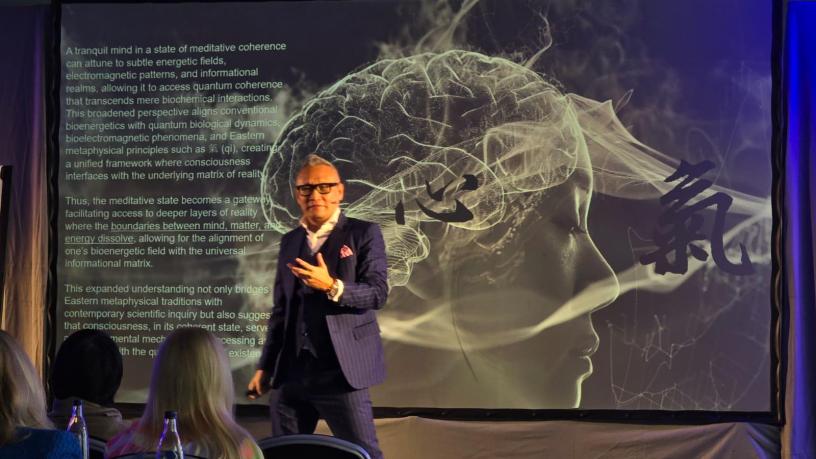
Meet Dr. David, a serial entrepreneur, author, and thought leader who has founded over 15 ventures across diverse industries since 1994. His entrepreneurial journey is driven not by domain expertise, but by bold intention, rapid learning, and a deep commitment to creating value where others see gaps.
Beyond business, Dr. Leong integrates Eastern philosophy, quantum physics, and mindset rewiring into his leadership philosophy. Drawing from the I Ching and neuroscience, he teaches entrepreneurs how to overcome self-limiting beliefs, make better decisions, and activate their future through clarity, energy, and intentional action.
You’ve founded over 15 ventures across diverse industries. What would you say is the common thread that ties all your entrepreneurial pursuits together?
When I started my first business in 1994 as a third-year university student, I didn’t have domain expertise in that industry—and the same goes for many of my subsequent ventures. The common thread across all of them is not industry knowledge, but confidence and intention.
Many people think you must be an expert before you start something. I believe the opposite. If I see an opportunity and believe there’s substantial value in that space, I’ll dive in, even if I don’t yet know how to organise it. I’m very clear about my intent to penetrate that industry.
Then I learn everything quickly, identify what’s missing, and create value through that gap. I build a model that is sustainable, run it until it’s stable, and move on to the next venture. Most young people hesitate because they focus on their limitations—they think they’re not confident enough, they don’t know enough people, or they lack experience.
But entrepreneurship is not about waiting until you’re ready. It’s about jumping in, staying afloat, and figuring things out as you go. That’s how confidence and intention have guided all my businesses.
Your economic work bridges entrepreneurship and Eastern philosophy. How do you see ancient Chinese wisdom like the I Ching influencing modern business strategy?
The I Ching has fascinated me since university. It talks about the warring states and uses divination to determine the right time to act. Strategy, at its core, is about timing. That resonated deeply with me. I couldn’t read Chinese well back then, so I struggled with the text, but I got the gist.
Even though I didn’t use the I Ching directly in my businesses then, I realise now in hindsight that it mapped closely to my journey. The Book of Change doesn’t necessarily change your life—it reveals how things are already unfolding, and how your intentions and decisions shape your trajectory.
The hexagrams, which represent yin and yang lines, help you understand the forces at play when you make certain choices. They provide clarity, not prediction. Knowing this doesn’t eliminate challenges, but it helps you respond with a sense of lightness rather than anxiety.
In your latest book, It Is in the Mind. Beyond Your Local Reality, you talk about quantum physics, neuroscience, and complexity theory. How do these concepts change the way we live our lives?
There’s a method to reorganise and rewire your mindset as an entrepreneur. Most people want to be successful—they say, “I want to make money, own a business,” but they wait for the right time or job. They tie their happiness to future events, hoping things will align.
The truth is, that mindset keeps you stuck. Your life is a simulation game. Your body produces chemicals based on how you think, and your personality is just a set of responses you’ve practised over time. If you say, “I’m not suited for business,” you’ve already defined your limit. That’s a self-imposed constraint.
The book teaches that if you want to succeed, you must pivot mentally into the future now. Think, behave, and feel as if you’re already living the future you desire. Your brain doesn’t know the difference between imagination and reality—it only responds to what you feed it.
When you get excited about a future vision and broadcast it, the universe aligns to help you. The frequency of your thoughts, your voice, and your actions becomes a signal. People will be drawn to your conviction and support you. This isn’t magic—it’s physics. Manifestation happens when intent, action, and frequency are aligned.


The real competition is not with others—it’s with yourself. Many people view others as competitors, but the real challenge lies in how well you can persuade, position, and present yourself. Success depends on your frequency—your energy, your style, your communication.
What are some common challenges people have when having a mindset shift?
Mindset shifts require action. It means going from one state to another, and that frightens people. Change threatens their sense of stability, even if they’re miserable. Misery becomes familiar—and familiar feels safe.
Unless someone has a catalyst—a crisis, a powerful experience, or an inspiring influence—they won’t flip that mental switch. Change often comes from encountering new frequencies, new energies.
Some of us are too comfortable saying “I don’t have higher qualifications.” or “I’m only good at this job.” That’s a loop of limitation.
When people listen to someone who truly believes in their potential, it activates something in them. That’s why I say: if you can do it, so can I.
You’ve been a regular commentator on economic trends. What major shifts do you foresee in Singapore’s entrepreneurial ecosystem over the next decade?
In the next three years alone, we’ll see major transformations. AI—especially large language models like ChatGPT—has already changed the way we work. It introduces a new paradigm.
This doesn’t mean that the fundamentals of business are obsolete, but the way we operate is changing dramatically. Traditionally, we were taught to memorise and acquire knowledge—chemistry facts, maths formulas—because competency was built through mental storage.
But AI now handles that. You no longer need to store everything in your head; you just need to know how to deploy AI effectively. It’s about connecting the dots. You don’t need to memorise each dot’s content—AI can do that for you.
Your job is to know where the dots are and how to draw lines across them to form a vision. Each person will draw different lines, forming different shapes and opportunities. AI will not eliminate business; it will redefine how we engage with it.
Whether you’re launching a business or crafting a solution, success will come from your ability to apply tools meaningfully—not just know them. This is what I teach even to my own children: learn fast, adapt quickly, and don’t be afraid to fail.
What advice would you give to young entrepreneurs who feel overwhelmed by volatility and competition in today’s market?
The real competition is not with others—it’s with yourself. Many people view others as competitors, but the real challenge lies in how well you can persuade, position, and present yourself. Success depends on your frequency—your energy, your style, your communication.
If people feel they can trust you with a project or business, they will choose you. That’s what matters. When I enter a new industry, I don’t necessarily have deep knowledge. I study what’s missing, where value can be added, and build from there.
That uniqueness becomes my advantage. Being different—not necessarily more experienced—is what attracts business. Don’t fear competition. It simply helps you measure where you are. You run your own race.
What’s your vision for Singapore in the next five years?
Singapore is now in the hands of the fourth-generation leadership, with Lawrence Wong navigating geopolitical complexities, particularly between the US and China. Regardless of what the West says, China is steadily rising.
With 1.4 billion people, if China can grow its middle class, it can sustain itself through domestic consumption. The US, with only 400 million people, has a trade deficit because it consumes so much and buys on credit.
Its power lies in the US dollar being the global reserve currency—this allows them to keep printing money to buy what they want. If that model is disrupted, the global balance will shift.
China’s advancement in automation and AI is moving quickly. In the next 18 months to three years, China may very well match or surpass the US in critical areas. They’re already running high-efficiency software on lower-end chips.
In my view, Singaporeans—especially our next generation—need to immerse themselves in the Chinese market and culture. If you can understand metaphysics like the I Ching, Bazi, or other frameworks, you’ll earn respect from Chinese businesspeople.
In the next decade, Chinese dominance is likely, and we must adapt with both skill and cultural depth to remain relevant.
If you could have a superpower for one day, what would it be and why?
I would choose the ability to travel at the speed of light and transcend time. Change only occurs when time exists. If you eliminate time, you enter a state of timelessness where things can be created and organised without constraint.
It’s the foundation of Einstein’s theory of relativity—time dilation, space contraction. That timelessness allows for clarity and precision. This is the secret to playing the long game. You begin to understand that everything that arises will eventually fall. Nothing is permanent.
So you play seriously, but with lightness of heart. You put in maximum effort, but without being burdened by emotions. Once you grasp this balance—serious action with emotional lightness—you master not just business, but life.
Connect with Dr. David: Facebook and LinkedIn.

