
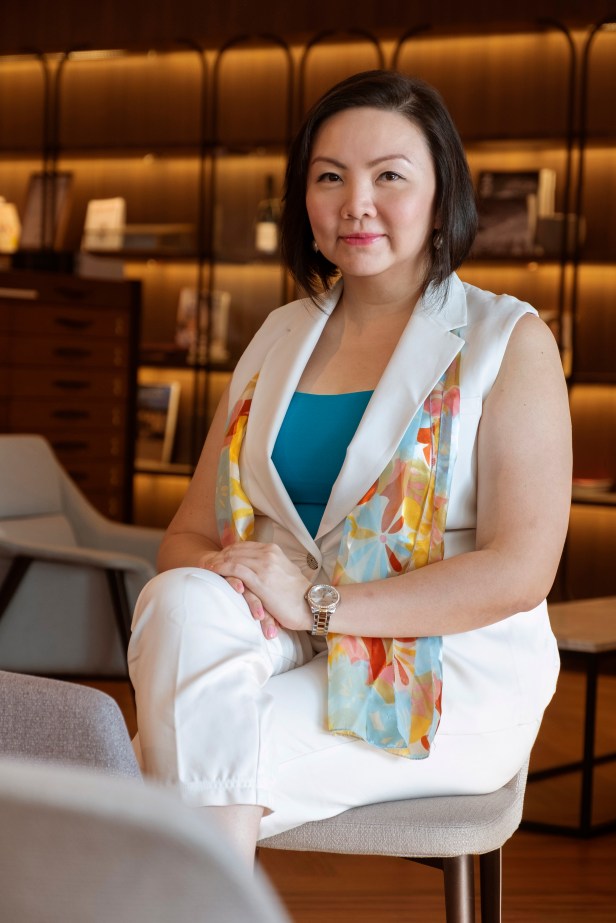
Meet Felicia, founder of Business Multiplier and a business coach on a mission to help entrepreneurs grow sustainably—without sacrificing their health, family, or values. Drawing from her corporate background and personal childhood experiences, she created a coaching model that blends strategy (the brain) with leadership and culture (the heart) to build scalable, sellable, and people-centric businesses.
Felicia shares how she transformed burnout into purpose, helped companies double in size, and turned young founders into confident leaders. She also opens up about her vision for Singapore’s SMEs, the challenges Asian businesses face, and why happiness in business is just as important as profit.
What inspired you to start Business Multiplier, and how did your own experiences shape the core values of your company?
I spent more than 10 years with one company. My last role was VP of Training and Communications. I was training over 100 salespeople, coaching all the sales directors, and I was also the go-to consultant for the marketing team whenever they needed ideas. So, I did a bit of everything.
When my corporate life ended, I was very sure I didn’t want to return to corporate life because it became very political at the top. I wanted to do something more meaningful—a blend of career and passion.
I got to know about business coaching through my mentor, who was already running a very successful coaching firm in Indonesia. She introduced me to the concept of business coaching.
The story that really moved me was about a law firm owner she coached. Although the business was very successful financially, her husband called her a horrible mother because she had no time for the kids. Even on holiday, her phone never stopped ringing.
That story hit home for me because when I was young, my mother’s business failed, and my childhood was quite difficult. I saw firsthand how the stress of running a business could wreck a family.
On the flip side, my uncle had a successful business, and I saw how that enabled a dream family life—his kids studied overseas, they built a life there, and they own multiple assets worldwide.
So, if I can help business owners build companies that support their families, it’s a mission I can dedicate my life to. I decided to start my own firm—Business Multiplier.
You emphasise that business owners shouldn’t sacrifice their lives and well-being for their company. How do you help them achieve that balance?
We hold a unique position. We call ourselves business coaches—some say we’re consultants, and that’s fine—but our role is really to be the external party who helps business owners put things into perspective.
Most of the business owners we meet are extremely busy and stressed. As their company grows, their stress grows too. They often don’t realise they’re holding on to too many functions, and because they’re running daily operations, they can’t pull themselves out of the hustle to gain clarity.
That’s where we come in. As outsiders, we can see what needs to be done to free them up. In Singapore, being busy is worn like a badge of honour. But what people don’t realise is that when you’re burnt out, you don’t even have the energy to fight, let alone strategise.
We help business owners get clarity on their direction. If you don’t know where you’re going, it’s like setting a boat adrift with no destination. It could float for 10 or 20 years, and you’re still stuck in the same spot.
Once we help them define their goals, we establish milestones and work backwards—what systems are needed, what strategies, etc. We guide them step by step, because if you look too far ahead, you’ll feel overwhelmed and take no action.
Can you share a few examples of businesses you’ve helped grow significantly?
One is a renowned mortgage loan brokerage company in Singapore. When they came to me, they were already the largest in the country, with about 20 to 30 people, but growth had stagnated.
The founder, whom I greatly respect, asked me to help develop his leaders. He was planning to launch new business units but felt the leadership team was still a bit siloed, focusing only on their own teams.
We came in, ran leadership programmes, coached on recruitment, and helped them build a strong employer value proposition. As they expanded, we also implemented a team culture programme. Within a year, they grew from 30+ to over 70 people. And when COVID hit, they kept growing past 90 staff.
Another example is a young founder who started her business before she turned 20. She’d been running it for over seven years with two part-timers and was doing well financially but felt stuck.
She joined our programme and within a year, her team grew from 2 part-timers to over 10 staff. Revenue increased by several hundred percent, and within 2–3 years, she bought her own office-slash-warehouse.
By the time we stopped working together, her team had grown to 35. Seeing her grow as a leader and seeing her team so engaged was very fulfilling.
Always aim to build a valuable, scalable, and sellable company. Without this as your North Star, you’ll chase too many things and end up with a business that sells too many services to too few people.
How does your brain-and-heart approach work in practice when coaching clients?
The brain-and-heart model is one of our key differentiators. The “brain” refers to strategy, systems, processes, and logical frameworks.
The “heart” refers to the human side—culture, engagement, team dynamics, leadership, and behaviour. In our early years, we deployed only brain-based strategies. While clients saw rapid growth in year one, it would plateau eventually.
That’s because no matter how good the systems are, if your people aren’t motivated, self-driven, and aligned with the vision, growth stalls. So, I became the master licensee of a team engagement and culture coaching framework.
It’s hard work—changing mindset and behaviour, getting people passionate about the founder’s vision—but it’s worth it. Once you activate both brain and heart, you unlock the next level of exponential growth.
What do you think are the most common obstacles that stop Asian businesses from scaling sustainably?
The biggest issue is what we call “the owner’s trap.” The owner is the centre of everything. When they’re away, the business slows down. Most owners believe they’re the only ones who can do things right.
In workshops, I ask business owners how many roles they handle—CEO, finance, sales, HR—and most of them say “everywhere.” If you’re only giving 20% to each role, there’s no way you’ll outperform someone giving 100%.
Another issue is that owners operate day-to-day without big-picture planning. They’re stuck firefighting instead of thinking long term. Without that mindset shift, many are stuck for years.
As a recognised speaker and coach, what is one insight you always emphasise when addressing SME growth?
Always aim to build a valuable, scalable, and sellable company. Without this as your North Star, you’ll chase too many things and end up with a business that sells too many services to too few people. This model is not scalable.
Owner-dependency is also a major killer of company valuation. You may love what you do, but one day, you’ll want to retire or move on. If your business depends entirely on you, it won’t be sellable. Even if you aim for global expansion, no one will invest if you’re the bottleneck.
Every decision you make should be measured against whether it makes your company more valuable, scalable, and sellable. Ultimately, the goal is to build a self-running team that runs the business better than you.
Looking ahead, what’s your vision for Business Multiplier’s impact across Asia in the near future?
Now our team is growing—we have several full-time coaches, a few associates, and we’re still hiring.
We’re well known in Singapore with a strong track record and are now coaching clients in Indonesia and Malaysia. Some of our overseas clients are large-scale companies with 500+ staff.
Our vision is to have a stronger presence in Malaysia and Indonesia in the next three years, while solidifying our role in Singapore as the go-to coaching and consulting firm known for delivering results with both brain and heart. We’re impact-driven—our mission is “happiness in business, happiness in life”—and we aim to make that a reality for every client.
What’s your vision for Singapore in the next five years?
Singapore is a unique marketplace—small, but rich in resources and government support. Our vision is to help more businesses become sustainable and profitable while employing passionate people who are proud of their work.
We also want to help more Singapore brands expand overseas. The market here is limited, but the talent is world-class. We want to see our clients gain global recognition while building happy, thriving companies.
If you wake up tomorrow with unlimited wealth, what is one thing you would never spend on?
If I had unlimited wealth, I would never spend on anything that harms the environment. Aside from the obvious things like weapons or drugs, I’m very much against businesses that profit at the expense of our planet.
Some of our clients are in sustainability, and I believe if we have all the money but destroy the Earth, what’s the point? So, I would never support anything that threatens our future or the environment.
Connect with Felicia: BusinessMultiplier, Facebook, and LinkedIn.
Felicia is a member of Rainmaker, a revolutionary movement that rallies like-minded people together based on the values of Love, Authenticity, Respect, Kindness and Youthfulness (LARKY).

