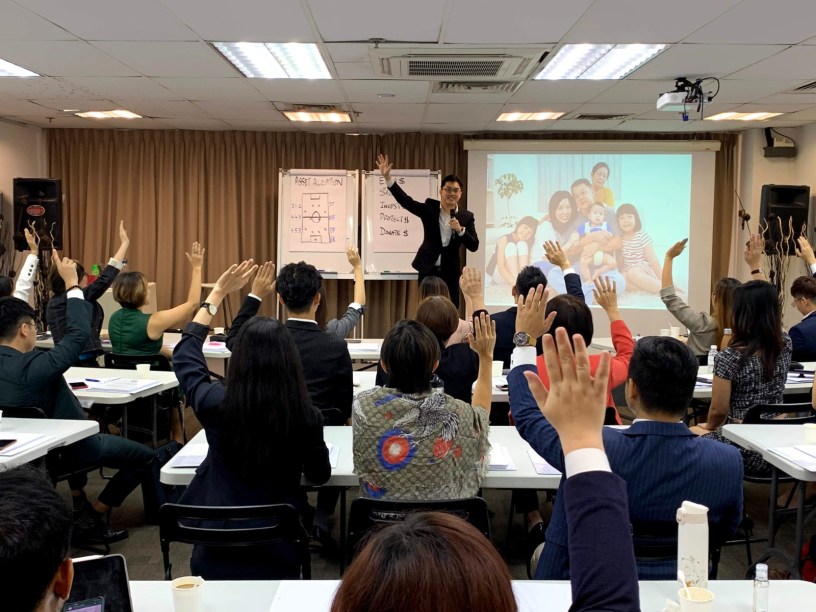
Meet Samuel, the digital consultant powering business growth with strategy and AI. With a unique blend of classical design training and marketing expertise, Samuel has spent over a decade helping SMEs transform their business models through digital strategy. What sets him apart is his ability to marry aesthetics with effectiveness—bridging the creative and business worlds to drive real impact.
From scaling a single dental clinic into an 11-outlet chain, to introducing AI-powered business systems and strategic brand positioning, Samuel has earned a reputation as a high-impact change agent. Through creative problem-solving, market research, and an acute understanding of emerging trends, he equips entrepreneurs with the clarity, tools, and mindset needed to thrive in today’s competitive digital landscape.
What inspired you to start a business as a digital business consultant and how did your journey begin?
My idea started off ever since I graduated. I’m both a classically trained designer and a classically trained marketer. So I have formal education in these two areas. I like to see myself as someone who can actually merge these two different schools of thought.
In design, everything just has to be nice—it doesn’t really talk about effectiveness. Whereas in the business or marketing world, it’s all about making things effective. In the past, there was a trend where people were so focused on effectiveness that they totally ignored aesthetics.
Like in the past, catching attention through ugly ads was common—just to optimise for effectiveness. But with my background as a designer, I’m able to help businesses while incorporating aesthetic sense.
I’m very inspired when I see companies actually make money and they thank me after that. Ever since I graduated, I started helping one company and I saw the smile on their faces—it continued to propel me to take the next step, work for more companies, and help them on their digital transformation journey.
So you have been described as a high-impact change agent. Can you share an example where strategy directly helped double or even triple an organisation’s revenue?
The thing is, it’s good for me to be outside the business. I don’t talk to the boss like just any other staff on a monthly basis. When we go in as business consultants, we provide a second pair of eyes for their business.
Sometimes, the advice we give is very simple—it’s just that people inside the company may not feel comfortable telling the boss. One example is a dental organisation I joined. Based on past experience, I helped many companies dominate their industries.
We used strategies to dominate the first page of search results. We helped them use different brand names so that whatever keyword someone typed in, all the results on the first page would lead back to them.
So no matter which link someone clicked, it would come back to us. This client grew from one clinic to now having about 11 clinics. We didn’t just double their business—it grew four to five times. We were there throughout the process, and the client is very grateful.
What are a few challenges businesses face when scaling up, and how do you help them overcome these?
Usually, the challenge is the lack of a mindset for testing and scaling marketing efforts. Business owners are very good in their craft, their technical skills—whatever their field may be. That’s why they started the business.
But this is where we come in—as marketers or change agents—to teach them simple but powerful concepts. For example, setting aside 20% of revenue to reinvest into marketing or scaling. Many business owners still operate on the old-school model—allocate a fixed yearly budget and that’s it.
But for SMEs we work with, this model doesn’t work. They’re still small, so they need to be flexible. Often, they allocate just $10,000 or $20,000 and spread it across the whole year. If they had the mindset to double down on winning campaigns, they could scale faster. From small business to medium-sized, the growth can happen quickly with the right advertising strategy.

This client grew from one clinic to now having about 11 clinics. We didn’t just double their business—it grew four to five times. We were there throughout the process, and the client is very grateful.
What are some key traits you believe are essential to building a high-performing, customer-oriented team?
Over the years, I’ve seen the traits change because every stage of business life requires different things. In the past, it was all about processes and giving responsibilities properly to my staff, with systems in place to support that.
But now, with the advancement of AI, everything is changing. I believe adaptability is the most important trait now. If a team doesn’t adapt to current business trends, technology, or the environment, the business will die out.
Every era had its own keys to success—industrial age focused on systems and factory-like operations. Today, it’s about continuously learning, evolving, and staying relevant.
How do you apply creative problem-solving in your consulting work?
In our consulting work, creative problem-solving involves benchmarking and analysing what competitors are doing. If a business is in a sunset industry, I’ll be upfront about it—there’s nothing much we can do.
But often, during consulting, we help clients craft future business models that they can pivot to. We do market research and competitor analysis. If there’s an opportunity aligned with their skill set, but not in a sunset industry, we help them explore it.
Creative problem-solving, in our context, means offering future-ready directions that are still aligned with their core expertise but open up more revenue channels.
In your opinion, what do you think makes a good entrepreneur?
I think first and foremost, a good entrepreneur must understand themselves well. A lot of advice on the internet may not apply to everyone. There are two parts to this: number one, what stage of entrepreneurship you are in, and number two, your personality.
For example, I’m an introvert—I do a lot of thinking and preparation before meeting a client. Someone else might be a natural people person—they need to meet more people to thrive. So the best entrepreneurs know their strengths and use them. If you’re quiet, use your quiet strength. If you’re loud, use your presence.
Next, you need to know what strategy to apply at different stages of your business. A startup needs to run growth-hacking strategies, but once the business grows and you have more staff, you become the conductor—you’re no longer facing the market directly.
Like Roger Hamilton’s Wealth Spectrum model says—at each stage, the entrepreneur’s role changes. Know yourself and apply the right strategy.
How do you see the digital consultancy landscape evolving, and what skills will be the most valuable in the near future?
With AI, everything is shifting fast. When ChatGPT first launched, even consultants from big firms were using it to write entire reports. There was a viral tweet about someone seeing a top consultancy guy writing a full report using ChatGPT on a plane. So things like reports and automation can all be handled by AI now.
When people say AI can’t think—I think what’s more important is knowing how to ask the right questions. As consultants, we’ve seen many business scenarios, so we know how to ask the right questions at the right time. That’s our value.
We’ve been exploring AI long before ChatGPT became mainstream. The most valuable skill moving forward is not just knowing the tools, but knowing what to ask and when to ask it. That is the real strategic thinking.
What’s your vision for Singapore in the next five years?
I’m not a politician, but this is something I’ve shared with many business networking groups. I talk about a concept I call the “AI Org Chart.” Most people use AI just for productivity—to write reports faster. But for business owners, small productivity gains don’t necessarily lead to more sales.
That’s why we work with businesses to build an AI-driven organisation chart. Imagine every company having AI agents running across departments, executing tasks based on a larger directive.
For example, a chairman or CEO sets a directive and the agents execute it across sales, marketing, HR, and operations. With the right tools, we can systemise all of this. That’s how I see the future—AI will be embedded into every department, working like brains within the company.

