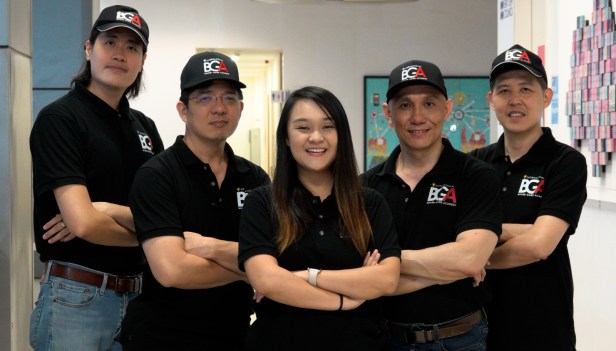
Meet David, founder of IBGA, who is on a mission to bring modern board games into the national spotlight. As a dedicated board game coach, he believes these games are more than just entertainment—they’re powerful tools for building critical thinking, social skills, and emotional resilience.
Through workshops, partnerships with student care centres and public outreach/awareness events, David hopes to cultivate a board game culture that not only offers a refreshing alternative to screen-based entertainment but also uplifts. His ultimate goal is to spark a nationwide appreciation for modern board gaming as a catalyst for emotional wellness and community building.
What inspired you to found IBGA and use modern board games as a medium to help children discover and refine their life skills?
It was 2010, and I had just started working at SAP, the Germany-based global software company. During one of our management orientation meetings, a colleague was tasked with coming up with an ice-breaker, and he brought out this super engaging game called Werewolves.
I had never played anything quite like it before—the player interaction was on a whole different level compared to the old-school board games I grew up with. Naturally, I was hooked and had to know if there were more games like this out there. He pointed me toward a specialty board game store in town, and that was the start of a whole new chapter for me.
Over time, I ended up building a collection of over 100 unique board game sets. What’s even better is that I got to share this hobby with my elder daughter, Cherylene. She’s just as passionate about board games as I am, and it’s become our favourite way to bond.
Cherylene was just 11 at that time. Fast forward a decade and she’s studying Psychology at NUS. One day, she suggested that I should use my training skills to introduce more kids to the world of modern board gaming. I loved the idea, but I thought—why not team up and do it together?
That’s how IBGA came to life—a father-daughter project. I handle the coaching, while Cherylene brings her expertise in child psychology (children & adolescent development) to the table. And that’s the story of how a simple ice-breaker at work turned into a life mission that is having a positive impact on the community and nation.
How do you balance fun and structure in your coaching sessions to ensure both enjoyment and skill development?
IBGA’s Coaching Programme is designed to support children through three progressive stages of their board gaming journey, Explore, Engage and Excel, each with a distinct focus and set of objectives.
The Explore stage serves as the entry point for children who are new to modern board gaming. Participants are introduced to simple modern board games, with an emphasis on enjoyment and social interaction rather than competition. The primary goal is to foster a positive first experience, allowing children to discover the fun in game mechanics and group play.
The Engage stage offers weekly sessions for children who wish to deepen their interest in modern board gaming. These 90-minute sessions are held every Saturday morning at Edventure Learning Academy, a student care centre attended by many IBGA students. This stage provides ongoing opportunities for children to explore a wider variety of games, build friendships in a supportive environment, and develop their social and communication skills.
The Excel stage is tailored for children who aspire to achieve advanced proficiency in modern board gaming. At this level, participants receive specialised coaching to prepare for community, national, regional, and global tournaments. IBGA’s Tournament Preparation Programmes are customised for competitive play and are available by application or special invitation. Greater parental involvement is encouraged to support children throughout the tournament seasons.
Have you observed any surprising transformations in your students through your programme?
True transformation isn’t always obvious in the day-to-day, but when you look back over six months or a year, the progress is remarkable. I want to shine a spotlight on Alvin Tham, one of my most dedicated students, whose journey has been nothing short of inspiring. What truly surprised me was the speed at which Alvin blossomed under IBGA’s structured coaching programme. He joined IBGA’s Explore programme during the September 2023 school holidays and very quickly moved on to the Engage phase of the programme.
In just six months, his parents noticed a profound change: Alvin became more focused and disciplined—not only at the board game table but also in his studies. The skills he picked up in time management, sustained concentration, and strategic thinking translated directly into his academic life. Even more, his outlook and personality became noticeably more positive and outgoing, as his self-esteem and confidence soared among his peers.
Alvin’s story is a testament to the power of play-based learning—how modern board games can spark not just cognitive growth, but also resilience, empathy, and a love for learning. At IBGA, we see these transformations every day. It’s a reminder that, with the right support, every child has the potential to surprise us with how far they can go.
Alvin, alongside his teammates, Emma Choo and Allyssa Frois are students in IBGA’s Excel coaching program. The trio stands as a luminous beacon among the prodigious young talents gracing the grand stage of the World Series of Board Gaming (WSBG) Asia Satellite Tournament.
This illustrious event, set to unfold in Singapore from May 31 to June 2, 2025, heralds the inaugural quest to crown the continent’s first-ever Asia Modern Board Gaming Champion. With the eyes of the region and the world upon them, these gifted gamer-learners embark on a formidable journey to etch their names in the annals of competitive modern board gaming history.
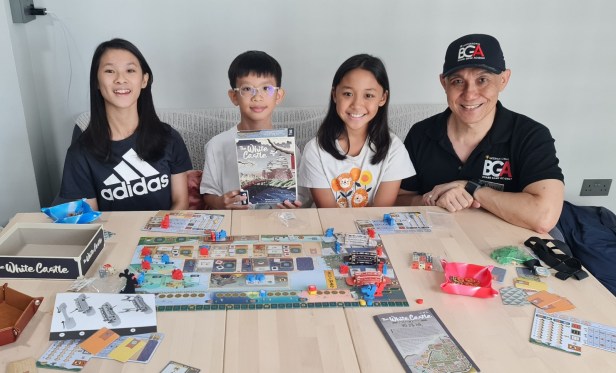
Children don’t automatically play well together. Oddly, parents often wrongly assume they do—when evidence often suggests otherwise. Left to their own devices, kids often play side-by-side rather than truly interact.
What are some key values or skill sets that modern board games naturally teach, and how do you reinforce them?
Many astute parents I’ve spoken to chose IBGA because they recognise that essential life skills aren’t always learned naturally or in traditional classrooms.
Children don’t automatically play well together. Oddly, parents often wrongly assume they do—when evidence often suggests otherwise. Left to their own devices, kids often play side-by-side rather than truly interact. “Sharing toys” can quickly lead to conflicts that often end in tears.
Modern board gaming, as practised at IBGA, creates a structured yet fun environment where children learn to play fairly, follow rules, and respect others. Every child at the table is guided to take turns, think through their moves, and communicate with courtesy.
Board games require everyone to play by the same rules, teaching children the importance of fairness, order, and respecting boundaries. Waiting for their turn helps children develop patience and self-control, as well as the ability to think ahead and strategise.
Kids practise expressing themselves clearly and listening to others, learning to appreciate different perspectives and handle wins and losses graciously.
When a child learns a new game, masters its rules, and starts to apply effective strategies, their confidence grows. IBGA’s coaches support each child, helping them develop critical thinking and problem-solving skills that extend beyond the game table. Children experience the satisfaction of planning well, making smart moves, and sometimes even surprising their peers with brilliant plays.
Sometimes, a child’s clever move might leave others feeling outplayed, even stirring feelings of jealousy. IBGA coaches turn these moments into positive learning experiences, teaching children to appreciate each other’s successes and use them as opportunities to learn. It promotes a supportive and collaborative atmosphere.
With the WSBG Asia tournament approaching, how are you preparing your young participants to face adult players?
A child’s mindset is the foundation upon which all growth and achievement are built, especially in the world of competitive modern board gaming. When a young prodigy steps up to compete against seasoned adult players in a regional modern board game tournament, it’s already a remarkable accomplishment—one that speaks volumes about their courage, curiosity, and potential. The experience itself—regardless of the outcome—becomes a powerful learning opportunity.
I remind our young participants that this tournament is not a one-time event, but rather the first step in a journey filled with many more competitions ahead. With each tournament, their confidence will grow, their skills will sharpen, and their resilience will deepen.
One of the most empowering insights I share with my students is that they have a hidden advantage: their recent experiences with academic exams. They are already familiar with the pressure, the adrenaline, and the importance of preparation.
I encourage them to draw on those moments—reminding them that, just as they have studied and succeeded in school, they are equally equipped to handle the intensity of tournament play. The nerves they feel are not a sign of weakness, but rather a sign that they care—and that they are ready to rise to the occasion.
What do you think makes a good entrepreneur?
What distinguishes a successful entrepreneur from a mediocre one is not just business knowledge, but the ability to innovate and deliver creative solutions that address real market needs. True entrepreneurial strength lies in identifying gaps in the market, developing a compelling value proposition, and executing with agility.
Innovation is the engine that drives differentiation and long-term growth, especially in dynamic sectors like children’s education, where new ideas and engaging experiences are in high demand.
However, innovation alone is not enough. A good entrepreneur possesses the business acumen to effectively market their solution, ensuring it reaches the right audience and achieves commercial viability. This includes understanding target demographics and leveraging appropriate sales channels—such as institutions of learning, student care centres, and children’s enrichment centres.
The ability to clearly articulate its business model and pitch key ideas to sponsors and venture capitalists is also critical to IBGA’s Go-To-Market strategy.
What are your future plans to expand the reach and impact of modern board gaming on life skills – for example, in schools and communities?
IBGA’s proactive engagement with industry players in the children’s education & enrichment space—as well as with other stakeholders including parenting groups, educators, and coaches—reflects a strategic approach to building a robust ecosystem around modern board gaming as the choice play-based learning tool for youth development.
By collaborating with these groups, IBGA can tap into established networks, better understand the evolving needs of families, and co-create programmes that are relevant and impactful for children’s holistic growth.
Looking ahead, IBGA plans to approach Singapore’s Ministry of Culture, Community and Youth (MCCY) to seek government support and incentives. The ministry actively partners with organisations to provide grants, facilitate industry collaborations, and support ground-up initiatives that align with national objectives for youth engagement and community building.
Connect with David: IBGA, Facebook and LinkedIn.
David is a member of Rainmaker, a revolutionary movement that rallies like-minded people together based on the values of Love, Authenticity, Respect, Kindness and Youthfulness (LARKY).