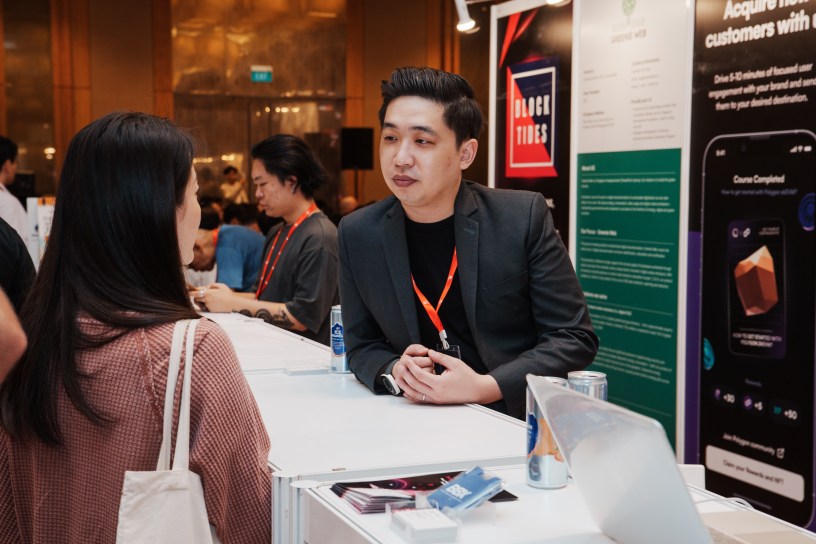
Meet Sebastien, a dynamic business development leader whose journey began in the skies with the Republic of Singapore Air Force. After being grounded due to a medical condition, Sebastien pivoted his career with remarkable resilience—transitioning from aviation to sales and eventually to business development.
Armed with strong communication skills and a deep-rooted ethical compass, he has since worked across multiple industries, building lasting client relationships and championing strategic partnerships. Today, Sebastien is known not just for securing major contracts and scaling startups, but also for his principled approach to leadership and deal-making which has enabled him to thrive in uncertain times.
What inspired your transition into business development and how does your MBA shape the strategic thinking in this role?
I was initially from the RSAF, and I was a flight crew with the C-130—one of the few to be sent to train with the USAF in the US. I was later diagnosed with severe sleep apnoea, which grounded me and meant I could no longer fly.
From then on, I started considering alternative careers. I wasn’t entirely sure what I wanted to do, but I knew I could articulate myself well and was confident in communication, so I thought, “Let’s try sales.” That was my first foray into sales and business development, and I gradually built my skill set.
Along the way, I upskilled with an MBA, which helped me adopt a broader, more strategic view—beyond just selling a product. I began to focus on how to create mutually beneficial partnerships, offer solutions that create stickiness with clients, and deliver value that lasts even if I move industries.
The goal is for clients to remember having had a positive experience working with Sebastien and to remain open to collaboration. It’s also about building genuine business relationships through proper networking and structured development, rather than relying on outdated brick-and-mortar sales methods like cold-calling.
Can you walk us through one of your most successful client relationship stories, and what do you think made it work?
One of my most successful client stories was when I started out in medical sales. In the medical field, it’s essential to always be anchored in the welfare of the patient. I made a conscious decision to focus not on my personal KPIs but on putting myself in the client’s shoes.
This builds a foundation of trust—they know you’re not just trying to hit your numbers. For one particular client, I arranged an endoscopy that revealed a polyp, which turned out to be potentially cancerous.
After removal, he referred his entire family to me, given the hereditary risk. His brother was discovered to be in an even more advanced stage—stage 0—and had the polyp removed too. The trust that followed led to many more engagements and checks they asked me to help arrange.
Even after I left the medical industry, we stayed in touch and collaborated on various projects. The key is ethics—I never push something I wouldn’t buy or believe in myself. That ethical foundation has allowed me to build trust that extends across industries, and clients follow me wherever I go.
With your cross-industry experience, what do you believe are the most critical elements for sustainable business growth today?
As a leader, ethical leadership is 100% critical. In today’s unpredictable climate—with geopolitical disruptions, tariffs, and events like COVID-19—trust is everything. Building an ethically grounded business ensures people are confident putting their money or partnership into your hands.
It gives stakeholders peace of mind that you will leave them in a better place than where they started. Ethical business builds long-term relationships. I actually wrote an MBA paper on how ethical leadership affects employee turnover in Singapore.
The Chinese saying “上梁不正下梁歪” (If the top beam is crooked, the lower ones will be too) applies—if leaders don’t show ethics, their teams will follow suit, and the business will collapse like a house of cards.
When leaders maintain integrity, they earn the right to take the moral high ground when challenges arise. Without it, the whole system becomes unstable, and good talent walks away.
How do you balance short-term sales goals with long-term strategic planning when supporting a start-up business?
A common mistake in sales is putting all your eggs in one basket and hoping the deal closes. To ensure sustainability, I implemented a disciplined sales routine for my team. It starts with five outreach activities per day—email, WhatsApp, or calls.
That’s 25 a week, 100 a month. If 50% respond, that’s 50 conversations, leading to around 25 meetings, 10 proposals, and 3–5 closes. It’s manageable and scalable. It also includes staying in touch with clients who’ve previously said no or had technical issues.
For example, I lost a deal in September last year due to payment limitations, but I maintained the relationship and found a solution by April. That deal later closed because we had since partnered with a payment provider that could accommodate their requirements. This approach builds a strong pipeline and confidence, avoiding the common fear of “I’ve run out of people to talk to.”
At our company, we believe bold ideas deserve bold marketing. That’s why we delivered 300 piping-hot pizzas to 170 startups across Singapore—sparking conversations, creating smiles, and showing that innovative outreach can be both fun and unforgettable.

As a leader, ethical leadership is 100% critical. In today’s unpredictable climate—with geopolitical disruptions, tariffs, and events like COVID-19—trust is everything. Building an ethically grounded business ensures people are confident putting their money or partnership into your hands.
You recently secured a large contract with a major tech company. What were some of the key challenges you overcame during that process?
In Singapore, compliance is a major concern for most companies. Especially in our context—my firm provides cloud services and billing aggregation—clients often worry about data access and privacy.
The first question was: Can we access their data? Will we access it? What could we do with it? I reassured them that we are ISO 27001 certified and that we don’t touch their data; we only manage the billing. I even drafted a customised clause in the contract, stating that if the client ever finds their data compromised, they could exit the contract immediately with no penalties.
That move alone showed how far I was willing to go to build trust. Putting it in black and white left no room for doubt, and that transparency helped us close the deal with a major client.
You mentioned being an academic. How do you think continuous learning enhances your professional development and client engagement?
Staying ahead academically and through reading offers a distinct advantage when it comes to client engagement and relationship-building. Some clients may be more or less informed than you, so being current allows you to either guide them or match their knowledge level.
For example, understanding geopolitical trends—like tariffs or elections—helps me anticipate their impact on the market. Some may say, “Singapore doesn’t export much to the US,” but if your client’s client does, then it will eventually affect you too.
Staying well-read and up-to-date enables you to prepare, advise, and align your business solutions with both current events and future developments. That’s why continuous learning is essential for high-quality business development.
What makes a good entrepreneur?
Adaptability. The best entrepreneurs know how to pivot. If I were running an events company during COVID-19 and refused to change, I’d be out of business. The world moves fast—generative AI, CRM systems, ERP platforms—all must be considered and adopted accordingly.
Good entrepreneurs don’t just react; they forecast and prevent. They integrate the right technology, plan for challenges before they arise, and stay open to change.
Alongside adaptability, ethics is vital. You need to be in a position where clients and stakeholders trust you. That trust becomes the foundation of your resilience and influence.
What’s your vision for Singapore in the next five years?
Singapore is already a top destination for business. Having spent eight years in the startup space, I’ve seen first-hand how conducive Singapore’s ecosystem is—with robust government support and active associations.
In the next five years, if businesses come in with the right strategy and tap into support schemes effectively, they stand a great chance of success. It’s important not to overcommit—don’t take on unnecessary office space or hire too aggressively.
If companies are lean and efficient while leveraging available resources, they’ll do well.
Politically, things have stabilised post-election, and I believe the current leadership will handle global challenges well. Singapore will continue to be a hub—a safe, stable, and attractive base for regional headquarters and high-growth opportunities.
Connect with Sebastien: LinkedIn.


Incredible journey—from flying high in the RSAF to soaring in the business world. Sebastien’s story is a reminder that adaptability, integrity, and empathy aren’t just buzzwords—they’re competitive advantages in business today. Check out Sebastien’s profile https://global-dbn.com/profile/sebastien-khoo
LikeLike