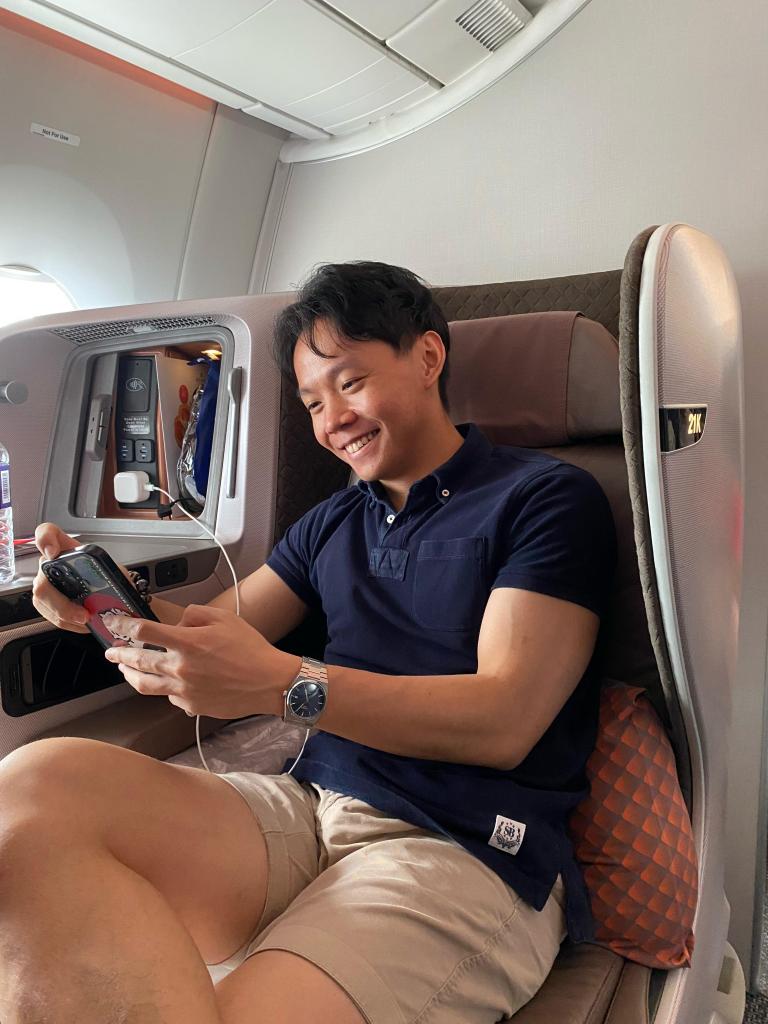
Meet Wen Yang, a visionary who offers a refreshing philosophy centred on achieving true lifestyle freedom through mastery of health, financial independence, time, location flexibility, and meaningful community. In today’s fast-paced world, many pursue success relentlessly, only to find themselves burned out, disconnected, and unfulfilled.
Having helped over 300 busy professionals transform their health and optimise their performance, he is passionate about building systems — not just chasing outcomes — to create sustainable success. As Singapore evolves, Wen Yang envisions a future where individuals are not only financially secure but also physically vibrant, mentally resilient, and part of supportive, high-performing communities.
What does lifestyle freedom mean to you personally, and how has that philosophy shaped your entrepreneur power?
If you ask me, I think overall lifestyle freedom is seeking how you can be disease-free, working on your finances, your time, and starting to be location-free.
And also being part of a community that can keep you accountable, build meaningful relationships, and have that sense of belonging and realise that you are giving purpose and joy to the people around you.
I think that’s how I define lifestyle freedom and how it guides me in my entrepreneur journey.
You have started multiple ventures from F&B to the agency world. What was the biggest lesson you took away from these experiences?
Having run F&B previously — I did it before my NS — the one thing that I realised, even though it was very successful at that point of time, is that without a system, process, or an operational manual, it led to the downfall of the entire brand and business.
I was running this brand called The Butcher’s Flaming Beef Bowl. We were quite popular. We had a restaurant at Suntec, and I was doing out all the SOPs and everything. But in due time, because the lead time wasn’t enough and I had to hand it over, it collapsed without the proper systems.
If you don’t build systems that can run without you, you will burn out very fast. And if you burn out, your brand and business will burn out as well.
For agency work, I would summarise it into one word: positioning. Having worked with many different brands and companies, I realised positioning is key. Sometimes we are not very sure what our positioning is. If we are not sure, the efforts we put in might go in the wrong direction.
One degree off can make your entire objective and outcome very different from the initial standpoint of what you want to achieve. So in my agency experience, working with press, working with people, the defining thing is positioning.
What are some daily habits or practices that you believe are key to achieving sustainable high performance?
When you wake up, try to declutter your mind. Many times, a lot of people in the busy environment these days don’t declutter. The moment you wake up, you pick up your phone and reply to messages.
But you realise that the act of picking up your phone and replying to messages doesn’t allow your brain to take that moment when you wake up to digest, reflect, and really meditate on what you want to achieve for the day.
Whenever I wake up, I avoid notifications by using the ‘Do Not Disturb’ on my phone. Once the alarm rings, notifications don’t come through immediately. I get up, freshen up, and allow my brain to start the day intentionally instead of reactively.
Another habit is definitely taking a cold shower. It’s non-negotiable. It shocks the system and wakes you up properly. Some people joke that it shocks your muscles and helps you grow, but for me, it’s about feeling fresh and ready.
Waking up to exercise is another defining habit. Movement mobilises your body and clears brain fog. It helps you to think better. I wouldn’t say this is for everyone — everyone has their own processes — but this is how I hold myself to a higher standard. That is the most important thing to me.


At the end of the day, people don’t buy products; they buy into the people. So if you build deeper connections and better relationships, you realise it will surpass surface-level networking and define your business.
How did your passion for health and high performance evolve into a system that has helped over 300 professionals?
It all started with my own transformation. Ever since young, I have been very athletic. I realised I prefer high-performing sports such as Muay Thai and Track & Field. These sports require a lot of energy and effort. I liked the adrenaline.
In essence, I wanted to bulk up. I wanted to look better. As men, we also have our insecurities. My insecurities came from not wanting to be overly small in size. I was training very hard, but I realised I was not actually seeing the results.
I realised that there are a lot of people out there, busy professionals like myself, who are probably high-functioning but not optimising their body and metabolism. I started to research even more. I started to beef up my nutrition, and I continued with my exercises.
I reverse-engineered my entire process. Today, I am glad that, together with a few of my business partners, we managed to create this entire system called the Body Recomposition Programme. Right now, we are not only helping busy professionals but executives and anyone who is looking to improve their health or increase their performance.
Many people chase success but end up feeling burned out. How do you help clients strike a balance between ambition and wellness?
I think I help my clients shift from being obsessed with the outcome to being obsessed with the system. Many times, we are obsessed with the outcome like, “Hey bro, I want to achieve $10,000 a month,” or “Bro, I want to lose 10kg by the end of this month.”
But when we’re obsessed with the outcome, most often we are overlooking certain things such as the habits and the consistent actions you take every single day to tune yourself into the right state of mind to achieve the outcome. When you become too obsessed with the outcome, it produces a lot of stress.
The most important thing is to take care of yourself — the things that you eat, the energy that you channel every single day. If you don’t take care of yourself, you cannot take care of other people. When you start to realise this, you start to define a purpose for yourself. When you create systems for yourself, it’s to be obsessed with the systems rather than the outcome.
Burnout happens when ambition is not backed by capacity and not backed by systems. That’s how I encourage clients to start pulling themselves out: define your goal, but don’t be so obsessed with the goal alone. Be obsessed with the systems, the processes, and the work that you have to put in on a daily basis.
Why do you think building deeper relationships and community matters more than surface-level networking in business today?
I think building deeper relationships is the missing link. At the end of the day, with the rise of technology like AI, we must self-check whether we are moving towards the right direction and running a sustainable business. These days, a lot of things are very high-tech, but they are missing the high-touch and high-trust elements.
If you look at very successful businesses, you realise that although robots may serve food or provide services, there’s still human interaction. For example, Haidilao’s service stands out. People will say you can find better food elsewhere, but nothing beats Haidilao’s service because it’s service-oriented and systemised.
At the end of the day, people don’t buy products; they buy into the people. So if you build deeper connections and better relationships, you realise it will surpass surface-level networking and define your business. Surface-level networking gives you attention, but it only stops at the attention phase. Real trust only happens when there are shared values and consistent energy you resonate with.
Looking ahead, what’s your vision for helping more people live on their own terms, both in health and in life?
My vision is very close to my brand: to create a global movement — Global TNF Life. The movement is about encouraging more people not to separate health from financial success. We want to help people see that they can be high-performing, fundamentally healthy, and financially successful at the same time.
The vision is to optimise their health and finances, and with finances settled, they can buy back their time and achieve location freedom. We want to provide a community where everyone can achieve lifestyle freedom together.
What’s your vision for Singapore in the next five years?
We are a business hub to many businesses worldwide. In Singapore, you can connect with many different people because it’s an integrated hub. The vision for Singapore is not just to build infrastructure — in that, we are already strong — but to grow the culture. The culture of giving, helping, and raising performance. Singapore today is a smart country, full of talented people.
But why can’t we be smart, highly efficient, highly energetic, and high-performing at the same time? If Singaporeans can align health and finances, Singapore can position itself even more powerfully. If lifestyle freedom becomes a norm — not rare — then we can truly thrive. Singapore will not only be an integrated hub but also a model for high-performance living. Self-leadership and thought leadership must rise.
Connect with Wen Yang: LinkedIn.
Wen Yang is a member of Rainmaker, a revolutionary movement that rallies like-minded people together based on the values of Love, Authenticity, Respect, Kindness and Youthfulness (LARKY).