Meet Edrick, a visionary entrepreneur dedicated to transforming lives by fostering growth, purpose, and financial freedom. With a mission to help individuals break free from routine and embrace a life of fulfillment, Edrick has built a community where success isn’t just about income—it’s about mindset, resilience, and meaningful connections.
Through his work, Edrick empowers clients to achieve financial independence, with a goal of earning $10,000 per month, while also strengthening their confidence and personal growth. Here’s how he started.
What inspired you to start a business focused on helping people grow financially and personally?
For myself, I came from a family that struggled with money. But it wasn’t always like this. In fact, when I was young, my dad ran a successful business. Because of that, we lived a very comfortable life. Because of him, I was always inspired to be a boss.
But in 2008, due to the Lehman Brothers crisis, the family business collapsed, and he got into very serious debt. Back then, I was 13 years old, and I witnessed how the lack of money disrupted the harmony in my family. My parents quarrelled very often, and my siblings and I hid in our rooms. There was a lot of fear.
That experience made me and my siblings realise the importance of money. Since young, we always wanted to be financially free when we grew older so that our future families wouldn’t have to go through the same struggles. Long story short, I tried working hard in a conventional path, but I struggled a lot in school.
Later, I realised I had ADHD, and because of my struggles, I was forced to explore alternative paths. So I started doing sales at a really young age, met many good mentors, and learned about business. Despite not completing university, I am financially stable today. Now that I’m financially stable, I find a lot of meaning in helping aspiring entrepreneurs and people struggling financially to master the art of sales and financial literacy.
How does your approach differ from traditional financial or personal development programs?
This is a very good question. If you look at traditional programs, they are very information-heavy. They give you a lot of theory, syllabus, concepts, and frameworks. But one thing I’ve learned in life is that the best way to learn is through experience and making mistakes.
What makes my approach different? First, I don’t rely on just information. I use a lot of games and simulations to teach people. My inspiration comes from Robert Kiyosaki—he has a game called Cash Flow, which is an interactive way to learn financial literacy. I’ve attended many programs and boot camps and have personally spent over $200K on my own education.
The programs I found most useful weren’t the ones with the most information but those that created real experiences and transformations. The second difference is that many “gurus” out there focus on teaching specific methods, like trading, dropshipping, or content creation.
But I don’t believe that’s the highest form of education. To me, being a guide or “mirror” means achieving success while allowing students to find their own path, rather than limiting them to just one method. Instead, he or she provides a set of principles and help individuals discover their own path based on their strengths and passions.
For example, you might have strengths in content creation, but not necessarily in face-to-face communication. Maybe your strength is in writing. So instead of forcing everyone into one path, I help individuals discover their passion and become masters in their own way, rather than just following what worked for me.
Your mission includes helping clients achieve financial freedom. What are some strategies you use to help them reach this goal?
I break financial freedom into five phases: 1. Mindset (Money Blueprint) – Our belief systems around money are shaped by childhood, school, and upbringing. Unfortunately, most people inherit limiting beliefs that don’t serve them well. Before anything else, we need to fix these belief systems.
2. Making Money– Before worrying about investments, you need to learn how to generate income. I teach people high-income skills like sales, content creation, and service-based businesses. Many people ask me, “How do I invest my money?” when they only have $2K in the bank. The right approach is to first develop earning ability.
3. Managing Money– Once you earn, you need to manage it properly through budgeting and disciplined financial habits.
4. Multiplying Money– Only after you have a stable income and proper money management should you focus on investing and compounding wealth.
5. Mastery – The final stage is when you have full financial control and can pass down your knowledge to future generations.
A common mistake people make is trading time for money. While a job is important for financial stability, long-term wealth comes from mastering skills that generate income independent of time.
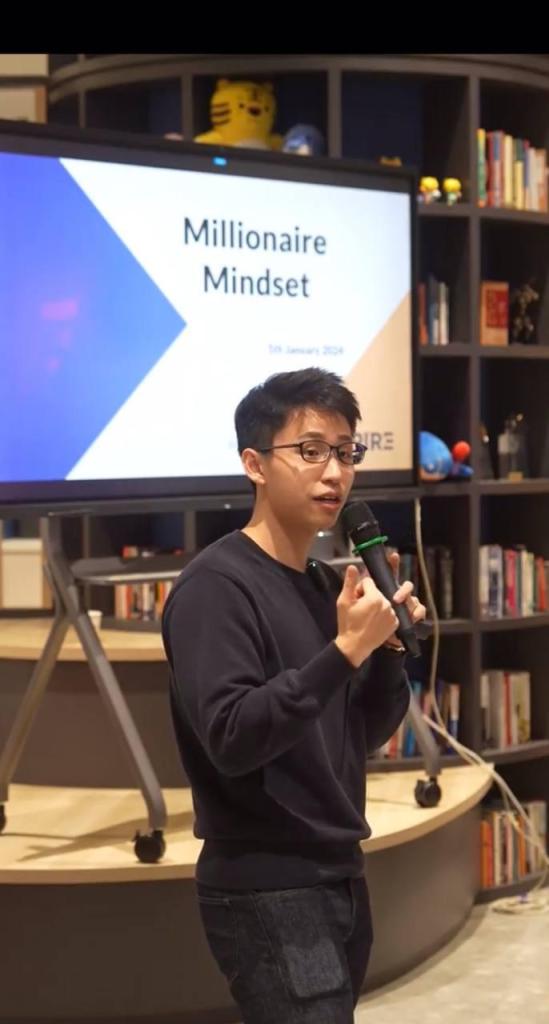
Another challenge is stubbornness. Many people resist advice and argue, and I have to ask, “If your way is right, why are you still struggling financially?” The key to growth is being open-minded.
How do you integrate personal growth, like positive thinking and connection, with financial success in your program?
Positive thinking and financial success are not separate—they are completely in sync. Your wealth is a direct reflection of your mindset and philosophy. Our beliefs and thoughts shape our financial outcomes. For example, many lottery winners lose everything because they don’t have the right financial mindset.
On the other hand, someone can be broke today, but if they focus on personal growth, they will naturally attract wealth. The key difference between a wealthy person and someone struggling financially is their way of thinking.
Can you share a success story of a client whose life has been transformed through your guidance?
We’ve helped many people, and last year alone, our community helped over ten individuals earn their first $10K per month while still in school or working part-time. One example is LW. When I first met him, he was a university student who believed he had no time and needed to wait until after graduation to start making money.
But after attending our boot camp, he learned the right mindset and money management skills. He started doing part-time sales and, within three months, was already earning a graduate salary. Within a year, he hit $10K per month. Recently, he surpassed $20K—all while still in school.
What key obstacles have you faced, and how did you overcome them?
One big challenge is skepticism. Many people are cynical because of fake “gurus” who profit from selling courses rather than real businesses. As a result, I get misunderstood easily. Overcoming this takes time—I focus on consistently sharing valuable content on TikTok without expecting immediate returns.
Another challenge is stubbornness. Many people resist advice and argue, and I have to ask, “If your way is right, why are you still struggling financially?” The key to growth is being open-minded. If you find someone with the results you want, just listen, be coachable, and apply their advice.
Where do you see yourself, and what’s your vision for Singapore in the next five years?
My dream is to be a key authority in financial literacy. Last year, I spent $130K to learn from Zhou Wen Qiang in China—he has helped millions achieve financial freedom. I see myself continuing to be a business owner, scaling my company, and being an authority in training salespeople and financial education.
For Singapore, my vision is to shift education towards what truly matters—AI is rising, and it can outmatch humans in memorisation and information processing. But what AI can’t replace is creativity, spirituality, connection, and emotional intelligence.
I hope to see the education system focus more on people skills, communication, and financial literacy, because ultimately, human connection is what drives success.
Connect with Edrick: linker.ee and Facebook.