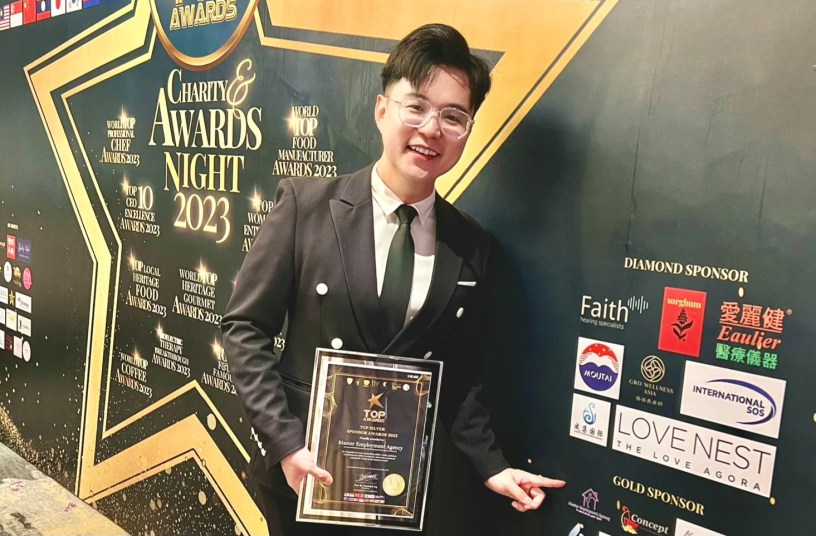
Meet Ryan, a visionary second-generation helper agency owner who is revolutionising the domestic helper industry. With years of experience passed down from his family, he is committed to transforming the way domestic help is provided in Singapore.
By embracing modern technology, promoting fair employment practices, and prioritising the well-being of both helpers and employers, Ryan is reshaping industry standards. His dedication to enhancing transparency, professionalism, and the overall experience for both clients and helpers is setting a new benchmark for the future of the helper agency business.
What inspired you to start Master Employment Agency?
Actually, I’m a second-generation owner. My mom started the agency, and it was more of a push factor that led me to join this industry. To be honest, even though my mom had been in this field since I was young, I never thought of joining. This is not a glamorous industry, and I was initially drawn to working in the banking sector.
I envisioned working in the CBD, on the high floors of tall buildings, wearing a suit and tie, and having lunch with colleagues. It was a push factor because I was working long hours at the bank, leaving the house while my children were still asleep and coming home when they were already asleep. This caused some challenges in my marriage.
How do you identify the need for proper matching in the Foreign Domestic Workers (FDWs) industry?
The two main factors that have made Master Employment Agency successful are proper matching and post-service support. These are the reasons people keep coming back and referring their friends to us.
As I grow my company, I want to retain these two principles, even as I take a step back from personally handling client matching and servicing. That’s why we reinforce the importance of proper matching and post-service support throughout our training programs.
Your agency has a very low transfer rate and very high retention rates. What specific practices or strategies contribute to this success?
For me, every relationship—whether it’s romantic or an employer-employee relationship—requires the three Cs: communication, compromise, and commitment. In our agency, we also abide by a Chinese saying: 将心比心,用得开心 (put yourself in others’ shoes to open your heart).
Our policies encourage both parties to give each other time to adjust. Unlike most other agencies that offer two or three replacements within six months, we do the exact opposite. We encourage employers to genuinely try working with the helper for some time.
Of course, they are not alone in this—we provide advice, assistance, and even counselling for the helper if needed. If an employer can work with a helper for at least six months, we offer unlimited replacements with no expiry date. In other words, you will never incur additional agency fees for hiring helpers from us in the future.
Based on our experience and research, if the employer and helper give each other six months to a year, many issues can be mitigated. Misunderstandings are often due to miscommunication.
That said, our policy is flexible. In cases such as theft or abuse, if there is evidence, we won’t enforce the six-month rule. In such situations, we also ensure the helper is not transferred to another client. We would rather lose money than allow an unsuitable helper to potentially harm another employer.

Based on our experience and research, if the employer and helper give each other six months to a year, many issues can be mitigated. Misunderstandings are often due to miscommunication.
What challenges do you face in matching the right helpers, and how do you overcome them?
Matching the right helper with the right employer often involves more than just reviewing the biodata. The personalities of both the helper and employer are crucial. For instance, some helpers are very chatty, while some employers prefer privacy. If matched incorrectly, the employer may find the helper intrusive, asking questions like, “Who was the visitor?” or “What does she do for a living?”
Our challenge lies in detecting these personality traits during the matching process. To address this, our matching team is trained to observe the helpers’ body language and communication style during interviews. Meanwhile, our Personal Relationship Managers (PRMs) assess employers’ personalities, preferences, and working styles.
For example, a strict employer who prefers a regimented schedule won’t be compatible with a helper who values autonomy. Conversely, a helper who needs clear guidance will thrive under a strict employer. The PRMs and matching team work closely to ensure compatibility, minimising mismatches and fostering successful employer-helper relationships.
How do you ensure that the FDWs you recommend are well-trained and possess the moral values and skills required by employers?
We can never completely eliminate the probability of encountering issues related to moral values or inadequate skills. It’s just like in every class of students—there’s always a star student and one who struggles. They may come from the same school and be taught by the same teacher, but outcomes vary.
For FDWs, whether they are top performers or less diligent during training, they often command the same starting salary and loan terms. This is an area in the industry with room for improvement. If higher pay or reduced loans were linked to performance, it would motivate trainees and encourage better skill acquisition.
As for moral values, it’s challenging to assess fully during interviews. This challenge isn’t limited to FDWs—it applies to hiring in any industry. In interviews, everyone puts their best foot forward.
During interviews, we try to observe traits like cleanliness through personal hygiene, posture, and grooming. These observations help us minimise risks, but no process is foolproof. What we can do is mitigate risks and manage employers’ expectations.
What is your approach to educating both FDWs and employers about mutual respect and cultural understanding?
This is an ongoing process. The Ministry of Manpower has introduced excellent initiatives, such as the Settling-In Program (SIP) for helpers and the Employer Orientation Program (EOP) for first-time employers. These programs educate employers on cultural differences, the helpers’ backgrounds, and the time required for adaptation.
They also emphasise the importance of patience and understanding. However, a single lesson isn’t enough. Our personal relationship managers (PRMs) continuously remind employers about these cultural differences and the importance of mutual respect.
Our agency is committed to respecting religious and cultural boundaries. If an employer insists on extreme demands, we draw a clear line and decline to take the case. On the other hand, we also educate helpers on respecting employers’ privacy. Unlike a workplace, a home involves personal boundaries, including the privacy of children and employers.
In this age of social media, we remind helpers not to record videos or take photos inside the employer’s home without permission. We advise them to use social media responsibly during their off days. Most employers are understanding and will even participate in a video call to greet the helper’s family and provide peace of mind. This fosters trust and mutual respect.
How do you stay competitive in an industry where many agencies offer similar services?
Like many industries, price is always a determining factor. That said, I’m not going to go for the cheapest market. With all the services and effort we put into the hiring and post-hiring process, we still price competitively. So, adding more value for clients and maintaining competitive pricing is how I stay competitive.
What are your future goals for Master Employment Agency, and how do you plan to further improve the industry’s standard?
As an ongoing effort to add value to the different stakeholders in the industry, I really hope my business can become more autopilot. This would give me more bandwidth to make a real difference.
For example, I aim to introduce a Singapore-standard training booklet to the source countries’ training centers. We can’t just start training helpers when they arrive in Singapore because the levy, salary, and ongoing costs for having a helper are very expensive. I want to provide a more transparent training grading system for fresh helpers.
Another goal is to help helpers upskill. I want them to progress to better jobs and command higher salaries. This will ensure Singapore remains a preferred destination for foreign workers. Many employers hiring helpers are managing someone for the first time. Therefore, I hope to continue educating employers, managing their expectations, and offering a wider range of profiles to suit different budgets.
Where do you see yourself, and what’s your vision for Singapore in the next five years?
For myself, I see myself collaborating with more like-minded business people who have similar clientele profiles. I hope to form a close group of business owners to add value to our clients through perks, discounts, and membership benefits.
I also want to create additional revenue streams for my PRMs. By continuously adding value and making clients happy, PRMs can be rewarded accordingly. On a personal note, since my parents and in-laws are aging, I really hope to retire them comfortably within the next five years.
As for my vision for Singapore, I’ll leave that to PM Lawrence Wong.
Connect with Ryan: MasterEmploymentAgency, Facebook and TikTok.

