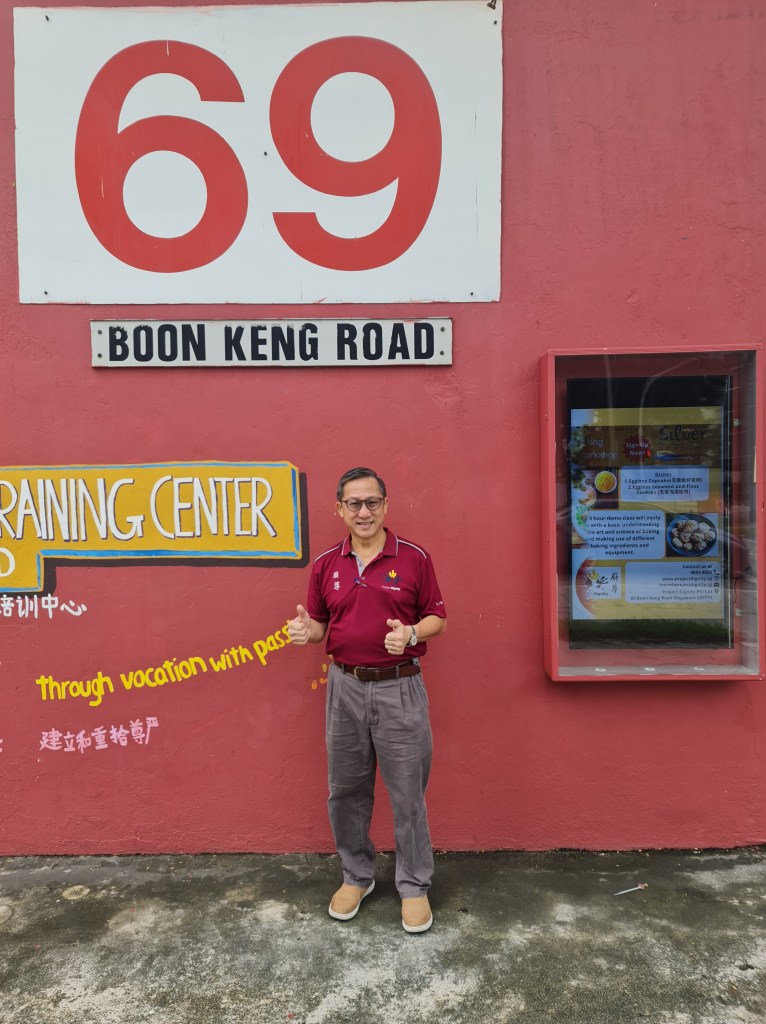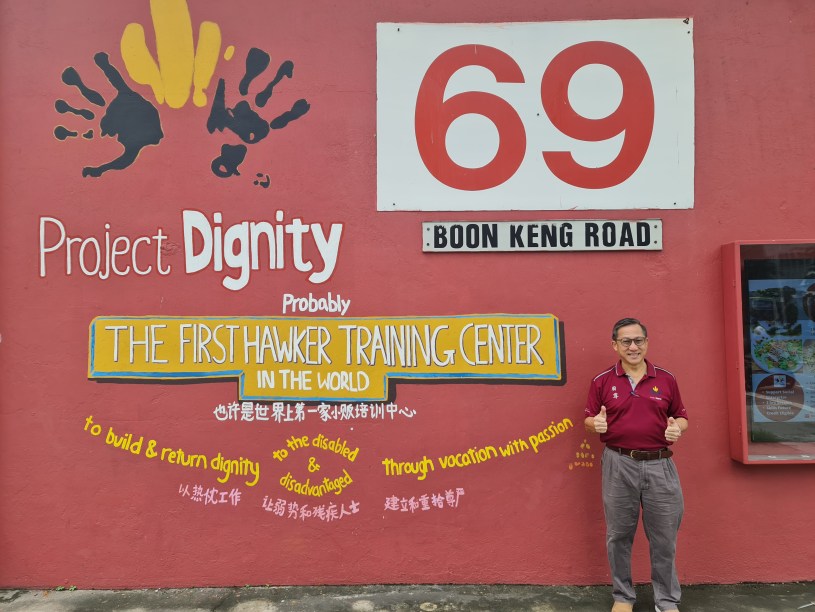
Meet Seng Choon, the visionary behind Project Dignity – an inspiring entrepreneur on a mission to reshape the employment landscape for people with disabilities. With a firm belief that business can drive social change, Project Dignity is more than just a business – it’s a movement to restore dignity and unlock potential for a marginalised community.
Seng Choon is also a business consultant who supports companies in expanding into China, India, and Southeast Asia through acquisitions and startup ventures. He also specialises in SME corporate restructuring and lectures on entrepreneurship and social enterprises. How did he get started on this journey? Here’s his story.
What inspired you to start Project Dignity, and how did your personal experiences shape the mission of the organisation?
Project Dignity was started in 2006. I lived in the UK for many years, and when I came back to Singapore, I realised you don’t see beggars, homeless people, or disabled individuals in shopping centres. I wanted to understand why, and through my search for answers, I uncovered another side of Singapore that most people don’t see.
That’s how the journey began. I started by doing social work, volunteering, and eventually realised in 2006 that I could make a difference. At the time, I was a management consultant, helping companies in China expand to India and vice versa, which was my full-time job. While doing this, I volunteered with Yellow Ribbon and took people out for lunch. In 2006, I decided to fully commit to this cause.
How does Project Dignity work with businesses and the community to promote inclusive hiring practices?
What makes this project unique is that it’s a “train and place” program. We train and place people with different abilities in jobs. We take them for 22 days of training and get them a job. If we can’t find them a job, we create one. They can either work for us in the kitchen or in the Mama shop. We have many different areas where they can work. It’s a program that focuses on skills development and job creation.
This initiative aims to raise awareness, engage people, educate them, and finally, inspire them. I don’t know if you’ve ever packed meal boxes for the poor, but perhaps one day you could come and bring your family. It’s a powerful way to see firsthand that poverty exists in Singapore and to witness the struggles of the working poor.
Employers must see each individual’s potential, not their limitations. Sometimes expectations differ—employers expect too much, while employees face personal obstacles, like commute. We monitor our trainees during placement. We track their progress over 1, 2, 4, and 8 weeks. If they stay past week one, they’re likely to stay long-term. This is why we’ve successfully placed thousands of people.
What are some of the biggest challenges you face when creating employment opportunities for people with different abilities, and how do you overcome them?
There are three main challenges. First is acceptance. We are a train-and-place program, and our goal is to get them jobs. Unfortunately, many companies consider people with disabilities to be less productive. To overcome this, we create jobs for these individuals. That is one challenge.
Secondly, employing people is difficult. Our work is very specialised. If you saw the classroom, you’d notice mental, physical, social, and intellectual disabilities. We have people with Alzheimer’s, dementia, and many other conditions. We have trained them before, and the trainers must meet two criteria—they must be very patient and passionate about their work. Finding people who can work with us isn’t easy.
The third challenge is money. As a social enterprise, we are not a charity. We don’t have tax benefits or regular financial support. We depend on ourselves. To raise funds, we sell food, deliver cookies (especially for Chinese New Year), organise events, and conduct training. The money we earn doesn’t stay with us. All the money goes back to the community. Despite these challenges, we have been around for 16 years.
Can you share a memorable success story or two of someone whose life was transformed through your initiative?
I have trained 3,000 people, and each one is a success story. I can’t pick just one because they are all significant. No one else in Singapore trains and places individuals of all abilities like we do. Maybe one example is a boy who has a terminal illness. He was expected to pass away eight years ago, but he is still with us because he found purpose in his work. Project Dignity, Dignity Kitchen, Dignity Farm, and all our initiatives have impacted many lives.
One achievement I’m particularly proud of is expanding to Hong Kong. It’s rare for a Singapore-based social enterprise to scale up internationally, especially to Hong Kong—a challenging market. Despite the difficult situation, we survived and trained hundreds of people there. We have won many international awards, which recognise our social impact. These awards mean more to me than local entrepreneurship awards. Scaling up and making a social impact drives our success, and I consider this project highly successful.
Our long-term goal is simple—restore dignity to the disabled and disadvantaged through vocational training. We are job creators.
How do you ensure that the skills training provided aligns with real-world job market needs and opportunities?
That’s a good question. We are mostly focused on the F&B industry. First of all, to enter F&B, you need a basic food hygiene certification. Our program is very unique. We offer the basic food hygiene course, and no matter the level of ability or disability, you cannot work in F&B without it. For a typical person, the course takes one day. For our trainees, under NEA guidelines, it can take three to five days. For example, washing hands might take one full day—learning eight steps repeatedly until they get it right. This is how we train people with dementia.
The training is rigorous, and the space is designed for them. The rules are simple—focus on their abilities, not disabilities. They must pass basic hygiene, which is part of five subjects. The second subject is mise en place (French phrase that means “putting in place”). You might be familiar with this- it’s about cutting, chopping, and weighing ingredients. We developed a comprehensive course for this. Even individuals with autism can learn to weigh and do other basic chores.
What are some misconceptions employers might have about hiring people with different abilities, and how do you address them?
You have to understand that disabilities fall into two categories—visible and invisible. Visible disabilities are easy to identify—like someone with a missing hand or a person with cerebral palsy. Employers must learn how to accommodate these individuals by creating one-hand solutions, for example. Invisible disabilities are harder to detect—mental health conditions, cancer recovery, or epilepsy. These are illnesses, not disabilities, but they present challenges.
Employers must understand their challenges and work around them. For example, someone with cerebral palsy can still perform data entry for eight hours. Secondly, employers must accommodate or innovate. We have machines designed for one-handed use as mentioned earlier. Employees with challenges often stay longer because they value their jobs and need financial stability.
Looking ahead, what are your long-term goals for Project Dignity, and how do you envision expanding its impact beyond Singapore and Hong Kong?
Our long-term goal is simple—restore dignity to the disabled and disadvantaged through vocational training. We are job creators. When one person gets a job, many problems are solved—they earn a livelihood and gain stability. Our purpose is to create more job opportunities.
We’ve recently launched Dignity Kitchenette, catering to individuals with cancer, mental health conditions, and dementia. We opened at Yio Chu Kang bus station and Ang Mo Kio Police Station last week, and by this month, over 20 differently-abled individuals will be employed there. We are planning five more locations.
Where do you see yourself and what’s your vision for Singapore in the next five years?
Hopefully, I will still be involved with this. I can make a difference in people’s lives. Imagine, I’ve helped over 3,000 disabled people in Singapore. I currently employ over 100 people with disabilities. I don’t just have employees; I have entire families involved. These people cannot get jobs—I’m telling you, it’s very tough.
The F&B in Singapore will be very tough. First of all, employing people is very tough because you need to pay them a high salary. This is especially hard for social enterprises. Secondly, the cost of items such as cooking oil, rice and eggs has been going up.
And the third thing that is more worrying is the number of people with disabilities and challenges such as mental health is increasing. Singapore is an aging population, and a lot of these elderly are still active. I’m trying to create jobs for people in the aging population.
Connect with Seng Choon: LinkedIn.
Dignity Kitchen Singapore
69 Boon Keng Rd, #01 Red building, Singapore 339772