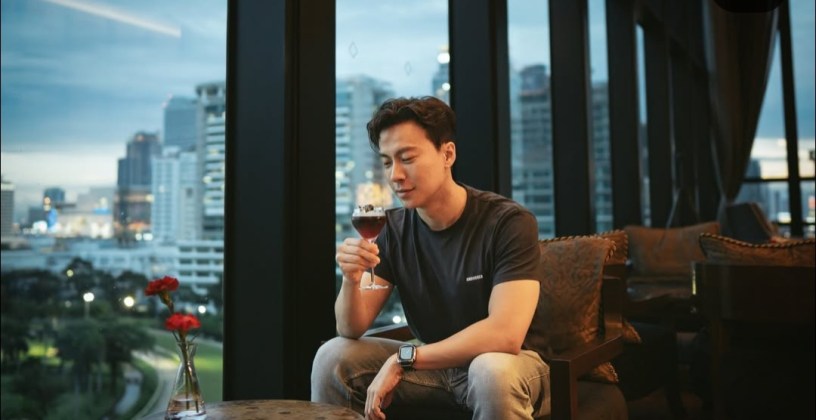
Meet Nat Ho, a Singaporean actor and singer who has made a remarkable leap from local stages to making waves in the South Korea music industry. With a passion for acting and doing music, Nat has captivated audiences across international borders, earning recognition for his dynamic performances and versatility.
From his humble beginnings in Singapore, Nat went on to shine as a topliner in the competitive South Korean entertainment industry. His works have also been recognised in the international arena. Read his story to find out what he has been up to.
What inspired you to move from Singapore to South Korea and pursue a career as a topliner in the music industry?
So this was something that kind of just happened. Korea wasn’t initially in my plans, obviously because of the language barrier, which is a very big challenge. Prior to this, I was studying in LA, where I was studying music production. That’s when I got in touch with a Korean publisher who reached out to me on Instagram.
We started casually working together, and that was kind of my first foray into K-pop. After LA, COVID happened, and immigration became a challenge. It wasn’t until April 2022 that I came to Korea for a holiday. During the whole COVID period, I was actually doing online writing camps and writing sessions, which is how I got my start in songwriting.
When I finally came to Korea for a one-month holiday, I liked the vibe here and even extended my stay for another half month. Three months later, I decided to move here, initially to study Korean on a student visa, but also to get a longer-term feel of living in the country, meeting people, and assessing the viability of building my life here.
I’m happy to say that, after about two and a half years, I’m happy with my decision to be here in Korea. South Korea is currently the entertainment capital of the East, and there are many exciting opportunities to learn and collaborate with amazing creatives here.
How did your experience as an actor and singer in Singapore influence your approach to songwriting and producing in South Korea?
In Singapore, I was more of an actor, though I did have a lot of training, whether it was at MDC or performing in local events like charity shows or countdown shows. I was always a staple in those big performances. However, Korea is a very different market. It’s very dynamic.
What I like about K-pop is that Koreans are very into trends, and K-pop takes influences from everywhere. Even within one song, you can have different genres and sections that are drastically different from each other. In some other music markets, things are a bit safer, not as varied, but K-pop thrives on this variety. For me, I love variety.
Although it can be challenging because Koreans are always chasing trends, it’s exciting because I can try different things. I like to experiment with new techniques, almost like a crazy scientist.
So, while being a singer in Singapore didn’t directly shape my approach to songwriting and producing, I would say that the excitement and variety within K-pop definitely have influenced me. This has refined my approach to songwriting and producing.

Have a regular collaborator, then when you level up, work with other people, and then come back and grow together. I think that’s a great way to do it because otherwise trying to do everything alone can be very lonely and difficult.
What were some of the biggest challenges you faced when trying to balance being a performing artist in South Korea as well as working behind the scenes as a topliner?
In Korea, my focus is more on toplining than performing. Opportunities would be more limited because I’m not fully fluent in Korean yet. But balancing between being a performer and working behind the scenes is not an issue for me. When I first entered the entertainment industry, it was never for the fame or bright lights. I’ve been in it long enough to know that it’s not all about fame. It involves a lot of hard work, and I’m not attached to always being in front of the camera.
The most important thing for me is taking an idea or concept and making it real—bringing a vision into reality. Whether in front of the camera or behind it, as long as I’m able to create, I can see myself doing this for a long time. It’s more about finding the right balance for where I am in life right now. Going behind the scenes is just another aspect of my artistry that I’m exploring.
Can you share a few memorable moments or collaborations that has stood out in your career so far in South Korea?
In my first year, I got to know a ballad singer named Nautilus. We did a YouTube cover of one of his songs in English. One of my schoolmates’ husband was his manager, which is how we connected. It was a really interesting experience, and I love collaboration. Collaboration is important for keeping you grounded because you learn new things and try new things with someone else. You have to put your ego aside. That was a memorable moment in my first year.
This year, I wrote a single for a Mexican boy band called BTW. It’s called “Lambo,” and it did really well. It was their first-ever single, and I think it’s now got over 4 million streams combined. They recently won a Nickelodeon Kids’ Choice Award, which was huge. I’m glad that my work contributed to their success. I’ve also written two songs for an upcoming group called EPTS. They’re probably going to launch this month, so I’m excited for that as well. So, slowly but surely, things are moving ahead, and I’m looking forward to having more memorable moments and collaborations in the future.
How does the music industry in South Korea differ from Singapore, and how have you adapted to these differences?
The music industry in Korea is very big and competitive. In Singapore, because of our market size and the level of music infrastructure, the industry isn’t as developed as it is in Korea. For example, even some of the big music labels in Singapore have very small offices or have merged with those in Malaysia. This reflects the scale of our market.
There are incredibly talented musicians and artists in Singapore, but many of them have to go outside Singapore or work with overseas artists to amplify their reach and income potential. It’s just part of the reality of being a small country with a small market size for music. That said, realising this is one thing, but what we do about it is another. I’m still incredibly thankful to be Singaporean. I chose to come to Korea, and I work hard, hoping to share my talent and Singaporean work ethic with others here in Korea.
What advice would you give to aspiring musicians in Singapore who want to break into the international music scene?
Firstly, work on your craft. I think that’s really important. Be open to collaborations, but also choose your collaborators wisely. The fact of the matter is that songwriting is a very competitive industry, and when it comes to pitches, the turnaround time is often very, very short.
The more prior preparation you have done, the easier it is to approach someone and say, “Hey, can we do a collaboration?” When you collaborate with someone, they want to hear your past work, right? They’ll want to see what you’ve done before, so that they can get a sense of your style. Have a prepared portfolio and don’t try to reach out to someone without proper preparation, then get upset if the person doesn’t want to work with you.
Even for myself right now, I’m still working on being good enough to collaborate with people who are at a higher level than me. So, I think it’s a constant pursuit. What I would suggest is to find people who are closer to your level and work together. Have a regular collaborator, then when you level up, work with other people, and then come back and grow together. I think that’s a great way to do it because otherwise trying to do everything alone can be very lonely and difficult.
When you get to know people, do it in a genuine manner, not just because you want something from them. I think relationships that grow organically are much better than going to someone just because you want something from them. People can sense that from a mile away.
Lastly, just put yourself out there. Think about what value you can bring. Bring value to the table, don’t just think about what you can get from others. Ultimately, true collaboration is about both people bringing value to the table, and that’s what makes the partnership work. If it’s just about asking, “Can I collaborate?” but only wanting the other person to do all the work, then that’s not a collaboration.
As a topliner, what do you consider the key elements of crafting a hit song, and how do you stay inspired?
The key elements of crafting a hit song can happen in a few ways. A lot of times, it’s about smart lyrics. But of course, if you are a non-Korean speaker writing for the Korean market, sometimes lyrics can be a challenge. For me, I write in English, and sometimes what comes out is totally different. The entire concept can change sometimes.
Even if you have smart lyrics, they may want to keep certain parts of it in the final version, or even if they don’t keep that lyrics, the concept itself can still remain in the final version of the song. That’s one way you can contribute to a hit song.
But secondly, and more importantly, as a topliner, melody is really important, right? Things that are easily repeatable are also memorable because it’s almost like hypnosis. But at the same time, if something is too repeatable, there’s also a chance of it potentially being boring or monotonous. So, I think it’s about finding that balance between excitement and repeatability. It’s about finding that sweet spot, and that sweet spot will be different for each artist that you work with.
What are your upcoming goals and plans, both as a topliner as well as a performing artist?
Currently, I’m not signed to any publisher per se. I work with different publishers and I hope to work with more people and eventually find a music publishing home that I’m comfortable working with, and who also wants to work with me.
Ultimately, I want to build up a decent catalog of work that can generate meaningful income for me in my retirement. I know I’m still quite a while away from it, but I’m giving myself about two to five years to do this, and we’ll see how it goes.
On a scale of 1 to 10, how fluent are you in Korean?
I speak like a three-year-old.
So that’s like a 3?
You’re very kind, man. Yeah, OK, maybe two, maybe two or three. Yeah, around there.
So, how do you actually pick up Korean?
The first year I came here, I was studying Korean full-time. But at the same time, I came here with no foundation in Korean at all. In fact, I was shocked to learn that out of all my classmates, many of them had studied Korean for six months to a year in their home countries, and when they came here, they were still placed in Level 1. I came here with nothing—I hadn’t studied Korean before.
So, the learning curve was very, very steep. And so, I repeated Level 1, and I think I repeated Level 2 as well, not because I’m stupid, but because I wanted to take my time and really build a good foundation. I will definitely continue to learn Korean. I’m planning to apply for the long-term visa. Being fluent in Korean is one of the requirements, so that is definitely on the cards.
Where do you see yourself, and what is your vision for Singapore in the next 5 years?
Oh, I love this question. So for myself, I see myself being based here and growing in the songwriting aspect in Korea and contributing more to the music scene here.
My vision for Singapore is to have many more Singaporean creatives being born. With social media and online platforms, I think the opportunities to work and collaborate internationally are much greater than before. So, I think it’s an exciting time, and I hope that more and more Singaporean creatives will be recognised on the global stage.
Connect with Nat: YouTube and Instagram.

Also read: Meet Vicky Vaswani, The Genius AI Marketer Who Wants to Inspire 50 Million People by 2050
